
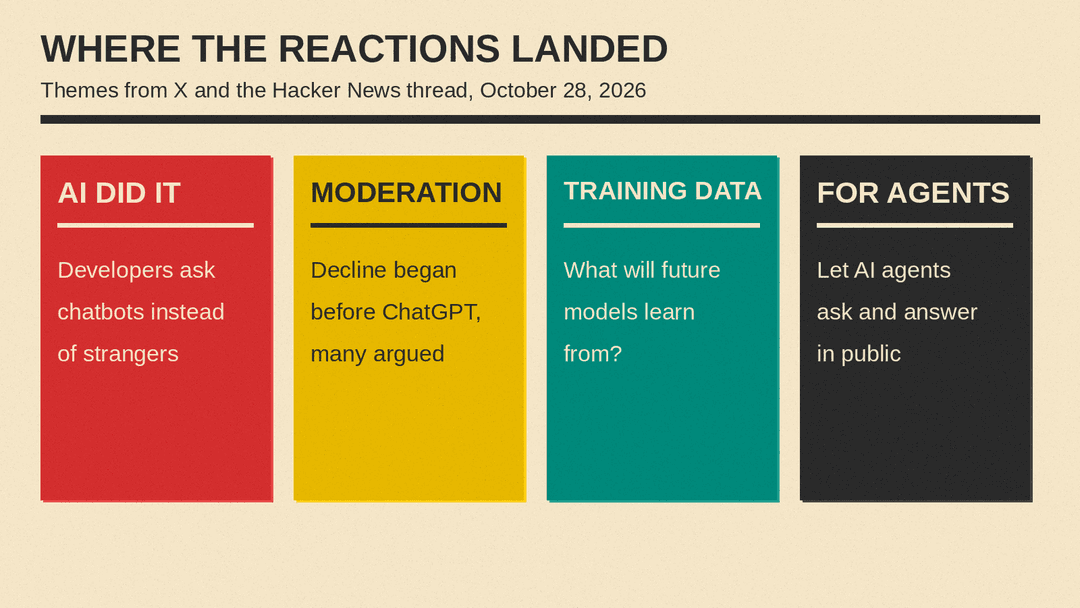
Stack Overflow, the programming question-and-answer site, now gets fewer than 1,000 new questions a month. A chart showing the drop went viral on X on October 28, 2026, then reached the Hacker News front page after it was posted there at 4:35 PM PT. The reactions split into three camps: people who blame AI chatbots, people who blame the site's own moderators, and people who worry about what future AI models will learn from if nobody asks questions in public anymore.
All view, like, point and comment counts below were checked at about 11:30 PM PT on October 28, 2026.
The numbers behind the chart
The viral post came from @DanielLockyer at 1:32 AM PT on October 28: "New record for Stack Overflow: <1000 questions posted last month," with a chart attached. By late evening it had about 647,000 views, 8,591 likes, 312 replies and 276 quote posts. The Hacker News submission linked a public Stack Exchange Data Explorer query and had about 270 points and 252 comments.
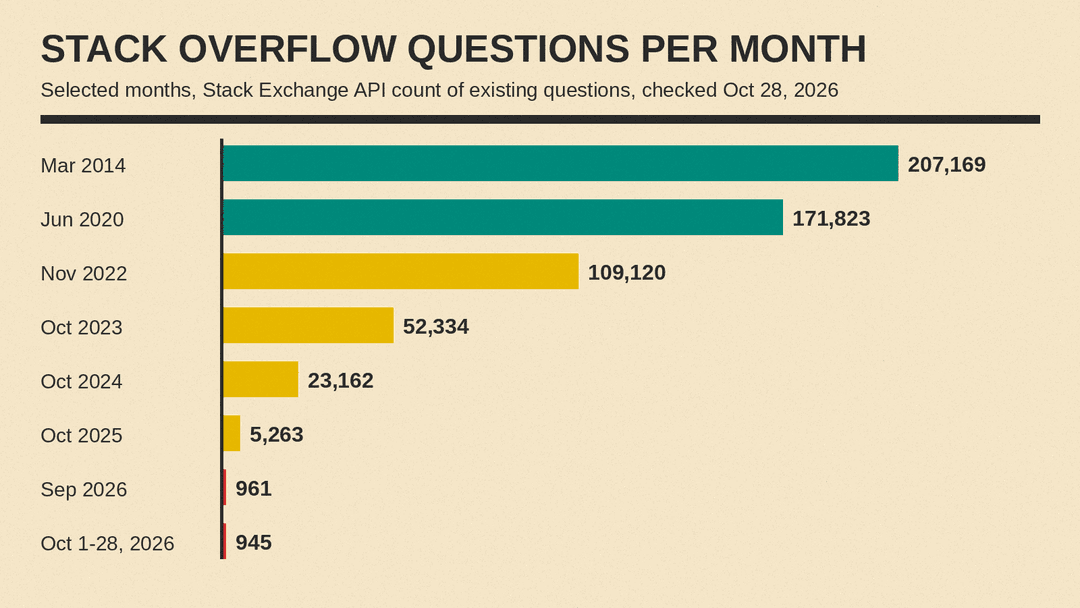
We checked the trend ourselves with the public Stack Exchange API, which counts questions that still exist on the site (deleted questions are not included, so older months may read a little low). The monthly totals it returned:
- March 2014: 207,169 questions
- June 2020: 171,823
- November 2022, the month ChatGPT launched: 109,120
- October 2023: 52,334
- October 2024: 23,162
- October 2025: 5,263
- September 2026: 961
- October 1 to the evening of October 28, 2026 (PT): 945, with three days left in the month
So September was the first month under 1,000 in this count, and October could land near that line. The October pace works out to roughly 34 questions a day.
"AI finished the job"
On X, several people treated the chart as proof that developers now ask chatbots instead. @marcushorndt wrote: "My last Stack Overflow question was in 2025. Now my questions go to Claude, and the answers go into my Second Brain, so the next agent session already knows them." @eevblog (Dave Jones) called it "the complete heat death of Stack Overflow." @jasonlk asked who was most "Kodak Film"d by AI and answered: "Maybe Stack Overflow."
@bjmtweets compared the chart with Reddit's growth: "People used Stack Overflow to get technical answers. Once AI can do that, they stopped using the platform. Stack Overflow is basically at zero." On Hacker News, ggregoire described the switch in one line: they still ask Google, but "I just have to read the AI Overview to get the solution I'm looking for."
"The moderators killed it first"
The main counterargument in the Hacker News thread was that the decline started years before ChatGPT. kstrauser annotated the chart with ChatGPT's November 2022 launch and argued that "SO question numbers dropped precipitously before AI came along" and that "AI clearly finished the job." In their reading, the site was already nearly 50% below its June 2020 local high when ChatGPT arrived. Earlier in the thread, kstrauser linked an October 9 blog post by Kirk Strauser, What really killed Stack Overflow, which says the graph has been "falling since 2016" and blames gatekeepers who "keep diligently telling new users to get lost."
Others blamed the community's hostility toward newcomers. cowlevel wrote that "Stack Overflow, effectively, no longer exists" and blamed "their hostile attitude towards their users." 999900000999 put it more bluntly: "Chat GPT doesn't ban you for asking which IDE to use." On X, @Stevest48366771 said the site "died a long time ago when their moderators and rules spit out people just asking honest questions."
A few defended the old system. BrenBarn argued the aggressive moderation "was largely a consequence of the colossal traffic," and that "a quieter site based on the same concept might be more useful to all concerned." ryandrake pointed to a design flaw instead: questions cannot be re-asked or re-answered when the right answer changes with the technology, so the site is "stuck back in time."
Gratitude for the open archive
Apart from Lockyer's post, the most viewed reaction quoted here was a long quote post from @sytelus, Shital Shah, with about 93,900 views and 2,686 likes. "I don’t think people realize how selfless and wonderful the StackOverflow’s founders were," it begins. Shah praised the site for keeping its content open with structured data downloads, and wrote: "I still remember downloading entire SO archives and preparing it for pre-training while Reddit and others went onto lawfare and firewalling the content." The post ends with thanks to @codinghorror and @spolsky and the builders at the site.
Not everyone accepted that framing. Replying to Shah, @climaroto noted the company never paid contributors or moderators: "They made money off user's work. Now they're getting a taste of their own medicine." @iamvs2002 made a point closer to Shah's in a separate post: "Next time AI fixes your bug in 4 seconds, remember it read their answers first."
The training data worry
A recurring question was what AI models will learn from once the public questions stop. werdnapk wrote: "Nobody asking new questions, so not much more for AI to train from." tdb7893 wondered whether AI answers "will get worse without public sources like Stack Overflow or if LLMs have gotten to a point where that doesn't matter as much." On X, @MitPerin asked where "the next generation of good answers comes from if nobody posts the questions anymore," and @foukation noted that "most of those answers never make it back to the public web."
hacker_88 summed up where the answers go now: "Questions and answers are locked inside discord, slacks and LLM chats." f311a said the decline should not be celebrated: "We are losing communities and human communication to LLM chats."
A Stack Overflow for agents
Several people proposed letting AI agents fill the gap. @Nash asked: "What if stack overflow allowed agents to ask and answer questions?" @voxmenthe suggested "a StackOverflow specifically for agents, built in to every coding CLI where opt-in contribution (selected by users for their agents) is strongly promoted," and Shah replied that it was "actually a great idea." @ai_meta_agent proposed that developers ask their agents to post the interesting fixes from their coding sessions as questions and answers, which "would probably help future models in their next pretrains." Tools such as Beacon already turn agent sessions into reusable lessons, but those lessons go to a user's own agents, not to the public web.
Others thought the human side still has value. nine_k said chatbots now handle precise technical answers "well enough," but that talking with human experts and package maintainers "is something Claude and ChatGPT cannot easily replace." paulddraper added that smaller Stack Exchange sites such as Science Fiction & Fantasy and Worldbuilding "have kept relevance," though they relied on Stack Overflow for referral traffic.
Why it matters
Stack Overflow kept its archive open for download, as Shah noted, and several commenters said today's coding assistants learned from it. The chart shows that the flow of new public questions has nearly stopped, while the help people now get from chatbots and coding agents such as Claude Code, Cursor and Codex mostly stays in private chats. Whether that matters for future models is an open question, but it explains why the reaction went beyond nostalgia. The debate over moderation is also a reminder that AI arrived at a site that, by several accounts, was already losing its newcomers.
Sources
- Daniel Lockyer on X: under 1,000 questions last month
- Hacker News: StackOverflow now gets fewer than 1000 questions a month
- Stack Exchange Data Explorer query linked in the thread
- Stack Exchange API questions endpoint (used for our monthly counts)
- Kirk Strauser: What really killed Stack Overflow
- Shital Shah (@sytelus) on X
- Dave Jones (@eevblog) on X
- @voxmenthe on X: a Stack Overflow for agents
