
Orestis Ioannou, VP of Technology at Bold.org, published a short essay on October 27 titled AI Promised Less Work. I Have Never Worked More. It was posted to Hacker News at 4:08 AM PT and, as of 9:39 AM PT, had 554 points and 477 comments. Ioannou wrote on X that the post "hit #1 on Hacker News today."
The essay is not a launch, but the thread became a long argument about what coding agents do to a working week. Below is what the essay claims, and what readers said back.
What the essay says
Ioannou says he uses agents "for all of my engineering work now." He says he is "not complaining about the tools." His point is about load. He used to carry "two or three serious tasks" a week. Now he runs "several agents running in parallel," and each one "eventually comes back with a question, a plan to approve, a diff to read or a result to make sense of."
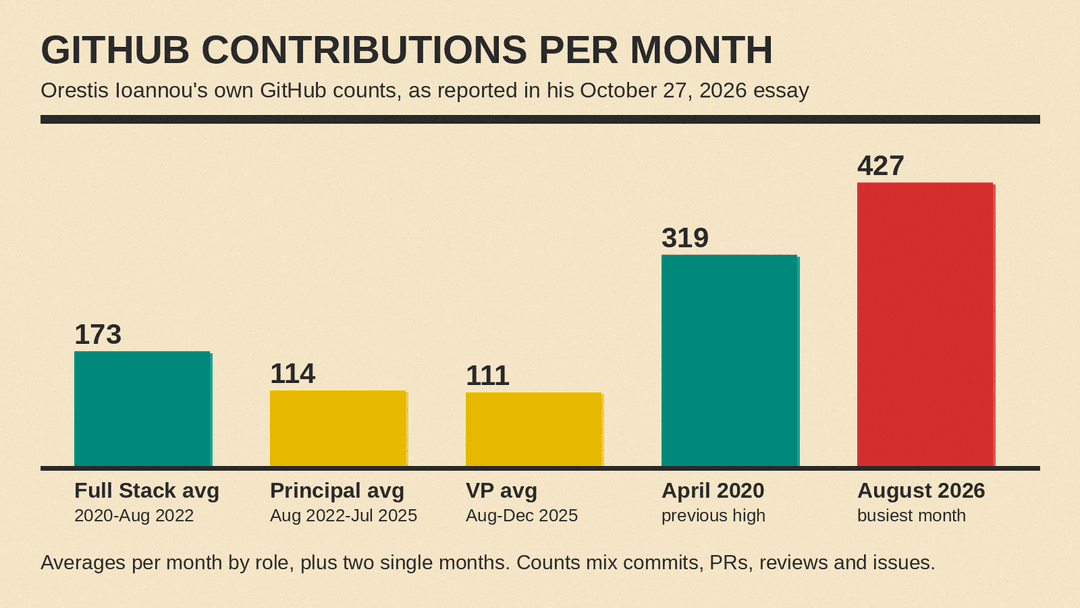
He backs this with his own GitHub contribution counts, which he says mix commits, pull requests, reviews and issues and are "a rough signal of activity, not a measure of value":
- As a full-stack engineer he averaged 173 contributions a month. As a principal engineer (August 2022 to July 2025) the average fell to 114, and his first months as VP averaged 111.
- By October 27, 2026 he had 2,102 contributions, more than any full year from 2021 to 2025.
- August 2026 had 427 contributions, the busiest month in his record. The earlier high was 319 in April 2020.
- He had 16 days this year with 24 or more contributions. From 2022 to 2025 he had one such day per year.
His explanation: "When coding is cheap, I can fix bugs I would previously have left alone." The work comes in bursts. A new model or workflow arrives, he starts more agents, and "the reviewing and context switching catch up with me." He ends with "I have not figured out a balance" and "I am tired." A closing note says AI helped him pull the data, build the chart and draft the article.
The biggest thread: who said it would be less work
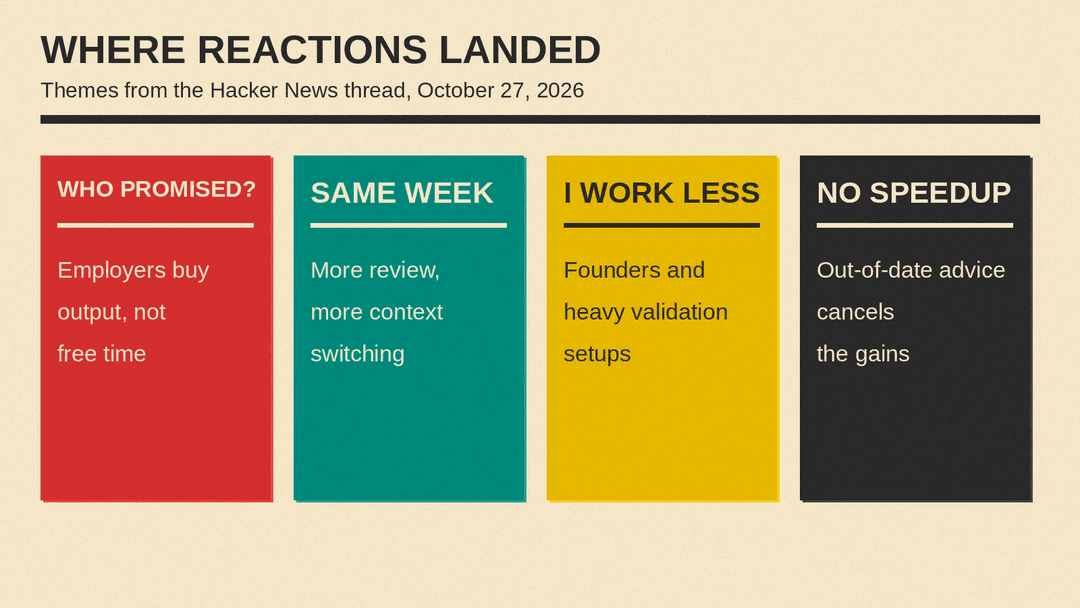
The most-replied comment, by nkrisc, had 282 replies as of 9:39 AM PT. It rejects the premise: "What kind of illusion must one be under to believe that employers would ever pay you the same amount of money to do less work?" nkrisc saw two outcomes: "you do more work for the same amount of money, or you’re one of the ones who were laid off and your work was transferred to the former."
Replies included three lines of argument.
- Expectations reset. 10111001 called the less-work idea a misreading among AI boosters: "I'm guessing that reflects their initial experience, before their employer adjusts their expectations, extrapolated out to infinity."
- Organize. conception answered: "You are missing a critical third - people organize and via unions or the polls push back and require less work." Pingk made the same case in a separate top-level comment: "Want to do less work? Join a union and campaign for a 4-day work week or something."
- That is how tools work. jve used a farm example: "Once you go from horse to tractor the fields increase but work hours doesn't decrease."
lysace questioned the essay's opening line directly: "Did it really promise that? Who pitched that?" kklisura posted, in a separate top-level comment, quotes from a Business Insider report in which, according to that report, Meta CTO Andrew Bosworth told an employee to "stop asking about Meta Days," a since-canceled program that gave staff a few extra days off.
The engineers who agree
Several readers said the essay matched their own experience.
sailfast pointed out that everyone around you speeds up too: "upstream inputs using AI also get faster - so you’re basically speeding up the entire machine but you’re still a human." The same comment adds: "It’s the best time ever to build. That excitement lasted about a year - but now it’s a treadmill I can’t escape."
keiferski said AI has also devalued work that used to feel like an accomplishment: "But now you can do that work to an ±80% quality level of the old, manual way, but in 1% of the time." The result, in that comment: "This makes the work seem even more pointless, adding to the feeling that you're working more and accomplishing less."
englishspot said the output still has to be owned: blaming the AI "isn't really an excuse when production goes down."
Reviewing agent output is a job of its own. Our explainer on how the Claude Code team reviews code walks through one team's layered review loop.
One fix came from carlgreene, who had a full agent setup on a phone: "I switched to a dumb flip phone as my primary device and now my work mostly only gets done on my computer during work hours."
The readers who say they work less
Other readers reported the opposite experience.
bushido summed it up as "I have never worked less and I have never been more productive," and said the effort goes elsewhere: "All of my effort goes into ensuring that agents work autonomously for days to weeks without me having to coddle them." hectdev described the same up-front cost, "after spending a few weeks setting up validation tools so I can trust the output."
One reply split employees from founders. wolframhempel agreed that the essay holds for employees, but wrote that as the founder of a small SaaS, "I genuinely work about 1-2 hours less and get more time walking with my dog through nature."
arend321 opened with "I may not work less, but certainly different and better," and described handling CRM, accounting and server tasks by voice during a beach walk. That drew sharp replies. mlsu mocked the idea of replacing quiet moments with CRM work, and _verandaguy wrote: "If I'm going for a walk, the last thing I want to have on my mind is dealing with CRM software in any way."
khasan222 argued the habits will come: "I think the burnout some of us are feeling is because as the author has said we don't know how to properly use the tool."
The skeptics of the speedup itself
Not everyone accepted that agents add output. comrade1234 said AI advice is often out of date on a framework that changes fast, so reading the docs would sometimes have been quicker: "So on average I would say I'm getting about as much work done now as before ai."
And sasaf5 objected to the essay's own process note: "Next time put the AI disclaimer at the top of the article so that I can avoid reading it while having a meal."
On X
Reaction on X was small. As of 9:39 AM PT, an X search found eight posts that link the essay: four by Ioannou, two by Hacker News repost accounts and two short summaries. @srinisankar summarized the post: "Implementation got cheap, so he took on more."
Why it matters
The essay opens with the pitch that AI would give people their time back. In this thread, many developers say the saved hours go somewhere else: more parallel work, more review, and more context switching. The data is one person's GitHub counts, and Ioannou says they measure activity, not value. Several replies that disagreed came from a founder and from readers who built validation around their agents first. Ioannou's own takeaway: "being able to do more keeps turning into doing more."
For the team-level view, a VB Transform 2026 panel covered AI coding agents writing 99 percent of code at some shops, and the token bills that follow.
Sources
- AI Promised Less Work. I Have Never Worked More., Orestis Ioannou
- Hacker News discussion
- @oorestisime on X
- @srinisankar on X
- Hacker News comments by nkrisc, 10111001, conception, Pingk, jve, lysace, kklisura, sailfast, keiferski, englishspot, carlgreene, bushido, hectdev, wolframhempel, arend321, mlsu, _verandaguy, khasan222, comrade1234, sasaf5
