
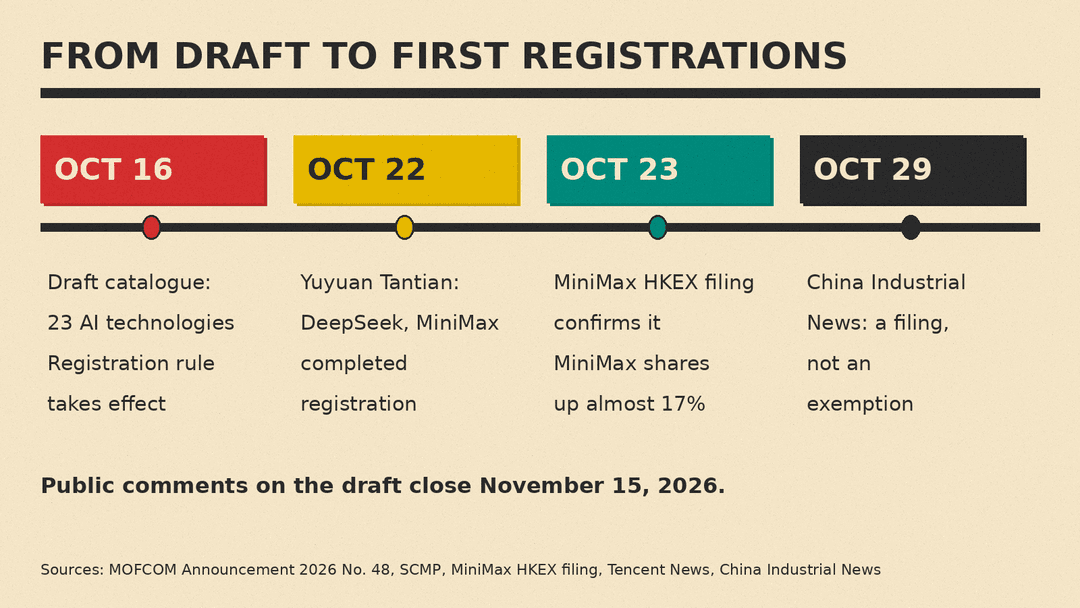
Two of China's leading AI model developers have completed the registration step in China's new AI export rules, Chinese state media reported. On the evening of October 22, Beijing time, Yuyuan Tantian, a social media account affiliated with state broadcaster CCTV, said DeepSeek and MiniMax had completed registration and gone ahead with open-source releases and overseas licensing, according to Odaily and the South China Morning Post. The next day MiniMax confirmed its own registration in a Hong Kong stock exchange filing.
A China Industrial News report published on October 29 asks experts and legal advisers what the step means. Their main point: registration is a filing, not a clean bill of health.
What happened
On October 16, the commerce and science ministries published MOFCOM and MOST Announcement 2026 No. 48. It is a draft revision of China's Catalogue of Technologies Prohibited or Restricted from Export, and it proposes adding 23 AI technologies, including large models, agents and compute clusters. We covered the draft when it came out. Public comments are open until November 15.
The draft is not final, but one part took effect at once. From October 16 until the revised catalogue takes effect, exporters must register with MOFCOM before exporting a listed technology, and exports already under way but not finished are covered too. The announcement lists four cases that trigger registration:
- transferring ownership of a technology to a party outside China
- licensing a technology held in China for use abroad
- a change of the owner or actual controller to a foreign entity
- other cases that MOFCOM names
Six days after the announcement, Yuyuan Tantian reported that DeepSeek and MiniMax had "smoothly" completed the procedure. It said MOFCOM's explanations of what the rules will not cover were more detailed than its explanations of what they will cover, and that the revision is about drawing boundaries, not only limiting AI exports.
What MiniMax said
MiniMax's October 23 filing is the only company statement we found as of October 29. It says MiniMax "has duly completed the technology export registration procedures with the Ministry of Commerce required for the open-source release and overseas licensing of certain recently released and upcoming models," in line with Announcement No. 48. It does not name the models.
DeepSeek did not immediately respond to a Reuters request for comment, Lianhe Zaobao reported. As of October 29, we found no public statement from DeepSeek on the registration.
Shares of listed Chinese AI labs rose after the news. At the October 23 close, MiniMax shares were up almost 17% and Zhipu shares were up more than 8%, according to a Daju Caijing report on Tencent News.
A filing, not an exemption
Some headlines called the result a licence or an approval. The experts quoted by China Industrial News describe it differently. Ge Linbo, CEO of Changxin Technology, described it as a declaration filed before technology leaves China. The report calls it a procedural duty, not a one-time ruling on how tightly a model is controlled. Whether a given model falls in the restricted tier, and whether a release counts as already public, is still decided case by case.
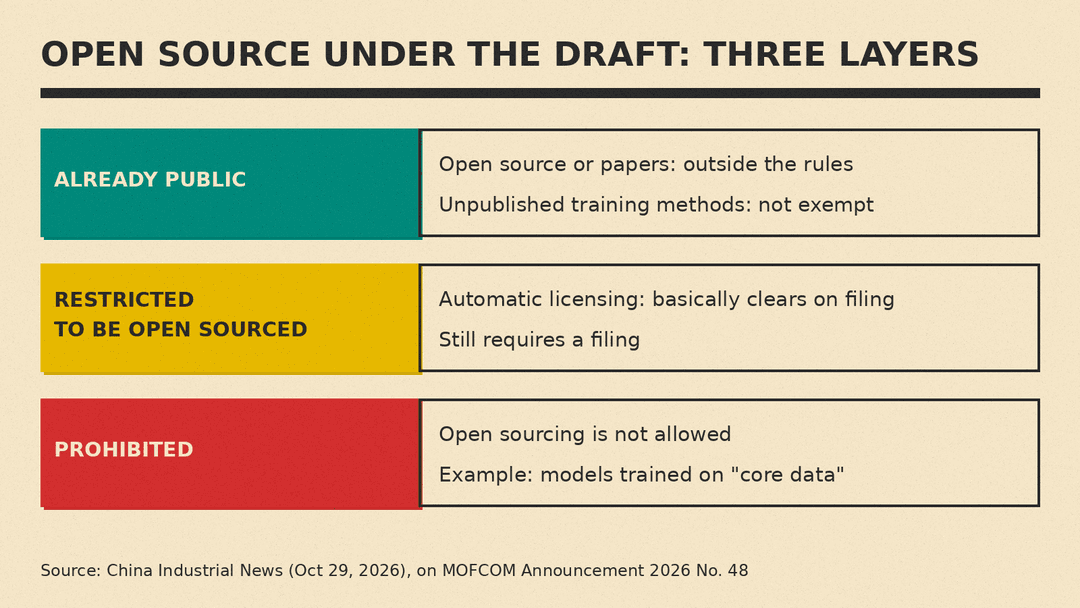
Hu Shuang, general manager of the international business of Huazhong Weiye Construction Group, set out for China Industrial News how the draft treats open-source releases in three layers:
- Technology already public through open source or papers is outside the rules. Ge noted that training methods that were never published do not get this exemption.
- Restricted technology that a company plans to open source goes through automatic licensing, which MOFCOM has said will basically clear as soon as it is reported. The report notes that the word basically (基本) leaves room for case-by-case review, and that automatic licensing still means filing.
- Prohibited technology cannot be open sourced at all. Large models trained on China's "core data" that then provide services are in this tier, and publishing them would itself be a banned transfer.
The report also separates services from transfers. Ge said API access is a service, not a technology export, and needs no registration. Licensing that gives a foreign company the right to use or deploy a model locally is a technology transfer and must be registered, with checks on end use.
Why it matters
For people who download Chinese open-weight models, the case suggests the release path still works. By the state media account, both labs registered and carried on with open releases.
The thresholds still matter. China Industrial News restates the draft's three tests for restricted "core technology" in large models: training compute of 10^26 FLOPs or more, 2 trillion parameters or more, or a global top 10 capability ranking. Meeting any one is enough, and Hu told the paper this means leading foundation model companies are in principle all in scope. For smaller labs, it depends on their models' actual numbers.
Registration does not settle trust abroad, Hu said in the report. Hu noted that the US Department of Homeland Security announced on October 19 that federal civilian agencies may not buy DeepSeek products and must remove them, and that Australia has already banned DeepSeek on government devices. A Chinese filing does not change how importing countries review the same models.
According to Lianhe Zaobao, STAR Market Daily cited analysts who expect more open-source developers to register next. Watch for filings from Zhipu, Moonshot and Alibaba's Qwen team (our guide to China's AI labs explains who makes which models), and for the final catalogue after comments close on November 15.
Sources
- MiniMax Group: voluntary announcement on export registration (HKEX, Oct 23, 2026)
- MOFCOM and MOST Announcement 2026 No. 48 (Chinese)
- Odaily: Yuyuan Tantian report on DeepSeek and MiniMax (Chinese)
- South China Morning Post: DeepSeek, MiniMax complete export registration
- Lianhe Zaobao: DeepSeek and MiniMax complete registration
- China Industrial News via Sina Finance: what the registration means (Chinese, Oct 29, 2026)
- Daju Caijing via Tencent News: market reaction (Chinese)
- llms.blog: China Proposes Export Controls on Frontier AI Models
