
ChatGPT can write first drafts of marketing work: ten subject lines, three versions of a product email, a week of social captions, an outline for a blog post. It does not know your facts. Ask it for a launch email with no rules and it may fill the gaps with ingredients, awards or customer love you never mentioned.
This guide gives you 30 copy-paste prompts for email, social, ads, SEO and planning, plus a five-step way to use them so nothing made up reaches a customer. We also tested four of the prompts on a small local model, and the results show what to check. You can use the same prompts in Claude or Gemini.
The 5-step loop
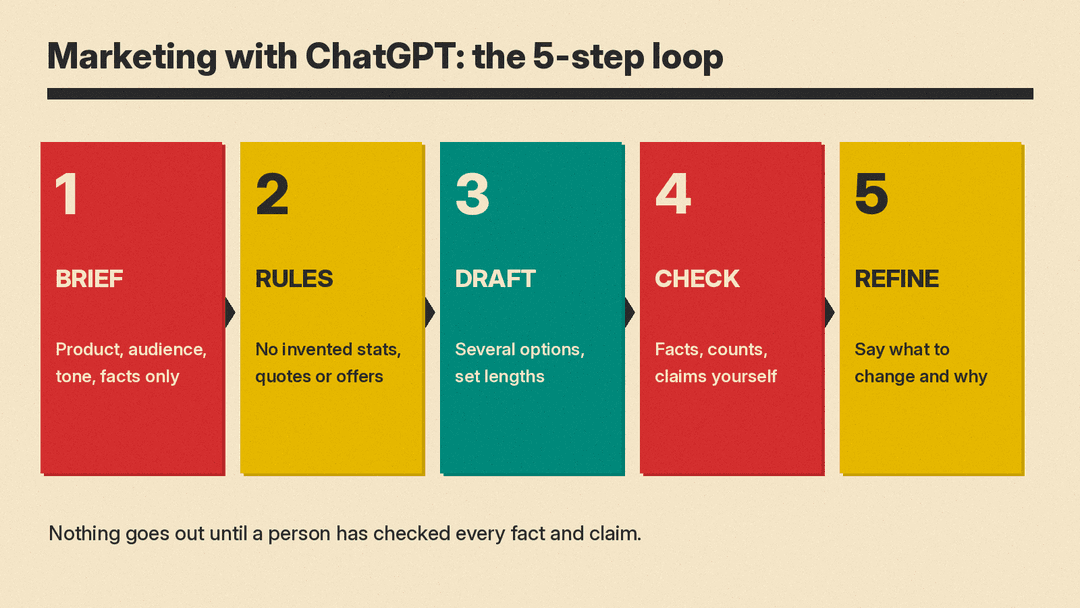
OpenAI's own prompt engineering best practices for ChatGPT come down to three habits: be "clear, specific," and give "enough context"; refine in rounds, because prompting "often requires an iterative approach"; and name the tone you want with words like "formal, informal, friendly, professional, humorous, or serious." The loop below builds those habits into marketing work.
- Brief. Give the product, the audience, the tone and the facts you can stand behind. Nothing else.
- Rules. Tell it not to invent statistics, customer quotes, reviews, awards or discounts, and to put anything missing in [brackets] as a question for you.
- Draft. Ask for several options at a set length, so you choose instead of accepting the first idea.
- Check. Read every fact, number and claim against your brief. Count characters yourself.
- Refine. Say what to change and why ("shorter, and lead with the price"), not just "make it better."
Fill in the [brackets] in each prompt below. If you are new to prompting, our beginner's guide to writing better AI prompts covers the basics.
Set-up prompts (use these first)
1. The brand brief. Paste this once at the start of a chat, then run any prompt below in the same chat.
Here are the facts about my business. Use only these facts in everything you write for me in this chat.
Business: [name, what you sell, where]
Product or offer: [name, price, what is included]
Audience: [who they are, what they care about]
Tone: [for example: warm and plain, no hype]
Words we never use: [list]
Rules: Do not invent statistics, awards, customer quotes, reviews, discounts or ingredients. If something would help but is not in these facts, put it in [brackets] as a question for me.
Reply "Ready" and nothing else.
2. Let it interview you.
Before you write any marketing copy for me, ask me up to 8 short questions about my product, customers, competitors and goals. Ask them all at once, numbered, then wait for my answers.3. Find the customer's words.
Here are [number] real customer reviews and support emails: [paste]. List the exact phrases customers use to describe the problem we solve and what they like. Quote them word for word. Do not add phrases that are not in the text.Email prompts
4. Launch email.
Write a launch email for [product]. Use only the facts in my brief. Give 3 subject lines under 50 characters, then the email in under 150 words with one call to action: [action].5. Subject line options.
Write 10 subject lines for this email: [paste email]. Mix styles: 3 plain, 3 curious, 2 benefit-led, 2 with a question. Keep each under 50 characters and show the count.6. Welcome email.
Write a welcome email for people who just joined our list from [where they signed up]. Say what they will get from us and how often, using only these details: [details]. Under 120 words. Friendly, no hard sell.7. Win-back email.
Write a short email to customers who have not bought in [time period]. Tone: [tone]. Do not offer a discount unless I give one here: [discount or "none"]. End with one question they can reply to.8. Turn a long email into a short one.
Cut this email to under 80 words without losing the offer, the deadline or the call to action: [paste email]. Then list what you removed.Social media prompts
9. A week of captions.
Write 7 Instagram captions, one per day, for [product or theme]. Each under 40 words, one emoji at most, and end with a question to invite comments. Use only the facts in my brief.10. One idea, four platforms.
Turn this announcement into a LinkedIn post (under 120 words), an X post (under 280 characters), an Instagram caption (under 40 words) and a Facebook post (under 80 words): [paste announcement]. Match each platform's tone. Same facts in all four.11. Hooks for short video.
Give me 10 opening lines for a 30-second video about [topic]. Each must be under 12 words and make the viewer want to see the next line. No clickbait claims we cannot back up.12. Reply to comments.
Here are 5 comments on our post: [paste]. Draft a short, friendly reply to each in our tone. If a comment is a complaint, apologize once, do not argue, and invite them to message us at [contact].13. Content calendar.
Make a 4-week social content plan for [business] with 3 posts a week. Mix: product, behind the scenes, customer questions, tips. Give each post a one-line idea and the format (photo, carousel, short video). Use a list, one week per section.14. Rewrite in our voice.
Here are 3 posts we wrote that sound like us: [paste]. Describe our voice in 5 bullet points. Then rewrite this draft in that voice: [paste draft].Ad prompts
15. Search ad headlines and descriptions.
Write 10 search ad headlines (30 characters or fewer) and 4 descriptions (90 characters or fewer) for [product], for people searching [keyword]. Each headline must make sense on its own. Use only the facts in my brief.Google's help page on responsive search ads gives those limits: headlines "support up to 30 characters" and descriptions "up to 90 characters each," with up to 15 headlines and 4 descriptions per ad. It also notes that headlines and descriptions "may appear in any order," which is why each one has to stand alone. Do not trust a chatbot's own character counts (see our test below); paste the lines into the Google Ads editor or a character counter.
16. Social ad variations.
Write 5 versions of a Facebook and Instagram ad for [product]. Each: a primary text under 125 characters, a headline under 40 characters, and a call to action. Make each version use a different angle: price, problem solved, ease, gift, local.17. Benefits, not features.
Here are our product features: [list]. For each, write the benefit to [audience] in one plain sentence. Do not add features or results I did not list.18. Landing page headline test.
Write 8 headline options for a landing page selling [product] to [audience]. For each, add a one-line subheadline. Mark which 2 you would test first and why.19. Objection handling.
List the 6 most likely reasons [audience] would not buy [product]. For each, write a short, honest answer we could use on the product page. Do not promise anything that is not in my brief.SEO and blog prompts
20. Blog post ideas.
Give me 15 blog post ideas for [business] that answer questions our customers actually ask, such as: [paste 3 real questions]. For each, give a working title and the question it answers.21. Outline.
Write an outline for a blog post titled "[title]" for [audience]. Use H2 and H3 headings, note where an example or a photo would help, and list the facts I need to supply. Do not write the post yet.22. Meta title and description.
Write 5 meta titles (under 60 characters) and 5 meta descriptions (under 155 characters) for this page: [paste page or summary]. Include the phrase "[keyword]" naturally. Show the character count for each, and I will check them myself.23. FAQ section.
Write 6 FAQ questions and short answers for the [product] page, using only the facts in my brief. If an answer needs a fact I have not given, write [ASK ME] instead of guessing.24. Product description.
Write a product description for [product] in 3 versions: 50 words, 100 words and a 5-bullet list. Use only these facts: [facts]. Keep the tone [tone].25. Refresh an old post.
Here is an old blog post: [paste]. List which parts are likely out of date and which claims need a source. Then suggest 3 sections to add. Do not rewrite the post.Strategy and planning prompts
26. Customer profile.
Based on these notes about our best customers: [paste notes], write a one-page customer profile: who they are, what they want, what worries them, where they spend time online, and the words they use. Mark anything you are guessing as a guess.27. Campaign plan.
Plan a 2-week campaign to launch [product] with a budget of [budget] and these channels: [channels]. Give a day-by-day list of what goes out where, and one number to watch for each channel.28. Competitor messaging.
Here is text from 3 competitor homepages: [paste]. Summarize how each one describes itself in one line, what they all say, and what none of them says. Base this only on the text I pasted.29. Positioning statement.
Write 3 positioning statements for [business] in this form: For [audience] who [need], [business] is the [category] that [main benefit], unlike [alternative]. Use only my brief.30. Review your own copy.
Review this marketing copy as a skeptical customer: [paste]. List every claim that needs proof, anything that sounds like hype, and anything confusing. Do not rewrite it; just list the problems.For prompts aimed at other office work, see our 50 ChatGPT prompts for work.
What we found when we tested four of these prompts
We ran four marketing prompts on Gemma 3 1B, a small model running on our own computer, on October 26, 2026, at temperature 0. This is not ChatGPT, and results from ChatGPT will differ. We used it because it shows the kinds of mistakes to look for. The business was made up: a small Portland tea shop launching an autumn chai at $14 for a 100 g tin, for customers aged 25 to 45, in a "warm and plain, no hype" tone. We gave no ingredients.
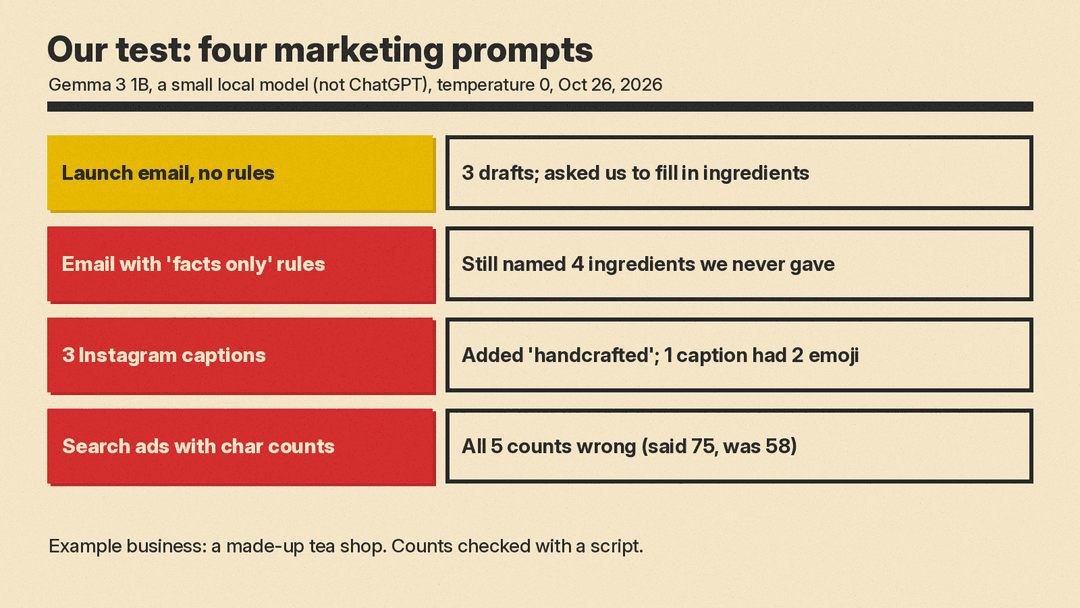
- Launch email with no rules. It wrote three drafts with the right price and size. Where it needed details, it left brackets for us to fill in, such as "[mention a key ingredient or two, e.g., cinnamon, cardamom, and cloves]".
- Launch email with "use only the facts" rules (prompt 4 plus the rules from the brand brief). It followed the length limit (135 words) and gave three short subject lines. But it stated that the blend has "cinnamon, cardamom, cloves, and a touch of orange peel," none of which we gave it. With the rules on, it filled that gap with made-up facts instead of brackets.
- Instagram captions (one emoji at most, no invented facts). It called the chai "handcrafted with care," which we never said, and one caption used two emoji.
- Search ads with character counts. It ignored the format (we asked for 5 headlines and 2 descriptions; it wrote 5 headline and description pairs), and every character count it printed was wrong. It said 75 characters for a description that is 58; the other four were off by 2 to 22. Two descriptions also said "small-batch" and "artisan," which were not in the brief.
The lesson: rules in the prompt help, but they are not a check. Step 4 of the loop is the one you cannot skip. Read every product detail against your facts, and count characters with a tool, not the chatbot. Our 5-minute routine for fact-checking AI answers works for marketing copy too.
Do not let AI write your reviews
One kind of marketing copy you should never ask a chatbot for: customer reviews or testimonials. In the US, the Federal Trade Commission's rule on consumer reviews and testimonials took effect on October 21, 2024. Section 465.2 makes it "an unfair or deceptive act or practice" for a business to write, create or sell a review or testimonial that materially misrepresents that the reviewer exists, that they used the product, or what their experience was. The FTC's Federal Register notice for the rule says "AI-generated reviews are covered by the final rule."
Use prompt 3 instead: ask the AI to find patterns in reviews real customers already wrote, and quote them word for word.
Sources
- OpenAI Help Center: Prompt engineering best practices for ChatGPT
- Google Ads Help: About responsive search ads
- Federal Register: Trade Regulation Rule on the Use of Consumer Reviews and Testimonials
- eCFR: 16 CFR 465.2, Fake or false consumer reviews, consumer testimonials, or celebrity testimonials
