
OpenAI shipped Images 2.6 on November 4. On X we found the announcements, two posts from a benchmark account and a few user tests. On Hacker News people ran the model, priced it, and argued about whether it is better than Images 2.5. This roundup collects what we could read and checks the main claims against OpenAI's own pages.
OpenAI's post on X went up at 3:35 PM PT and said Images 2.6 is available in ChatGPT and Codex across all tiers, with GPT-Image-2.6 Flare and Sunburst in the API. At about 8:15 PM PT it showed 635 likes and 93,751 views. The Hacker News thread had 172 points and 115 comments at about 8:15 PM PT. Reddit cannot be read from our tools, so everything below comes from X, Hacker News and OpenAI's pages. For the launch details, see our news post on the GIF feature. This post is only about what people said.
What OpenAI announced
The launch post makes four claims. Images 2.6 generates images 50 percent faster than before. Flare, which can finish in as little as six seconds at low quality, is the fast API model, and Sunburst is the one for higher detail and consistency across edits at medium or high quality. ChatGPT now makes animated GIFs from a prompt or a photo. The API gains image markup, SVG export and a new complexity setting. OpenAI also says people now create 4 billion images per week across ChatGPT, Codex and the API.
Praise: the leaderboard claim and a plain GIF win
The strongest positive number came from a benchmark account, not a user. DesignArena posted at 3:32 PM PT, about two minutes before OpenAI's own post, that GPT Image 2.6 Sunburst "is ranked #1 on Image Arena" and was "overtaking its predecessor Image 2.5 Sunburst." It listed first places for Flare in portraits, architecture and typography, and for Sunburst in product and landscape. It also said Flare is 2.6 times faster than its predecessor and Sunburst 1.15 times faster. By about 8:15 PM PT that post had 120 likes and 23,785 views. Those speed multiples are DesignArena's figures, separate from OpenAI's 50 percent figure.
In a follow-up post, DesignArena said Flare "produces fewer unnecessary text slogans in generated images," and showed GPT Image 2.5 Sunburst adding two slogans nobody asked for. That is a specific claim, and one Hacker News user later built on it.
Some users liked the GIF feature simply for existing. On Hacker News, vunderba tried it and wrote: "I didn't have high expectations, and I still think you can probably get better results by doing a First-Last-Frame using something like Minimax H3 but I was still rather surprised that it could do it at all." He posted several results, the last of which turns an existing picture of his husky in a snow globe into a GIF. jawns named a small use case: "My only use case for this is animating custom Slack emojis." On X, @learnwithcheer posted a backflip GIF test and wrote: "Medium and high complexity look neck and neck during the fast backflip, but high's motion feels smoother."
On quality, Computer0 replied "I preferred 2.6 in all examples supplied" to a comparison posted by another user. minimaxir cautioned that the ChatGPT web app does not say which image model and effort level it is using, then said one of his more difficult image prompts "surprisingly passes."
Complaints: 2.5 might be better, and the artifacts are still there
The most direct complaint was about regression. jjcm, who runs a prompt-to-design site, wrote: "2.5 is better than 2.6." After an hour of use he said he was "rolling back 2.6-flare to 2.5-flare" because Flare produced outputs that were "too simplistic" or "inherently broken," while "2.6-sunburst seems solid however." He later added that arena.ai appeared to show 2.5 scoring higher than 2.6 on its text-to-image leaderboard. DesignArena's post says Sunburst is first, and jjcm's comment does not say which 2.6 model he compared, so the two claims may not conflict. We could not load either leaderboard from our tools to check, so treat the ranking as unconfirmed. In a separate reply, jjcm wrote that, based on the DesignArena post, 2.6 looks post-trained to output less text, and suggested that this may be why text elements look more zoomed in and why UI designs show less detail. The DesignArena post itself says only that Flare produces fewer unnecessary text slogans.
Others posted failures on their own prompts. neom wrote that 2.6 "Did a considerably worse job than Image Gen 2.0 on my standard test prompt," a macro photo of a watchmaker's hands. His baseline is Image Gen 2.0, not 2.5, so it is a different comparison from jjcm's. ipsum2 complained that it "Still has the gross artifacts (visible watermarking) that the other GPT-Image-2.* has," and said Google's Nano Banana watermarking is "practically invisible." minimaxir wrote that "The splotchiness on that simple chess animation makes this GIF feature a nonstarter." Computer0 made the same point: "The gifs really accentuate the artifacting, not sure I would've lead with that."
The text of the launch post includes no benchmark comparisons. scottyah noted: "They didn't even compare on cost, speed, or any benchmarks at all."
The price argument
The launch post says what the models are for but not what a typical image now costs. Two Hacker News users did that arithmetic. minimaxir noticed that OpenAI claims 50 percent faster generation "but curiously price is the same as Image 2.5." Then bsboxe used OpenAI's image pricing calculator and wrote that per-token prices are unchanged between 2.5 and 2.6 but token use per image roughly quadruples at low and medium quality. At 1024x1024, 2.5 low was 196 tokens and $0.006 and 2.6 low was 823 tokens and $0.025. 2.5 medium was 439 tokens and $0.013, and 2.6 medium was 1,449 tokens and $0.043. Higher quality settings, bsboxe wrote, "show no change in token usage between the models." bizer made the same point: it "ends up being a bit more expensive."
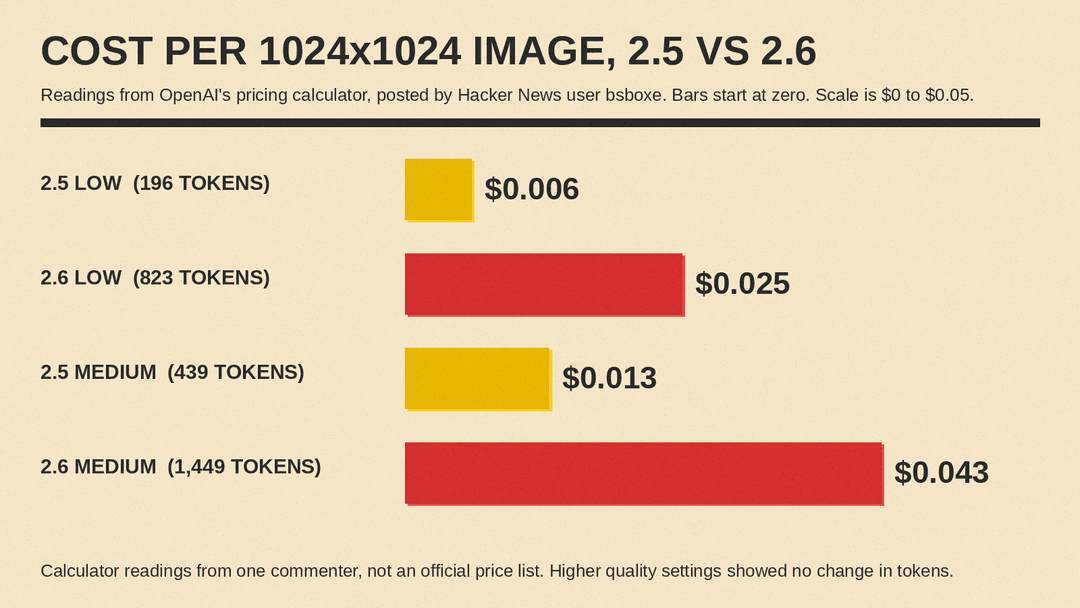
A second user, bnmathm, posted a table from their own workflow that was close on cost and added times: 2.5 medium took 12.0 seconds and 2.6 low took 6.7 seconds, while 2.6 medium took 7.9 seconds and 2.6 high took 8.9 seconds. They also said round art came out "significantly less round" without changes to the prompt. These are calculator readings and one person's timings, not an official price list, so check the pricing details OpenAI links from its launch post before budgeting. The takeaway is that "50 percent faster at the same price" and "the same cost per image" are different claims, and the second one may not hold at low and medium quality.
SVG: more complicated than it sounds
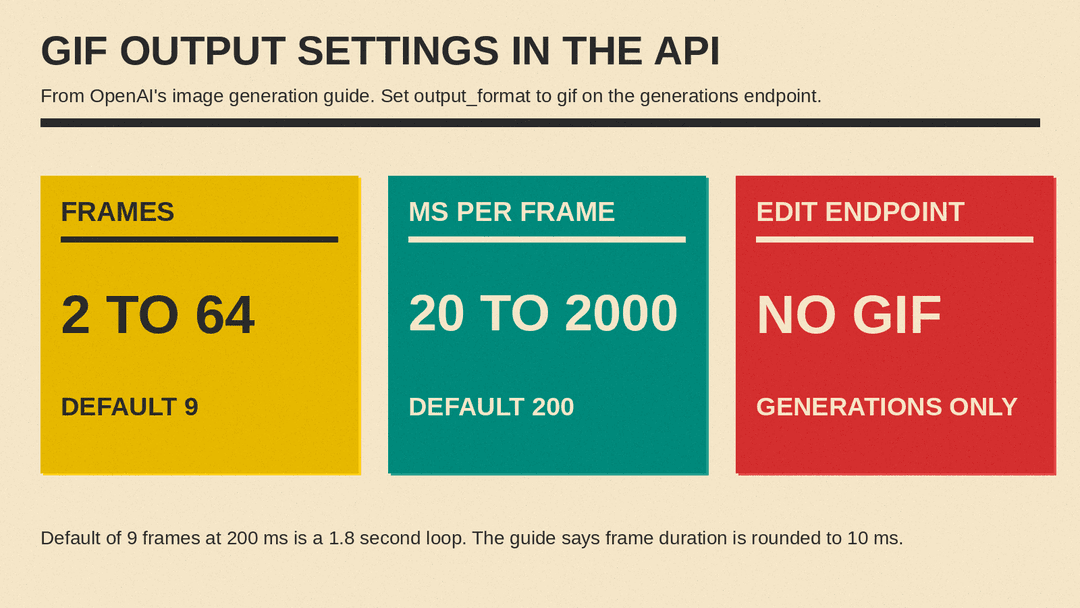
The SVG export drew the most skepticism. minimaxir guessed that "shenanigans are afoot" because "that's not how image generation models work," and said OpenAI had probably put a raster-to-vector tool in the pipeline. He then checked the documentation and wrote that he was right. The developer guide says the API "creates a reference image and uses it to produce the SVG," with the quality setting controlling that reference image. It also says SVG output returns static vector content and does not support streaming or partial images.
vunderba reported a setup snag: requests failed with an error that "SVG generation requires 'svg.model'," a requirement he could not find in the documentation. He tried Sunburst with two language models and called the results "nothing spectacular," saying you could already ask ChatGPT to convert an existing image to SVG. One Hacker News user asked for an example SVG, and minimaxir pointed to the two examples in the documentation. The developer guide's cost section does mention an "authoring model" for SVG output, which is billed on top of the image model's reference image.
Rollout and the GIF experience
Several people could not use the feature at all. On X, @ItsmeAjayKV wrote: "The only gif i wanted to create and it didn't generate it" while a plain image did generate. @synthesiscx noted that the release notes describe GIFs as "rolling out," so "today" means eventually. On Hacker News, dllu said that codex-cli version 0.166.0 still could not make GIFs even though the launch post says Codex gets Images 2.6. schneehertz replied that the model used by codex-cli is still gpt-image-2, linking to a file in OpenAI's Codex repository that we did not open.
Refusals came up too. solyin reported a refusal for a violent xkcd-themed GIF prompt, and Den_VR suggested asking the model to confirm the concept is clear and then telling it to make it. shepherdjerred said a similar prompt was refused for them. On sharing, a user complained that sharing a GIF from a phone sends a ChatGPT.com link to a static image, not the GIF.
The 4 billion images per week figure also drew doubt. viraptor wondered "if there's some weird accounting going on, or if this is real," working out that it means about 24 million images an hour.
What to take from it
The early picture is that Images 2.6 is faster and adds GIF, SVG and markup features, but that quality looks mixed and the cost per image at low and medium quality may be higher than before. One leaderboard account says Sunburst is first and a Hacker News user says arena.ai shows 2.5 ahead. The GIF feature works for simple loops and shows visible noise between frames, and at launch some users could not reach it. If you build on the API, test Flare and Sunburst against 2.5 on your own prompts and compare cost per image, not just speed. For a broader comparison, see our Midjourney vs GPT Image guide and our earlier look at GPT Image 2.6 in OpenAI's API spec.
Sources
- Introducing Images 2.6 (OpenAI)
- OpenAI on X: Images 2.6 announcement
- Hacker News: Images 2.6
- DesignArena on X: leaderboard result
- DesignArena on X: fewer text slogans
- OpenAI image generation guide (GIF and SVG output)
- @learnwithcheer on X: GIF complexity test
- @ItsmeAjayKV on X: GIF not generated
- @synthesiscx on X: rollout note
