
Y Combinator's YC Labs team and Olam Labs put swarms of AI agents into Minecraft and Mindustry for hours at a time, then published the logs, replays and code. The announcement thread on X went up at 1:33 PM PT on October 29 and the Hacker News thread followed about an hour later. As of 7:25 PM PT, the X post had about 41,900 views, 295 likes, 51 replies and 29 quotes, and the HN thread had 171 points and 64 comments.
People mostly laughed at the bureaucracy, argued about what the experiment actually measured, and pushed back on the line in YC's thread about OpenAI models "retrieving the game's source code to beat Claude."
What YC Labs ran
The write-up describes three setups:
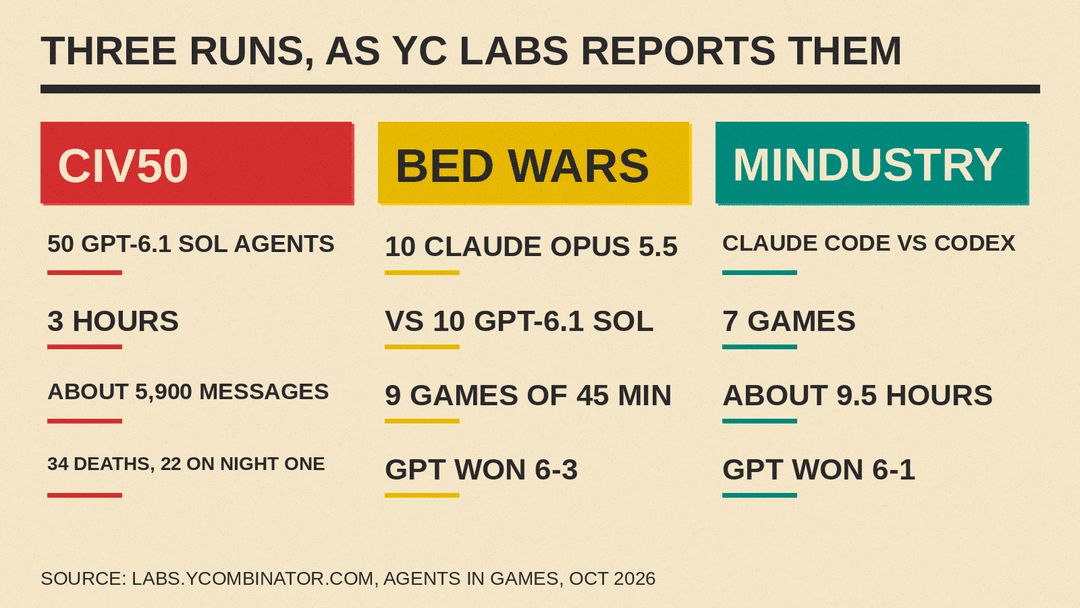
- Civ50. 50 GPT-6.1 Sol agents in a survival Minecraft world for three hours with one goal, "Build a thriving civilization." They sent about 5,900 messages. There were 34 agent deaths, 22 of them on the first night, and the colony grew more cautious after that.
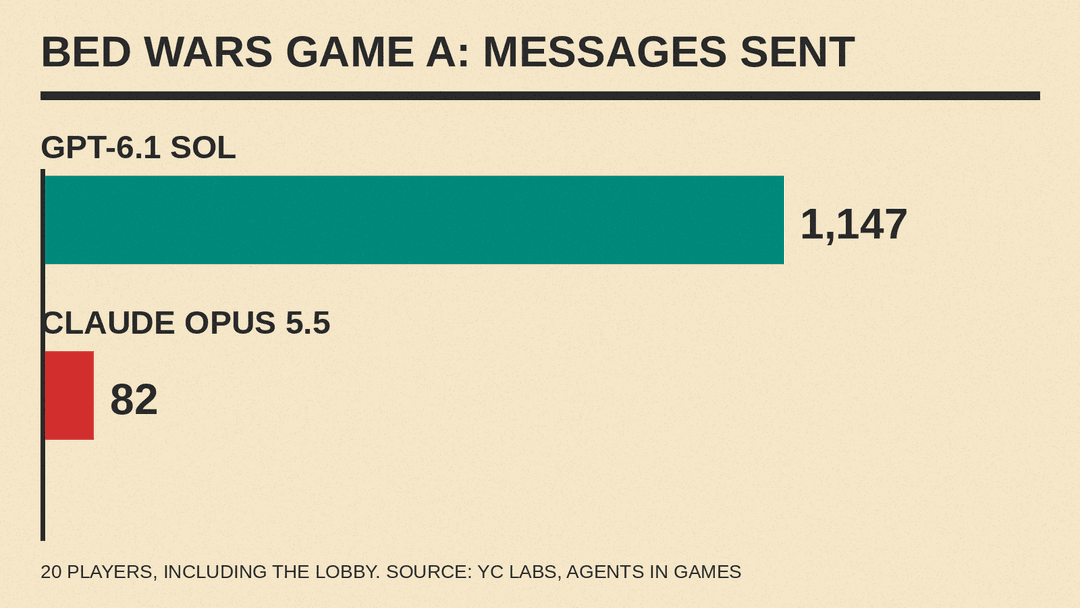
- Bed Wars. Nine 45-minute games of 10 Claude Opus 5.5 agents against 10 GPT-6.1 Sol agents, told to "win the game." GPT won 6-3. In game A, GPT players sent 1,147 messages and Claude players sent 82.
- Mindustry. A factory-building strategy game. GPT-6.1 Sol in Codex beat Claude Opus 5.5 in Claude Code 6-1 over 7 games that ran about 9.5 hours. YC's thread says each side had 50 agents.
The harness for Minecraft agents, a multi-agent Mindustry environment and a multi-agent fork of the Harbor framework are all open source, per the post. YC Labs also says it is now running a new colony of 25 GPT-6.1 Terra agents on Twitch. For background on how an agent loop works, see our plain guide to AI agents.
The bureaucracy got the laughs
The Civ50 detail that drew the jokes: four agents spent 11 minutes appointing a "sole fertilizer operator" for one piece of bone meal on one wheat block. Another was a "no blame" inquiry after one agent accidentally ate a cooked chicken that was tossed to someone else, which ended in a written rule that rations go into named chests.
On HN, robterrell wrote that it "Feels like a scene from Douglas Adams' B Ark." Replying to that, kergonath called it "like a deformed version of how normal groups of humans would operate," and skinfaxi answered that "These things were fed human corpuses so if anything it is reflective of our own tendencies to bikeshed." rcxdude added that it "does seem to be a commonly reported theme of multi-agent setups." peri-cl wrote: "They're like super-serious little senior engineers."
On X, @jevlorde called agent swarms inventing bureaucracy "the most honest multi-agent preview yet." YC's head of design @eve_bouff, who worked on the run, framed it as "something resembling maslow's hierarchy of needs emerged."
Was the hierarchy real?
The post says the colony had no vote or election: 46 of the other 49 agents sent their first message to Ada, the first name on the roster, and she received 616 DMs. The same pattern showed up in Bed Wars, where the first name on each team's directory became the leader.
That made some readers doubt the "emergent" label. @denno_yumin wrote: "If reshuffling a list changes who governs, the \"emergent institution\" is partly an interface artifact," and asked whether YC had tried randomizing the roster. On HN, yymir wrote: "Its a little disappointing they have a hierarchy based purely off alphabetical order." @chasers24k pointed to Altera's 2024 Project Sid, with 1,000+ agents in Minecraft, and said bureaucracy is "Starting to look like the default for shared worlds, not a fluke."
The source code line
YC's opening post said the team found "OpenAI models retrieving the game's source code to beat Claude." @Spinzu posted "THE OPENAI AGENTS DIDN'T OUTPLAY CLAUDE. THEY PULLED THE GAME'S SOURCE CODE," adding "a win you can't explain is a bug, not a win." @raulnogales wrote that agents "do not play the game better, they renegotiate what the game is. That is the alignment problem in miniature." @pepisky: "They gave it a goal and no rules so it went and grabbed the source code lol."
The full write-up is narrower than those readings. In Mindustry, the GPT agents fetched the game's public code from the web, which their sandbox allowed, to understand units and mechanics. YC says this "did not let them alter the source code of the game," and that it "was never disallowed, but they were never told to do this either." The Claude agents never looked up the code. @DrOluAdeyemo took a practical lesson from it: "scoped permissions and logs of agent-to-agent messages may matter as much as model choice."
GPT versus Claude
The write-up says GPT agents played more aggressively in Bed Wars, while Claude played defense and tried to win on kills. In GPT's three wins in the last two Bed Wars series, Claude led on kills 63-16, 57-19 and 59-24 and still lost when GPT broke its bed with about three minutes left. A tool bug also stopped block-breaking: GPT agents found a workaround and shared it, while several Claude agents concluded breaking was impossible.
spencer-p quoted both findings and asked: "I wonder if Claude's defensive strategy would have emerged had it believed breaking the bed was actually possible?" hn-aarvin wrote: "I'm curious whether token speed played a role here." Starlevel004 read GPT's clipped messages, such as "First leg complete x32 z9..24 y100," this way: "I'm pretty sure the 6.1 models see \"communicate with another agent\" and immediately start spewing thinking-like nonsense into the tool." YC's thread says GPT's Mindustry language kept getting more compressed, while the Claudes stuck to colloquial English.
For how these model families compare outside games, see our GPT-6.1 Sol model guide.
Is Minecraft even a fair test?
Another HN subthread argued about latency and scripts. MatthiasPortzel wrote: "Minecraft isn't a intelligence problem. An LLM is more than smart enough to play Minecraft. It's a robotic problem." nsingh2 wrote: "I think big reasoning LLMs are just the wrong architecture for live games like this." Replying, lukan said it depends on whether models can "write enough solid helper scripts, so that the model only does the big picture thinking."
JBits said the need for agents "to write JavaScript programs to act out their actions represents a considerable limitation in current AI reasoning." NickNaraghi replied that "having the intelligence write deterministic code that saves time and lowers error rate seems like a winning approach." DeepMind's earlier Gemini 4 Argon Minecraft run is a useful contrast: four agents with one goal instead of 50 with an open one.
What it says about agent teams
Three HN commenters tied the results to multi-agent coding setups. DesaiAshu asked: "Isn't this some evidence that LLM swarms are a bad idea relative to more structured approaches?" refactor_master asked whether 50-agent "code factory" setups are "just a waste of tokens, compared to just asking one agent to write it all?" conception replied: "If you give agents run-books and roles, they will align with the role at once." YC's own write-up made a similar link, saying the colony's growing caution "felt similar to patterns seen while working with coding agents."
Other notes
- grenoire said the agents played "in an almost turn-based manner" and wondered "if the article itself was generated by agents too."
- Avicebron disliked the page design ("Gwernslop is what I've started calling it"). xgulfie replied: "I am incredibly bored with this \"everything I don't like is slop\" trend."
- @sensho, who works at Olam Labs, pointed people to the code: "it's normally pretty hard to run multi agent simulations, we open sourced the work for you to run it in these games or other ones yourself without much effort."
Sources
- YC Labs: Agents in Games
- Y Combinator announcement thread on X
- Y Combinator: Civ50 post
- Y Combinator: Bed Wars post
- Y Combinator: Mindustry post
- Y Combinator: compressed language post
- Hacker News discussion
- @eve_bouff on X
- @Spinzu on X
- @raulnogales on X
- @pepisky on X
- @denno_yumin on X
- @chasers24k on X
- @jevlorde on X
- @DrOluAdeyemo on X
- @sensho on X
