
Rights holders for Elvis Presley and the publisher of many Eminem songs filed two separate lawsuits against the AI music generator Suno on Friday, November 6, 2026, in the U.S. District Court for the Northern District of California. The Presley suit adds a claim under Tennessee's ELVIS Act, a state law on voice and likeness, to federal copyright claims. Both complaints allege that Suno's own statements in another case are false. These are allegations. No court has ruled on them.
Variety reported the suits on November 7, and The Verge followed on November 8. Both complaints are public: the Presley complaint (PDF) and the Eight Mile Style complaint (PDF).
Who is suing Suno
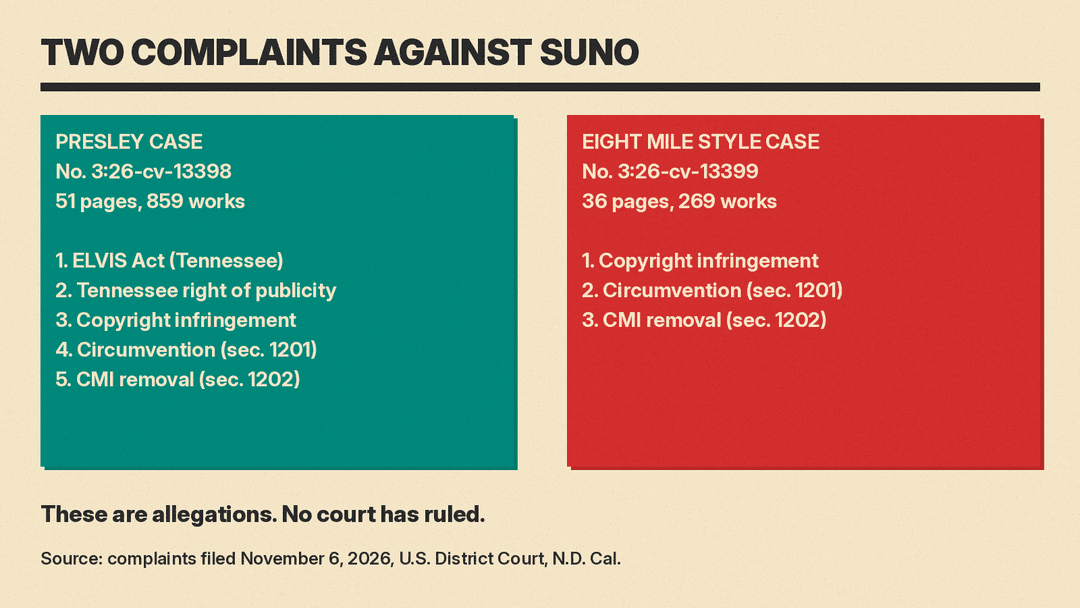
The first case is Elvis Presley Enterprises, LLC et al. v. Suno, Inc., No. 3:26-cv-13398. The 51-page complaint lists 15 plaintiffs. They include Elvis Presley Enterprises, LLC, ABG EPE IP LLC, Raleigh Music Publishing LLC, three trusts and individual rights holders. Variety reports that the group includes Authentic Brands Group. The complaint says Elvis Presley Enterprises "solely retains Elvis Presley's likeness rights."
The second case is Eight Mile Style, LLC and Martin Affiliated, LLC v. Suno, Inc., No. 3:26-cv-13399. The 36-page complaint describes Eight Mile Style as "an independent music publisher and copyright administration company" that owns and administers Eminem compositions, including the 269 listed in Exhibit A. Variety reports that Eminem is not individually participating in the suit.
The same lawyers represent the plaintiffs in both cases: Richard Busch, Mark Block, David Niemierzycki and Andrew Davis of Adams and Reese, with Skaggs Faucette in San Francisco.
What the Presley complaint alleges
The Presley complaint has five counts:
- violation of the ELVIS Act (Ensuring Likeness, Voice, and Image Security), Tenn. Code 47-25-1101 et seq.
- violation of the Tennessee common law right of publicity
- direct copyright infringement
- circumvention of protection measures under 17 U.S.C. 1201
- removal or alteration of copyright management information (CMI) under 17 U.S.C. 1202
It lists 859 works in Exhibit F. These are Elvis songs plus songs held by the "Raleigh Plaintiffs," such as Chubby Checker's "Let's Twist Again."
The complaint points to recorded Suno outputs in five exhibits, including five examples it says infringe both Presley's name, image and likeness (NIL) and copyrights, 33 NIL examples in Exhibits B and C, nine Elvis copyright examples, and three Raleigh copyright examples. It says the voice examples are "NOT examples of Elvis Presley singing" but "synthetic and unlicensed uses of Elvis' voice and likeness," and that one output, "Elvis in The Jailhouse Rock," was "still live on Suno with over 125,000 plays" at the time of writing.
The complaint's framing is blunt. It says "Suno has mechanically encoded itself with artists' identities, hard-work, creativity, and time, and harnessed them all for a consistent conveyor belt of cold hard cash coming in." It also says: "The next Elvis won't pick up a guitar."
What the Eight Mile Style complaint alleges
The Eight Mile Style complaint has three counts: direct copyright infringement, circumvention of protection measures under section 1201, and removal or alteration of CMI under section 1202. Its 269 works include "Lose Yourself," "Without Me," "Till I Collapse," "The Real Slim Shady" and "Stan."
The complaint alleges that Suno has admitted to copying "essentially all music files of reasonable quality that are accessible on the open Internet" to train its generator, and that it got works from streaming and paywalled platforms "by scraping and circumventing technological access controls," including through Bright Data tools and, "upon information and belief," stream-ripping tools that get around YouTube's "rolling cipher." The Presley complaint makes similar scraping claims.
On outputs, it alleges Suno songs use the lyrics, "often verbatim," and musical elements of works including "Lose Yourself," "Till I Collapse," "The Real Slim Shady" and "Houdini," with examples in Exhibit B. It also says Suno's guardrails "are easily circumvented," for example by rejecting "Reba McEntire" in a prompt but allowing "in the style of Reba McIntyre [sic]."
How the complaints use Suno's Isbell filing
Both complaints quote Suno's November 3 memorandum in Isbell v. Suno (D. Mass., No. 1:26-cv-14005), covered in Suno's motion to dismiss the Isbell publicity suit. There, Suno said that "by design and in practice," its outputs "do not replicate the auditory characteristics of any real artist's voice to the point that someone would confuse a Suno creation with one actually sung by a particular famous musician," and that it "has never allowed prompts for specific artists or copyrighted songs."
The Eight Mile Style complaint calls those statements "demonstrably false." The Presley complaint calls them "unequivocally false."
What the plaintiffs ask for
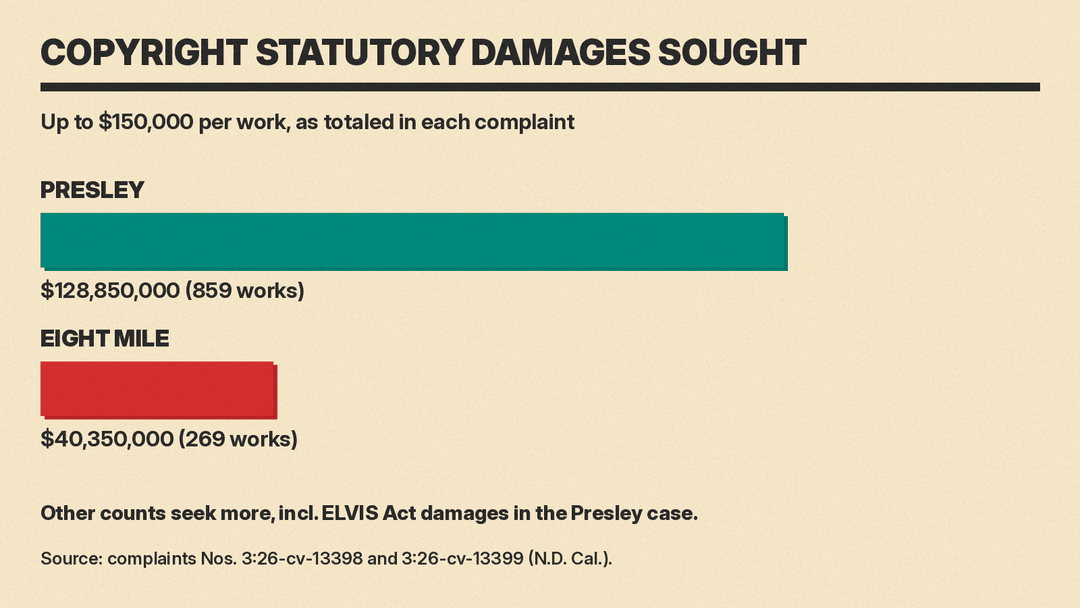
The copyright counts seek statutory damages of up to $150,000 per work: $128,850,000 for 859 works in the Presley complaint and $40,350,000 for 269 works in the Eight Mile Style complaint. Circumvention and CMI counts seek further sums listed in each complaint ($2,147,500 and $21,475,000 for Presley; $672,500 and $6,725,000 for Eight Mile Style).
The Presley complaint also seeks ELVIS Act damages and profits "believed to exceed $50 million," plus treble damages and fees, tying the treble request to Presley's U.S. Army service from about March 1958 to March 1960. Its common law publicity count seeks damages also "believed to exceed $50 million," plus punitive damages.
Both ask for a permanent injunction, for impoundment or destruction of unauthorized copies (including in training data and model weights), and for an accounting of training data and scraping.
What Suno says
Suno spokesperson Cat McCormack told The Verge: "Suno exists to help people create new, original music, not to trade on anyone's name or likeness, and we prohibit any unauthorized use of an artist's work. To protect against this, we do not allow prompts for specific artists' names and songs and work with third-party providers to screen uploaded audio files and lyrics for potential misuse." Variety reported the same statement from a Suno spokesperson.
Why it matters
Variety calls the Presley case the latest test of whether an artist or their estate can use the courts to protect name, image and likeness from use by an AI company without explicit authorization or compensation. The Verge says the suits "closely mirror" the Isbell case, which did not claim copyright infringement directly. The Presley complaint pairs likeness claims with copyright, circumvention and CMI claims; Eight Mile Style brings only federal claims.
The suits add to Suno's legal load. Variety lists other cases from Round Hill Music, Universal Music Group and Sony Music Entertainment, and reports that Warner Music Group settled its case in 2025. It says deals with WMG, BMG and Believe helped power Suno's label-backed v6 model, covered in our Suno v6 explainer. Variety also notes that Presley rights holders sued Anthropic in October 2026 (see Presley rights holders' suit against Anthropic). Variety reports Anthropic has denied those allegations.
What happens next
The Justia docket for the Presley case and the Justia docket for the Eight Mile Style case, as of November 6, 2026, each showed two entries: the complaint and a notice of manual lodging of exhibits. Suno's answer was not yet on those dockets. Its public response so far is the spokesperson statement above.
Sources
- Complaint, Elvis Presley Enterprises, LLC et al. v. Suno, Inc., No. 3:26-cv-13398 (N.D. Cal., filed November 6, 2026) (PDF)
- Complaint, Eight Mile Style, LLC v. Suno, Inc., No. 3:26-cv-13399 (N.D. Cal., filed November 6, 2026) (PDF)
- Justia docket, No. 3:26-cv-13398
- Justia docket, No. 3:26-cv-13399
- Variety: Elvis Music Owners, Eminem Publisher File Sprawling New Lawsuits Against AI Music Generator Suno (November 7, 2026)
- The Verge: Elvis and Eminem rights holders are suing Suno (November 8, 2026)
