
Baidu has released ERNIE-Wizshot-ME, a video model that turns a still image of a person into a short clip of that person speaking and acting out a script. Baidu calls it a "micro-expression" model: faces, body language and mood are meant to change with the lines. Baidu's own pitch is an end to the stiff "AI face".
Jia Lei, who heads Baidu's application model R&D department, announced it on November 12 at Baidu World 2026, Phoenix Tech reported. Its Chinese name is 文心一镜微表情大模型. It is live on Baidu AI Cloud's Qianfan platform as an API for enterprise customers and partners. Baidu has not announced open weights.
What is ERNIE-Wizshot-ME?
Wizshot-ME is a talking-character video model. You give it a cast (an image and a voice sample for each person), storyboard images for each shot, and a script with stage directions. It returns a short video in which the characters speak the lines in their own voices, with expressions and gestures that follow the scene.
According to Sina Finance's report on the launch, Baidu says the model:
- Models text, vision and speech together in one system.
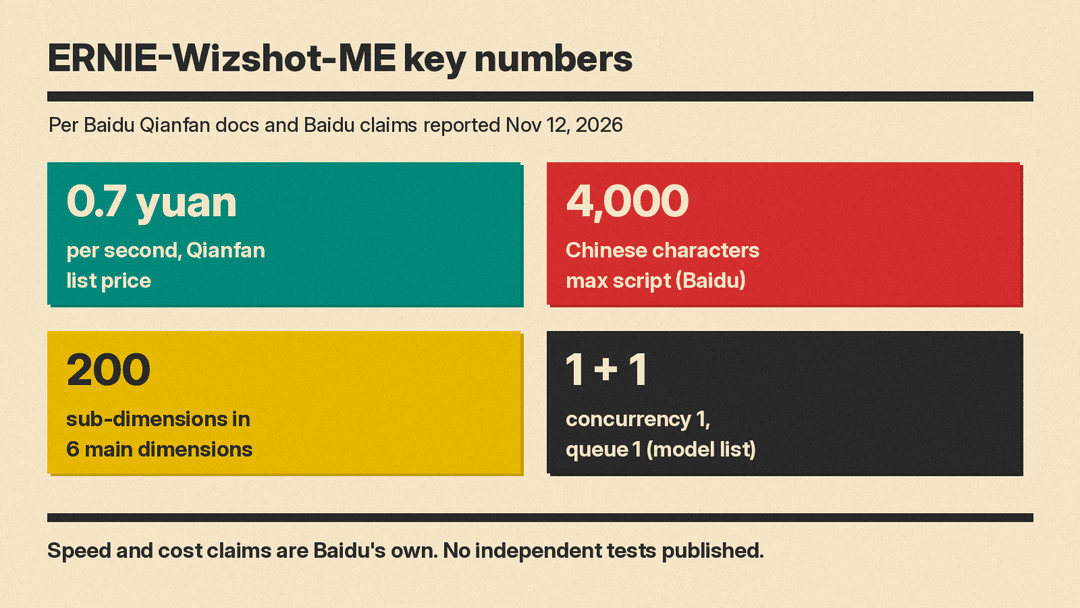
- Accepts scripts of up to 4,000 Chinese characters.
- Uses a description system with 6 main dimensions and 200 sub-dimensions to turn emotional cues in the text into facial expressions, body movement and mood changes.
- Adds "passage-level dubbing": it voices a whole script in one pass, instead of the common method of splitting a video into roughly 30-second pieces, making audio for each, and stitching them together. Baidu says this keeps the voice and the pacing consistent.
Baidu also claims its video generation cost is 50% below the industry level, and that a fast version generates in real time, so one minute of video takes about one minute. These are Baidu's own figures. No independent tests have been published.
What does it cost?
Qianfan's model pricing page lists ERNIE-Wizshot-ME at 0.7 yuan per second of generated video. At that list price, a 10-second clip costs 7 yuan per generation. Each retake is a new generation, so budget for several tries per shot.
The Qianfan product page describes 4 to 15 second clips at 1080p, as unwire.pro and other outlets reported.
There is a second, lower number in the news. Baidu Yijing (百度一镜), Baidu's digital human business, said at the same event that its own video generation model now costs as little as 0.2 yuan per second, Beijing News reported. The report does not say whether that rate applies to the Wizshot-ME API on Qianfan. Until Baidu says so, treat 0.7 yuan per second as the Qianfan API price.
What you need to make a clip
The create-task API documentation (updated November 11) shows how much the model expects you to prepare. This is not a one-line prompt tool.
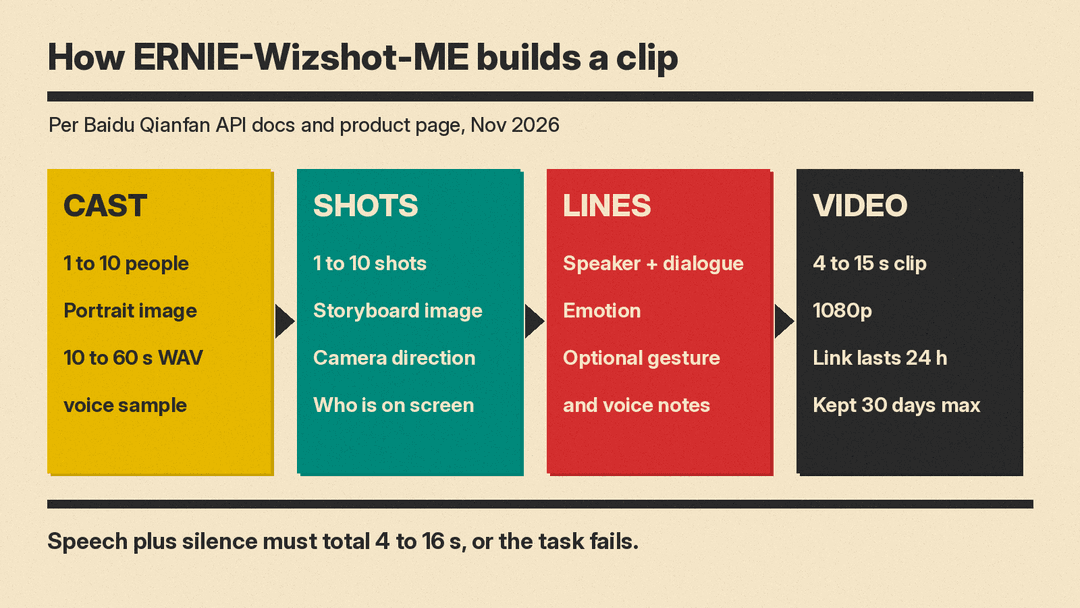
Characters. Each request defines 1 to 10 characters (Baidu suggests 3 or fewer). Each one needs:
- A portrait image in JPEG, PNG or WEBP, up to 10 MB, between 300 and 5,000 pixels on each side, with an aspect ratio from 1:3 to 3:1. It must show the face clearly and match the clothing in the storyboard.
- A WAV voice sample of 10 to 60 seconds that contains speech. This is a voice reference, not the length of the output.
- Optional identity and temperament notes, such as "tech finance host" or "calm and authoritative".
Shots. Each clip has 1 to 10 shots (Baidu suggests 4 or fewer). Each shot needs a camera direction, a storyboard image (short side at least 720 pixels, aspect ratio from 9:16 to 16:9) and the names of the characters on screen.
Lines. Each shot has 1 to 10 speaking segments. Each segment names the speaker and gives the dialogue and an emotion. You can add optional notes on performance (for example, a nod on a key word) and on voice delivery (speed, pauses, stress). An empty line with a set silence length adds a pause.
Length. All speech plus silence in a clip must come to 4 to 16 seconds, measured by the server. If the clip falls outside that range, the task fails. The docs give a rough guide: about 4 Chinese characters per second (20 to 60 characters for a clip), or about 2.5 English words per second (13 to 37 words). Each line is capped at 450 bytes.
Note the small gap: the product page says 4 to 15 seconds, while the API check allows up to 16. Plan for 15.
How the API works
Generation is asynchronous. You send a create request to the Qianfan endpoint with an API key and get a task ID back. You then poll the query endpoint, which reports pending, processing, succeeded or failed. A finished task returns a video link, the clip duration and the resolution.
Two limits matter for production:
- Download fast. The video link expires after 24 hours, and Baidu keeps the video for 30 days at most.
- One at a time. The Qianfan model list sets Wizshot-ME at a concurrency of 1 and a queue of 1, so you can run one task at a time, with one more in the queue.
The API also rejects inputs or outputs that its safety checks flag as unsafe.
Short dramas and digital humans
Baidu says the model shows strong emotional expression in podcasts and short animated dramas, according to Sina's report. The Baidu Yijing announcements point the same way. Beijing News reported that the Wizshot-ME model, combined with a quality agent, can show up to 8 to 9 micro-expressions per second. Baidu Yijing also opened a "Short Animated Drama Studio". Wu Chenxia, head of Baidu's digital human innovation business, said it pairs a script agent with a video agent to take a story idea or a novel through to a finished short drama, and a one-click restyle feature helps adapt dramas for overseas markets. Baidu Yijing also says the Fast version of its video model produces a 10-second video in 10 seconds.
This is a crowded field. Talking-character video already has many tools, as our guide to the best AI lip sync tools shows, and open options exist too, such as Kandinsky S2V 1.0. Baidu's angle is control: a full storyboard, multi-character scenes, and per-line notes on emotion, gesture and delivery.
Who can use it?
For now, Wizshot-ME is an API for businesses. Access needs a Qianfan API key, and prices are in yuan. We found no statement from Baidu on whether accounts outside mainland China can use it. The docs and examples are in Chinese, though the docs give word-count guidance for English scripts.
Wizshot-ME launched alongside ERNIE Lightning, a reasoning model first built for Baidu Search. Baidu also opened the Ciyuansuo token exchange that day, which we covered in our Baidu World 2026 post.
What to watch
- Independent quality tests against other talking-avatar models.
- Whether the 0.2 yuan per second rate reaches the Qianfan API.
- Access for international accounts and an English interface.
- Higher concurrency limits for teams that need volume.
Sources
- Baidu AI Cloud Qianfan: Model list (ERNIE-Wizshot-ME)
- Baidu AI Cloud Qianfan: Model service pricing
- Baidu AI Cloud Qianfan API: Create video generation task
- Baidu AI Cloud Qianfan API: Query video generation task
- Phoenix Tech: Baidu releases ERNIE Lightning and Wizshot models
- Sina Finance: Baidu releases two ERNIE application models
- PingWest: Baidu ERNIE models on Qianfan
- Beijing News: Baidu Yijing video generation as low as 0.2 yuan per second
- unwire.pro: Baidu releases ERNIE Lightning and Wizshot-ME
