
Apple has lowered the daily AI spending limit for some of its engineers and is planning deeper cuts, Bloomberg reported on Wednesday, November 4, citing people with knowledge of the change who asked not to be identified because the discussions are private. Techmeme's summary credits the report to Mark Gurman, and Bloomberg's page carries his byline. Apple did not immediately respond to a Reuters request for comment, according to Reuters' write-up.
What Bloomberg reported
The numbers come from Bloomberg's report, as summarized by MacRumors and Investing.com. We could not read the full Bloomberg article, so every detail below is attributed to one of those summaries.
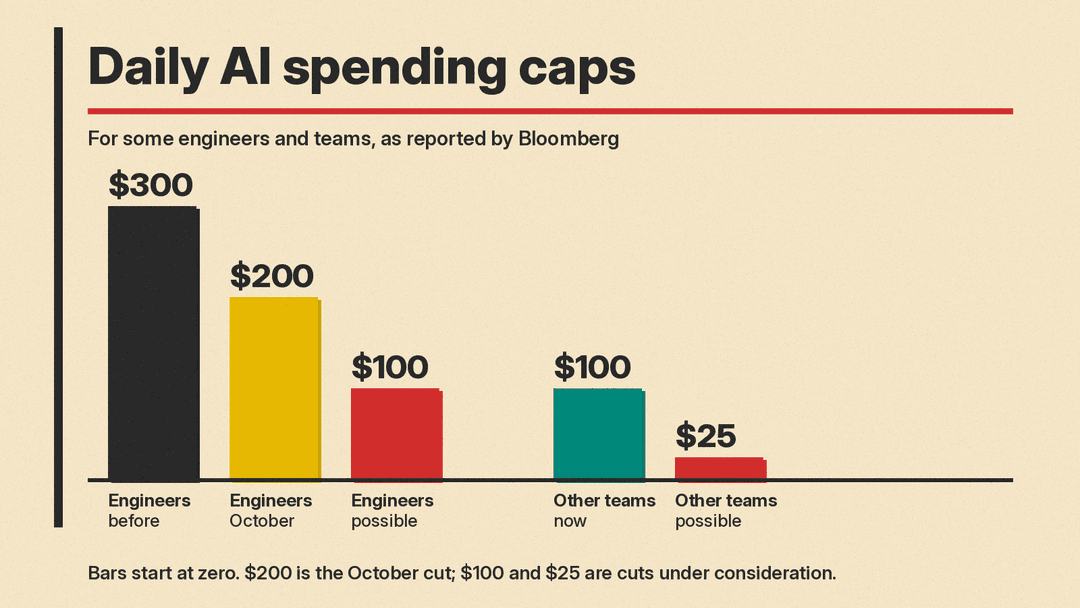
- In October, Apple lowered the daily spending cap for some engineers who use AI models to $200 from $300.
- Apple is planning further cuts for some engineering teams, potentially to as little as $100 a day.
- Many groups outside engineering already have a $100 daily cap. Some of those teams could see it fall to as little as $25.
- Employees who need a higher allowance can ask senior leadership for an exemption.
- Some teams are being asked to use less expensive models or to switch to AI models that run on the device.
The budgets cover tokens, the small units of text and other data that AI models process. Investing.com notes that AI providers typically charge by token volume, that more advanced models generally cost more, and that tasks like writing and debugging code can use a lot of tokens. MacRumors reports that engineers have the largest budgets for that reason.
Apple employees have access to several outside models. MacRumors says Apple lets employees use Claude, ChatGPT, Gemini and other models, and Investing.com lists Anthropic's Claude, OpenAI's ChatGPT and Google's Gemini.
Mixed reaction inside Apple
According to Investing.com's summary, reactions inside the company have been mixed. Some employees told Bloomberg that few workers were using their full $300 daily allowance, which Investing.com says made the previous limits unnecessarily generous. Others read the cuts as a sign of broader cost cutting, which adds to concern about possible layoffs.
Both summaries also mention outside consultants. Investing.com says some Apple divisions have hired consultants to evaluate efficiency and operations, and MacRumors says the productivity reviews, combined with the AI cost cuts, have fueled worries about possible restructuring.
The savings may be small. In MacRumors' words, "Some Apple employees told Bloomberg that few were using their full $300 daily limit, so the savings may be small." Investing.com says the actual savings "remain unclear."
The leadership backdrop
Bloomberg has reported that Apple chief executive John Ternus wants the company to run faster and leaner, with fewer management layers, according to Investing.com. MacRumors adds that Ternus took over on September 1 and reportedly wants to reduce corporate hierarchy and bloat so the company can do more with fewer people.
The budget cut also sits alongside rising spending on the technology. Apple's annual report for fiscal 2026, filed with the SEC, shows research and development expense of $45,765 million, up 32%. Apple attributes the increase mainly to "higher infrastructure-related costs, including investments in artificial intelligence, and headcount-related expenses." Total operating expenses were $75,539 million, up 22%.
The same filing says Apple's AI offerings depend on access to enough compute capacity, and that demand for cloud compute and AI infrastructure "has increased substantially across the technology industry, resulting in constrained supply, extended lead times, and increasing costs." Our earlier post on how AI data centers pushed flash prices up and squeezed Apple covers one related cost line, memory.
Another company limiting AI tools
Reuters' write-up places the Apple report next to another recent one. It says Bloomberg recently reported that Goldman Sachs restricted access to some AI coding tools after a review of productivity and risk management. Bloomberg reported that the bank now limits Anthropic's Claude Code and Microsoft's GitHub tools to engineers, according to Quartz's summary.
The two cases differ. Goldman's restriction concerns who may use certain coding tools, and the bank's stated reasons were productivity and risk management. Apple's change, as reported, concerns how much an employee may spend per day, and Bloomberg ties it to a cost-cutting effort. Goldman spokesperson Nick Carcaterra told Bloomberg: "We make certain AI tools available to our people to determine the best use cases across different parts of the firm." Reuters says the Apple move "reflects a broader trend among technology companies scrutinizing AI-related expenses after initially encouraging widespread adoption." Reuters gives that framing without attributing it to Bloomberg.
What is still unknown
Apple has not confirmed the figures in the reports we found, and Bloomberg's account rests on unnamed sources. Several details are not public:
- How many engineers and teams the lower caps apply to.
- Whether the planned $100 and $25 limits will take effect, and when.
- How much Apple spends on employee AI tokens in total, and how much the cuts would save.
- Which exemptions leadership will grant.
Bloomberg's account says some teams are being pointed to on-device AI models. For background on running models on local hardware, see our guide to how much memory you need to run an AI model locally.
Sources
- Bloomberg: Apple Cuts Internal AI Usage Budgets in Move to Reduce Spending
- MacRumors: Apple is Putting Employees on an AI Budget
- Investing.com: Apple reportedly lowers daily AI spending limits for engineers
- Reuters via Investing.com: Apple cuts employee AI budgets in cost-control push
- Techmeme: summary of the Bloomberg report
- Apple Form 10-K for fiscal 2026 (SEC)
- Quartz: Goldman Sachs limits AI coding tools for traders and bankers
