
Apple's redesigned Health app is back. It returned on November 3 in the iOS 27.3 developer beta, three weeks after Apple pulled it from the iOS 27.2 beta and shipped that update without it. Apple says the new app, built on Apple Intelligence, will roll out to users as a free software update later this year.
Here is what is in it, what you need to use it, and what Apple has not said yet. It is still a beta, so details can change.
What happened
Apple let testers try the redesigned Health app in the iOS 27.2 beta in September, after previewing it at its iPhone event. MacRumors' hands-on from September 16 said it would not be part of the iOS 27.2 release and would launch later in the year. The Apple Post reported on October 13 that Apple had removed it from beta 4, and AppleInsider confirmed that iOS 27.2 went public on October 26 without it. Most of what iOS 27.2 did add is covered in our Siri AI explainer.
On November 3, Apple published a Newsroom update on the redesigned Health app, and the app appeared in iOS 27.3 beta 1. Apple's wording for the public release is "later this year." 9to5Mac says it will ship to all users next month, and MacRumors says that lines up with the expected December release of iOS 27.3. Those dates are the press's reading, not an Apple promise.
What is new in the app
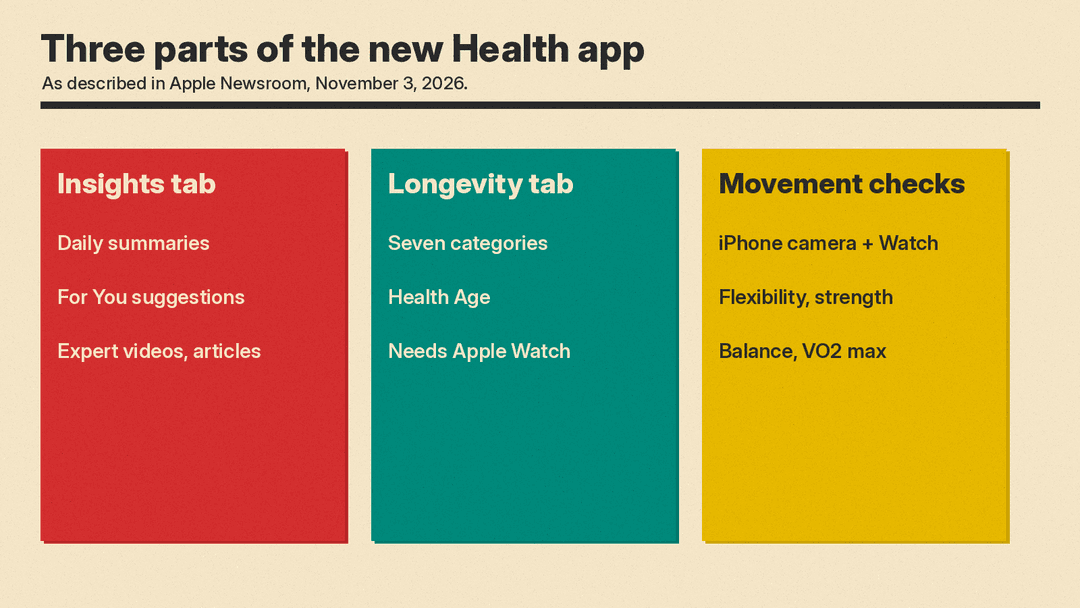
Apple describes three main pieces.
- An Insights tab. It shows summaries across heart, sleep, readiness, fitness, vitals and cycle tracking through the day. A "For You" section gives recommendations based on your habits. Apple's example is advice on adjusting a wind-down routine after several nights of interrupted sleep. The app also pairs your data with videos and articles from Health app clinical experts.
- A Longevity tab. It looks at long-term trends across heart health, sleep, mental wellbeing, movement, metabolic health, hearing and nutrition. Its main feature is Health Age, which turns Apple Watch data into a measure of how your body is tracking against your actual age. Apple says the inputs include VO2 max, resting heart rate, sleep and heart rate variability.
- At-home movement checks. Using an iPhone camera and an Apple Watch, you can measure flexibility, strength, balance, movement mechanics and VO2 max, with live audio and visual feedback.
MacRumors adds details from the beta. Apple Intelligence uses the data in the Insights tab to offer Personal Guidance, with suggestions based on your goals and the kinds of activities you do. Owners of the Apple Watch Series 12 and Apple Watch Ultra 4 also get a readiness score, meant to help you decide whether to push harder, take a recovery day or work out as usual. The Vitals section has overnight and daytime views, and heart rate variability now appears as both an overall number and a recovery number.
Where the AI is, and what Apple has not said
Apple says the app is "built with Apple Intelligence at its core." It does not say which models write the guidance or where they run. The camera-based movement checks are different: Apple says they use on-device vision models developed with clinical experts, and that "no video is ever recorded, stored, or shared."
The Newsroom post gives no accuracy figures for Health Age and does not describe it as a diagnosis. Treat it as a way to watch a trend in your own numbers, not as a medical result. Apple says the app is built to "securely and privately protect a user's data at every step," but it does not spell out what leaves the phone when the guidance features run. That is worth checking when the app reaches the public.
What you need
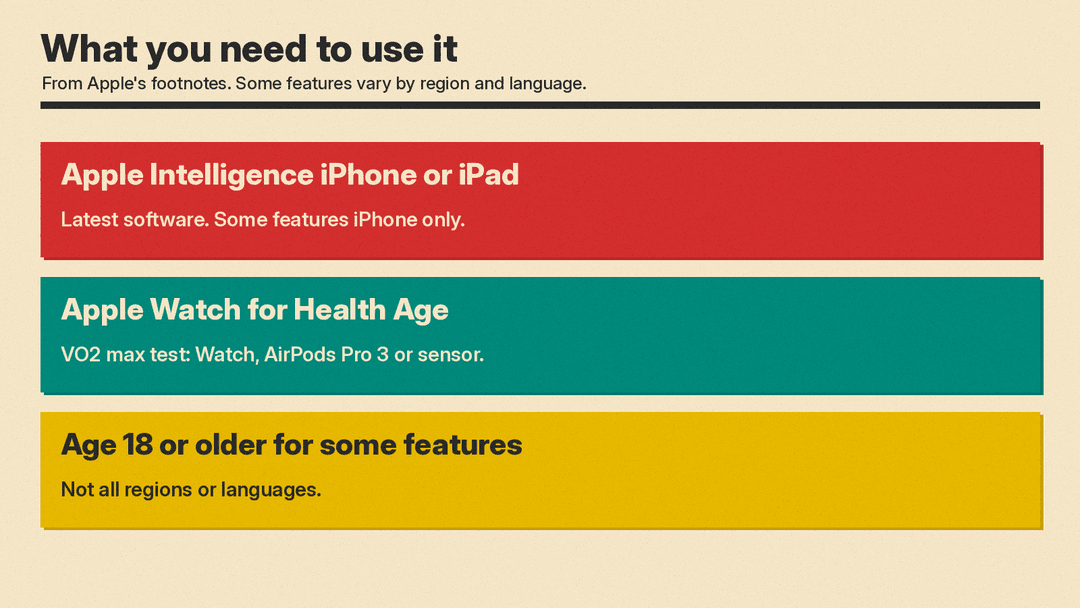
The requirements are the main catch. Apple's footnotes say the redesigned app is for Apple Intelligence-enabled iPhone and iPad models running the latest software, with some features only on iPhone. Health Age needs an Apple Watch. The VO2 max test needs an Apple Watch, AirPods Pro 3 or a third-party heart rate sensor. Some features require users to be 18 or older, and some may not be available in every region or language. Our Apple Intelligence guide lists which iPhones, iPads and Apple Watches qualify.
Language support is wider than before: global English, Chinese (Simplified and Traditional), French, Japanese, Korean, Norwegian, Portuguese, Spanish, Turkish and Vietnamese.
Lab results and cost
The Longevity tab can also use clinical lab data. Apple says you can add results such as A1c and LDL cholesterol. MacRumors reports that Apple will offer a $119 laboratory panel from Quest Diagnostics that contributes to Health Age, and that you can also upload recent results or sync medical records. The $119 price comes from MacRumors alone; Apple's Newsroom post does not mention it.
The app itself is described as a free software update. The same footnotes say some Apple Intelligence features that use server-side models have daily usage limits, with expanded access offered for a fee in the future. Apple does not say whether any Health feature falls under those limits.
Why it matters
AI health coaching is already common on wearables. Oura's support page says Oura Advisor began gradually rolling out personalized plans on November 3, each lasting up to seven days, and WHOOP offers AI coaching built on its Sleep, Strain and Recovery data. Apple's version puts a daily summary and a long-term view into the Health app on iPhone, plus a readiness score for owners of the Apple Watch Series 12 and Ultra 4, though the best parts depend on owning an Apple Watch. For how AI is used in clinical settings, see our list of 12 real uses of AI in healthcare.
What to do now
If you are not on the developer beta, you do not need to do anything. Apple says it will roll out later this year, and 9to5Mac ties it to the public iOS 27.3 release. If you want it, check that your iPhone supports Apple Intelligence, that your language is on Apple's list, and whether you own an Apple Watch, since the headline Longevity feature depends on one. If you plan to add lab results, decide first whether you are comfortable putting blood-test data in the Health app.
Sources
- Apple Newsroom: Redesigned Health app expands language support
- MacRumors: iOS 27.3 Beta Brings Back Apple's Redesigned Health App
- 9to5Mac: iOS 27.3 adds all-new Apple Health app
- MacRumors: Hands-On With the Redesigned Health App in the iOS 27.2 Beta
- The Apple Post: Apple removes redesigned Health app from iOS 27.2 beta 4
- AppleInsider: iOS 27.2 is out without the Apple Health revamp
- Oura Advisor support page
- WHOOP: How WHOOP AI guidance works
