
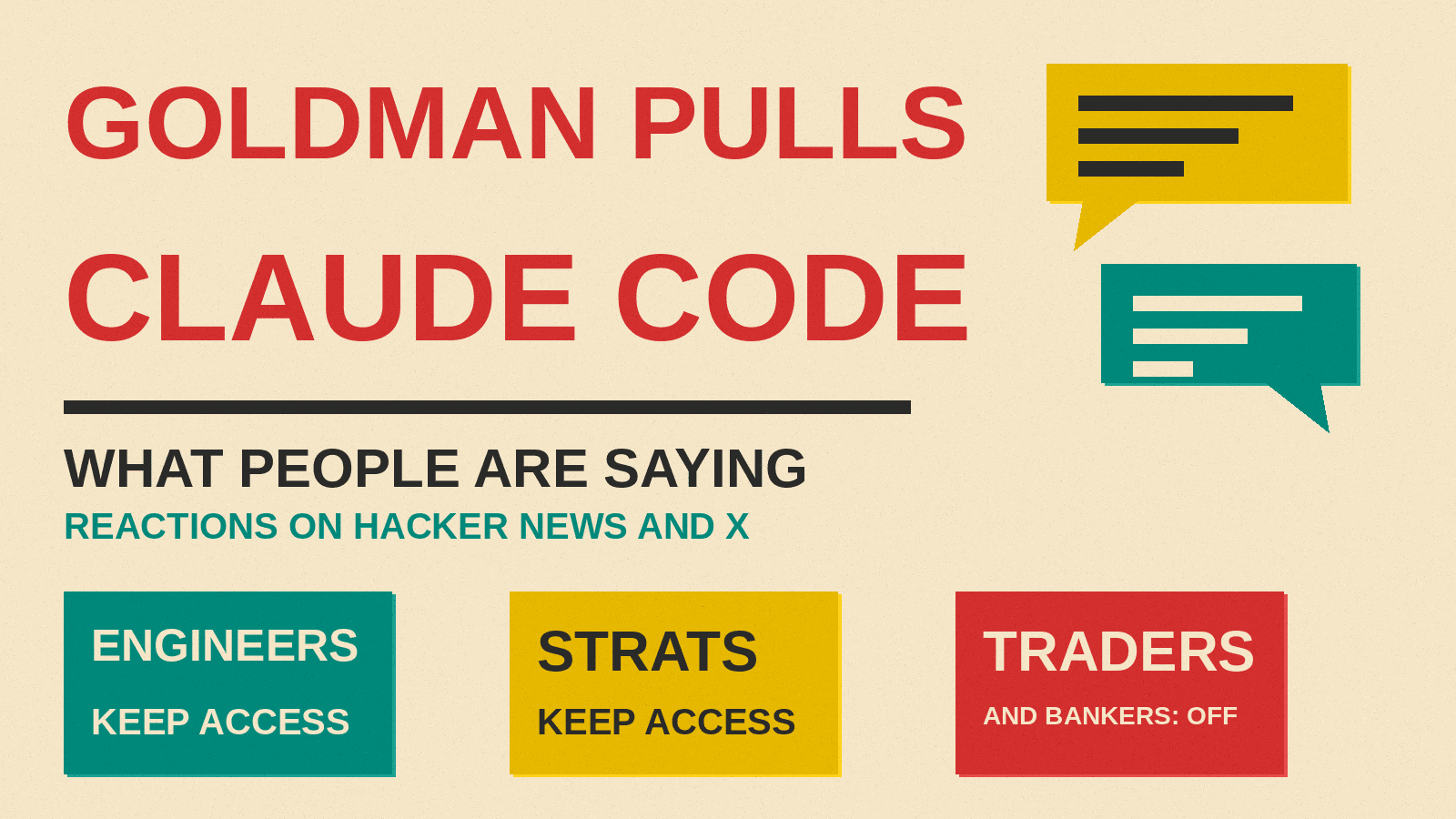
Goldman Sachs has limited Anthropic's Claude Code and Microsoft's GitHub coding tools to its engineers, and the story got a second wind on Sunday. Bloomberg first reported the change on November 2, and Quartz summarized it the same day. On November 8 at about 10:16 AM PT, a Hacker News post linking a State of AI write-up drew a long discussion. By about 11:30 PM PT it had 722 points and 396 comments. This roundup covers what people on Hacker News and X said. Reddit cannot be read from our tools, so it is not included.
What was reported
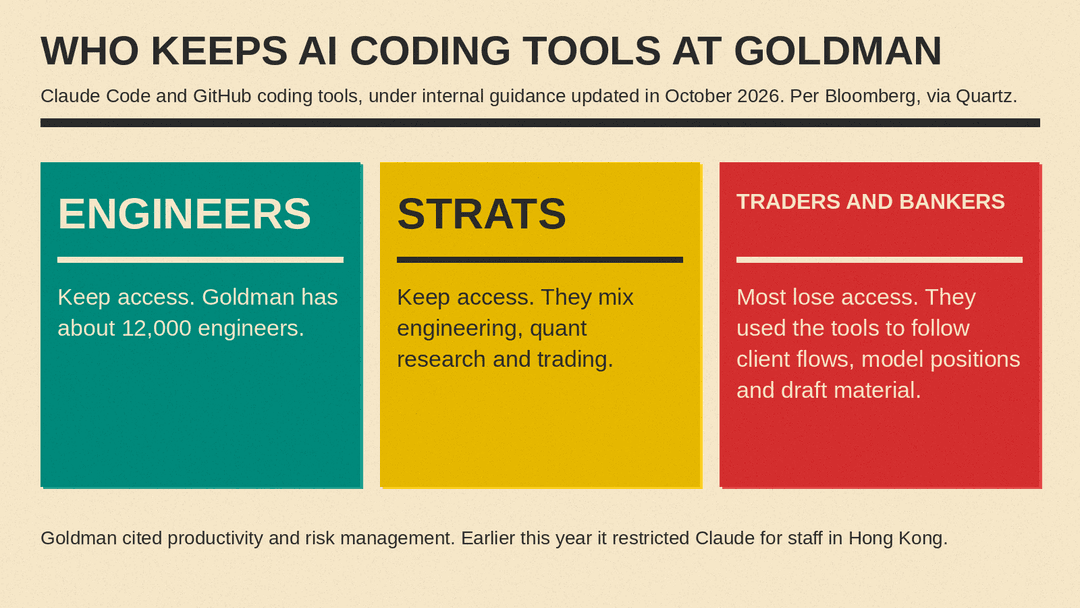
The facts below come from Bloomberg's reporting as summarized by Quartz. Internal guidance updated in October limits Claude Code and GitHub's coding tools to engineers, after a review of "productivity and risk concerns." Bankers had been allowed to use the tools for months. "Strats," who mix software engineering, quantitative research and trading, keep access. Some traders are frustrated: they had used the tools to follow client trading flows, simulate moves in markets and positions, and draft text and visuals.
Goldman spokesperson Nick Carcaterra said: "After a period of experimentation where we assess a variety of factors including productivity and risk management, we put them in the hands of those who are best suited to leverage them for the long term." In July, chief information officer Marco Argenti had praised "vibe coding" by traders and bankers, who built tools and handed them to the bank's roughly 12,000 engineers to polish. Earlier this year Goldman also restricted Claude for staff in Hong Kong.
Hacker News: security first
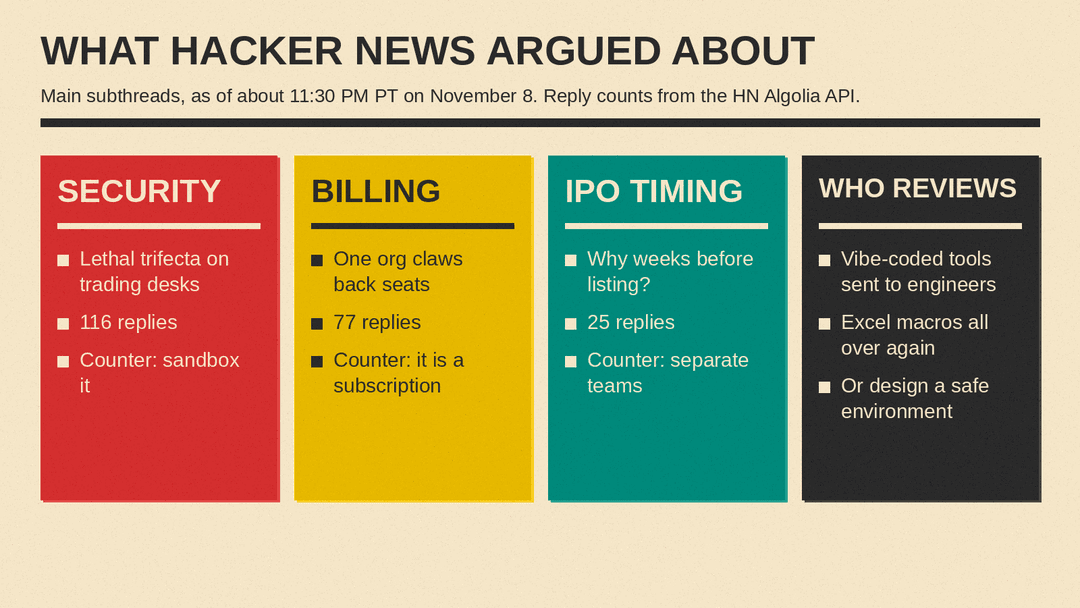
The largest subthread starts with lukebuehler, whose comment had 116 replies under it when we counted. They argued that agents on finance workstations run "directly into the lethal trifecta," meaning an agent that can read private data, see untrusted content and send data out. "You cannot have semi-unattended agents running on the same workstations that have access to client/trade/prop information and email client, and internet, and internal networks, it's too dangerous," they wrote. pelican0 replied with a link to Simon Willison's post that coined the term.
Not everyone bought the security reading. jeremyjh replied that "That sort of risk could be controlled," since Goldman controls its desktops and could sandbox the tool or host it remotely. They thought the bigger worry is "financial risk due to bad trades based on misinformation from buggy code that the authors don't understand." fancyfredbot went further in a separate comment, arguing it is "much more likely there was an operational loss," because only traders can send orders and book trades. That is a guess, and nothing in the reporting mentions a loss.
Billing and cost
The second largest subthread, with 77 replies, came from legitster, who said their own employer has been "clawing back Claude access because of chronic billing overages" and that Gemini is "swooping in" there because it offers flat billing and throttles overages. That is one company's account, not Goldman's. Replies pushed back: ipdashc wrote that "The $20/mo plan pretty much works fine for most people at my company," and cr125rider noted that "Claude code is primarily a subscription." Goldman itself named productivity and risk, not cost.
The IPO timing
Goldman is a lead underwriter on Anthropic's planned listing, according to the State of AI article. cactca called the timing "the most interesting part" and asked why Goldman would act a few weeks before trading starts. Two replies disagreed with the premise. pdpi said that in a well-run firm those decisions are made by groups that "do not (and should not) report to each other," and lg5689 wrote that if a security risk was found, "it'd be completely inappropriate to wait a few weeks."
Engineers, vibe-coded tools, and who reviews them
Engineers who maintain business-built tools had views too. cloudednine, quoting Argenti's line about engineers improving the tools, wrote: "I feel 'improved' is doing some heavy lifting here." steveBK123 called non-technical staff pushing prototypes onto engineering "a timeless story," and listed the concerns banks have: entitlements, data licensing, auditable approval chains and financial risk. microflash compared the new tools to the "thousands of Excels with obscure macros" that already run many businesses.
Others took the traders' side. Ericson2314 wrote that they have "a lot more sympathy for non-technical users writing slop than engineers," and suggested the engineering team design a safe programming environment for bankers instead. cco argued the change may not mean much, since "Claude Code is a poor fit for non-engineers" and the Claude app can already build shareable artifacts.
A few comments questioned the source. MallocVoidstar pointed readers to Bloomberg as the original reporting and was skeptical of the State of AI site. The facts in this post come from the Bloomberg reporting as Quartz summarized it.
X: sandboxes, not bans
On X, the most-liked post in our searches came from Amjad Masad (@amasad), whose bio lists him as CEO of Replit, on the evening of November 2 PT. He wrote that "AI agents running on employee endpoints are becoming a systemic security risk for enterprises & governments," cited the Goldman report, and quoted an article posted by @lhchavez titled "Security advisory: Make managed cloud environments the default for AI agents," introducing it with "In this security advisory, we outline the risks and recommend a path forward." Replit sells cloud coding environments, so the advice also points toward its own kind of product. By about 11:30 PM PT on November 8 Masad's post showed 540 likes, 247 replies and about 75,000 views.
@HochstatMichael wrote a long post on November 2 that showed 478 likes and about 146,000 views by about 11:30 PM PT on November 8. It read the move as a line between experimentation and production, and ended with: "The AI revolution isn't being stopped. It's being given a risk committee, an approval process, and restricted access." @BenjieMalinao said he would rather "make the engineer review part of the deploy," warning that "banning it just pushes it onto personal laptops."
Smaller accounts went for the irony. @gweeyc replied to another post that Goldman is the first bank named on Anthropic's IPO filing, and added: "the chainsaw shop took the chainsaws off the cashiers." @NickBandy8020 set the July praise next to the new rule and concluded: "So the bankers were the experiment."
Why it matters
The reaction splits along one question: is the problem the tool, or where it runs? Security-minded commenters say a coding agent on a trader's desktop has too much access. Others say the fix is a sandbox, a hosted environment or a required engineer review, not a ban. Goldman's own statement points to fit: the tools go to people "best suited to leverage them." For any company handing agents to non-engineers, the thread is a useful list of the risks to settle first.
Sources
- Quartz: Goldman Sachs is restricting traders and bankers from using AI coding tools
- State of AI: Goldman Sachs Is Pulling Claude Code From Its Bankers and Traders
- Hacker News thread
- Simon Willison: The lethal trifecta
- Amjad Masad on X
- Luis Héctor Chávez on X: security advisory
- @HochstatMichael on X
- @BenjieMalinao on X
- @gweeyc on X
- @NickBandy8020 on X
