
Market research used to mean a consultant, a survey budget, or a long weekend of reading. AI research tools now do a big part of the desk work in minutes: they read public pages, pull out what competitors sell, and draft a report with links. That can save a small business time on the desk part of market research. It does not make it automatic. The useful skill is knowing which questions an AI tool can answer from public sources, and which ones only your real customers can answer.
This guide walks through a five-step workflow a small team can run with tools it may already have, such as ChatGPT deep research or Gemini Deep Research, plus free public data. It also covers where AI goes wrong, so you can check its work before you bet money on it.
If you are still choosing which AI apps to pay for, our guide to the best AI tools for small business owners compares six of them.
Start with the questions, not the tool
The U.S. Small Business Administration's market research and competitive analysis guide is a good checklist to hand an AI tool, because it says what market research is for. The SBA lists six questions to answer about your market:
- Demand: is there a desire for your product or service?
- Market size: how many people would be interested in your offering?
- Economic indicators: what is the income range and employment rate?
- Location: where do your customers live, and where can your business reach?
- Market saturation: how many similar options are already available?
- Pricing: what do potential customers pay for these alternatives?
For competitors, the SBA suggests you assess market share, strengths and weaknesses, your window of opportunity to enter the market, how important your target market is to competitors, barriers to entry, and indirect or secondary competitors.
Write the questions that matter for your business into a short brief before you open any AI tool. A vague prompt ("research the coffee market") gets a vague report. A brief with your location, your product, your customer, and these questions gets something you can act on.
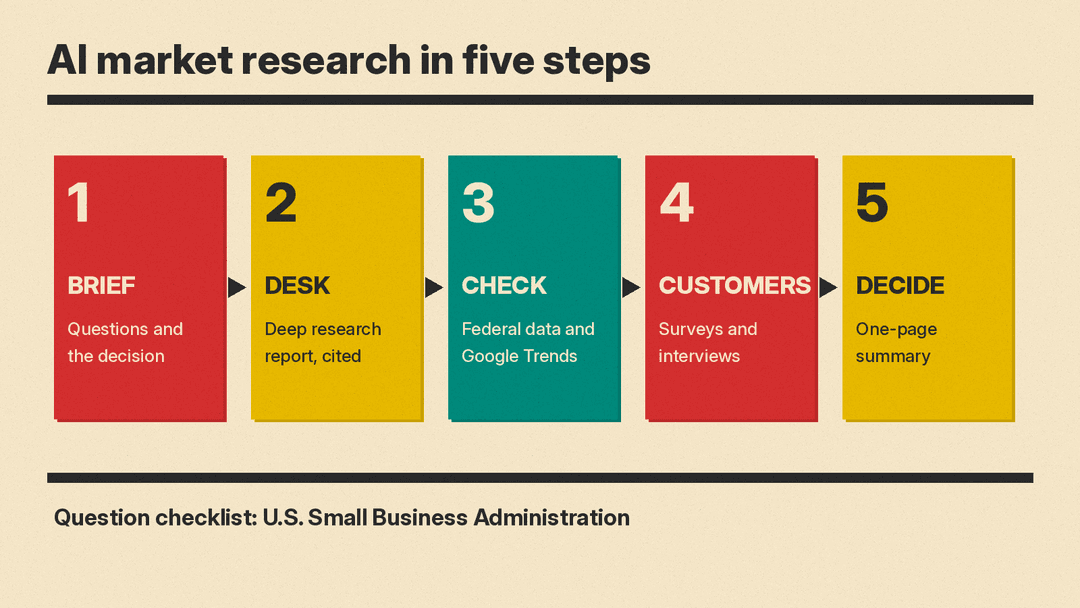
Step 1: Write a one-page research brief
Your brief should say what you sell, who you think buys it, where you operate, and what decision the research should support. Examples of decisions: whether to open a second location, what to charge for a new service tier, or which customer segment to target first.
Then list the SBA questions that apply, plus your own. Add the competitors you already know about. A good closing line for the brief is "Cite a source for every number, and say when you could not find one." That one sentence makes the report much easier to check later.
Step 2: Run desk research with a deep research tool
ChatGPT and Gemini both offer a research mode that works through many web pages and writes a cited report.
OpenAI describes deep research in ChatGPT as an agent that "conducts multi-step research on the internet for complex tasks." OpenAI's help center says you pick Deep research from the tools menu (+) in the ChatGPT prompt window, describe the outcome you need, and can add files or choose specific websites. ChatGPT then proposes a research plan that you can review and edit before the research begins, and the result is a report with citations or source links. OpenAI's launch post gives "a competitive analysis on streaming platforms" as an example request and says a run may take 5 to 30 minutes. A February 10, 2026 update to that post added the option to restrict web searches to trusted sites and to connect deep research to apps.
Google's Gemini Deep Research works in a similar way. Google says it turns your prompt into a multi-point research plan that you can review and refine before it starts, then browses up to hundreds of websites and writes a multi-page report. If you choose, it can also draw on your Gmail, Drive and Chat. Google lists "competitive analysis" and "due diligence" on a sales lead among its example uses, and says Deep Research is available to Google Workspace users.
Practical tips for this step:
- Paste your brief as the prompt. Ask for a competitor table with product lines, stated prices, locations and customer reviews, each with a link.
- Read the research plan before the research begins. ChatGPT and Gemini both let you edit it. Remove items you do not need and add any competitor it missed.
- Attach your own material where it helps: a past customer survey, your price list, or notes from sales calls. Only attach files you are allowed to share with the tool under your plan and your company's rules.
- Ask for a separate section called "Open questions" for anything the tool could not confirm.
Step 3: Check the numbers against free public data
AI research reports are a starting point, not a source. OpenAI's own launch post says deep research "can sometimes hallucinate facts in responses or make incorrect inferences, though at a notably lower rate than existing ChatGPT models, according to internal evaluations." The post adds that deep research may struggle to tell authoritative information from rumors and often fails to convey uncertainty accurately. Google's Gemini page carries the footer note "Check responses."
For more on why AI tools state wrong facts with confidence, and how to catch them, see our AI hallucinations explainer.
So check every number that will drive a decision. The SBA points small businesses to free federal data for this, including the U.S. Census Bureau and its Census Business Builder for business and market data, the Bureau of Labor Statistics for demographics and employment, and the Consumer Price Index and Bureau of Economic Analysis for economic indicators. Open the link the AI cited, find the number on the page, and confirm it is current and about the right place.
For demand, Google Trends is a free way to see relative search interest in a topic over time and by region. Read it with care. Google says Trends data is a sample of searches, normalized and scaled from 0 to 100, so it shows relative interest, not search volume. Terms with low volume show as 0. Google also adds statistical noise for privacy, which can cause one-off spikes on low-interest queries. And Google says plainly that Trends "is not a scientific poll" and should be "one data point among others."
A good habit: if the AI report says demand is growing, check whether Google Trends for your region agrees, and note it if it does not.
Step 4: Ask real customers what AI cannot know
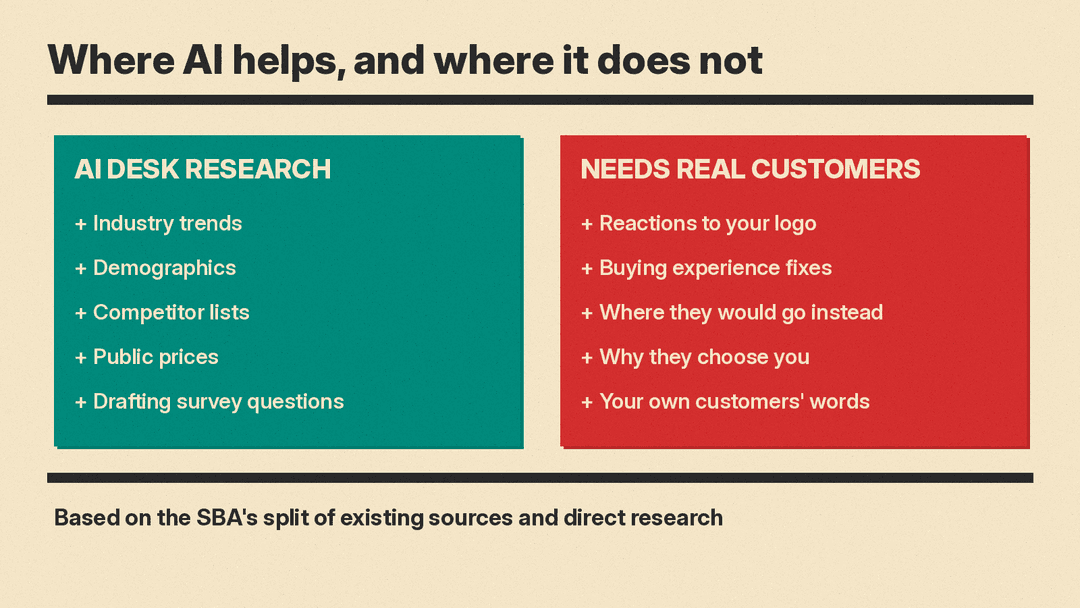
The SBA splits market research into two kinds. Existing sources save time, though the SBA notes the information may not be as specific to your audience as you would like. They are good for "general and quantifiable" questions such as industry trends, demographics and household incomes. Direct research with consumers can be time consuming and expensive, but it answers questions about your specific business: reactions to your logo, how to improve the buying experience, and where customers might go instead. The SBA lists surveys, questionnaires, focus groups and in-depth interviews as methods.
AI is strong at the first kind and weak at the second. A deep research report can list the bakeries within five miles. It cannot tell you why your regulars pick you over the one next door.
AI still helps with direct research. Use it to draft survey questions, write a short interview guide, and summarize the answers you collect. Keep a person reading the raw replies, because a summary can drop the one comment that changes your plan.
For ready-to-edit prompts for other weekly jobs, such as review replies and product descriptions, see our ChatGPT prompts for small business.
What about AI "synthetic" customers?
One idea that comes up is to use a language model as a stand-in for survey respondents. There is real research behind it. In the 2022 paper Out of One, Many, researchers at Brigham Young University conditioned GPT-3 on thousands of demographic backstories from real U.S. survey participants and found that the "silicon samples" closely matched human response patterns on U.S. political questions. The one exception the authors report is vote choice for pure independents, where the estimates did not match well.
Read the scope carefully. The study covered U.S. politics and public opinion, and the authors describe uses for silicon samples only after a model's "algorithmic fidelity" is established for a given topic or domain. Their examples include piloting question wording and drawing up analysis plans before collecting any data from human participants. For a small business, that means synthetic respondents can help you test a survey draft, but they are not your customers.
Step 5: Turn the findings into a decision
End with a one-page summary that answers the question in your brief. A simple structure:
- The decision and your recommendation.
- Three to five findings, each with a checked source.
- What real customers said, with a few direct quotes.
- Risks and open questions the research could not settle.
- What you will measure after you act, so you know if you were right.
You can ask the AI tool to draft this from your notes, then edit it yourself. The person who signs off on the decision should have read the sources behind the key numbers.
Common mistakes to avoid
- Treating the report as fact. Every number that matters needs a source you opened yourself.
- Asking without a brief. Broad prompts produce broad, generic reports.
- Reading Google Trends as volume. It shows relative interest on a 0 to 100 scale, and low-volume terms show as 0.
- Skipping real customers. Public data cannot tell you why people choose you.
- Sharing private files carelessly. Check what your plan and your company allow before you upload customer data.
The bottom line
AI research tools cut the slow part of market research, reading and organizing public information, from hours to minutes. The SBA's questions give you the structure, free federal data and Google Trends give you a way to check the numbers, and a handful of real customer conversations give you what no model can supply. Used in that order, AI can speed up a small team's research while a person still checks what it finds.
Sources
- U.S. Small Business Administration: Plan your business (Market research and competitive analysis)
- OpenAI: Introducing deep research
- OpenAI Help Center: Deep research in ChatGPT
- Google: Gemini Deep Research
- Google Trends Help: FAQ about Google Trends data
- Argyle et al., Out of One, Many: Using Language Models to Simulate Human Samples (arXiv)
