
Many prompt engineering courses say "free" on the first screen. Fewer say what you get at the end, and the answer differs a lot: a completion badge, a digital credential, a pass mark on a profile, a paid certificate, or nothing at all. This page lists courses from eight providers and, for each one, says what the provider's own page states about cost, time, prerequisites and credentials.
We read every page in November 2026, so all prices and terms here are as of November 2026. Where a page states something, we use its wording. Where we draw a conclusion of our own, we mark it as "our reading." Courses change often, so check the provider's page before you enroll. If you are new to the subject, start with our plain explanation of prompt engineering. For courses on how the models work, see our list of free LLM courses.
Words to know before you compare
Providers use different nouns for the thing you get at the end, and the noun matters.
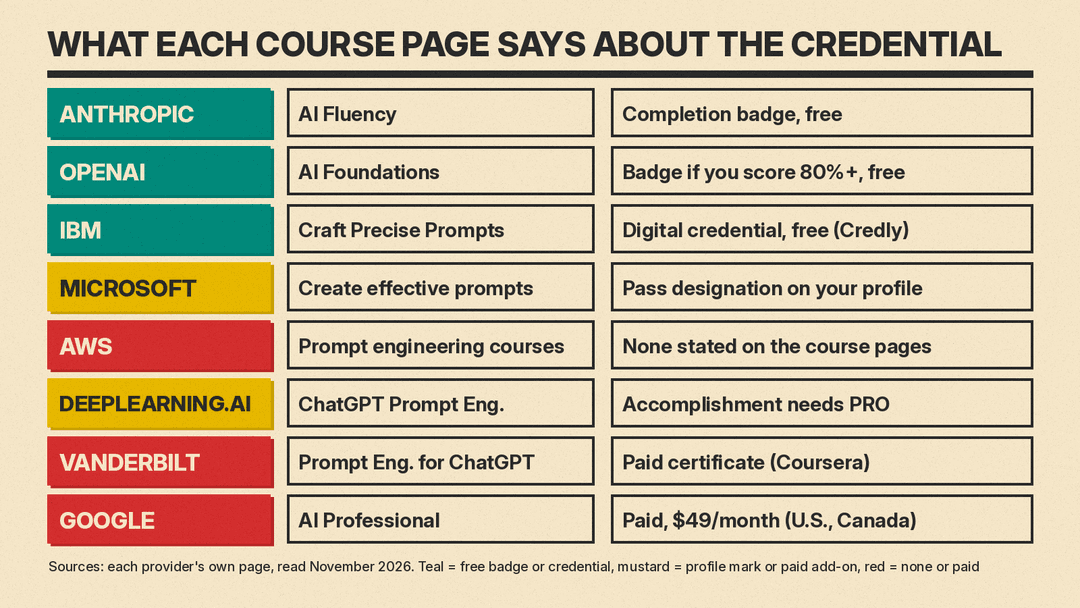
- Completion badge (Anthropic): a digital badge for passing a course's quizzes.
- Badge and certificate of completion (OpenAI): a badge per course, and a separate certificate when you finish a whole pathway.
- Digital credential (IBM): a badge issued through Credly.
- Pass designation and achievement (Microsoft): a mark on your Microsoft Learn profile.
- Certificate (Coursera and Google): a paid certificate on these pages.
OpenAI's help page makes a point worth keeping in mind for all of them. It says its badges and certificates of completion "are not certifications and do not guarantee eligibility for a future certification." Our reading: the same caution applies to every free credential on this list. They show that you finished a course, not that you passed a proctored exam.
Anthropic Claude Academy: AI Fluency: Framework and foundations
Anthropic's courses have moved. The Claude Academy FAQ says the old course site, anthropic.skilljar.com, "closes in early December," and that after that you will not be able to sign in or download certificates there. Certificates from the old site carry over to Claude Academy as completion badges if you import your history with a Claude account that uses the same email. If you earned a certificate on the old site, save the PDF before December.
On cost, the same FAQ says Claude Academy is free. You can browse without signing in, and signing in with a free Claude account saves your progress and lets you earn completion badges. You do not need a paid plan or a work account.
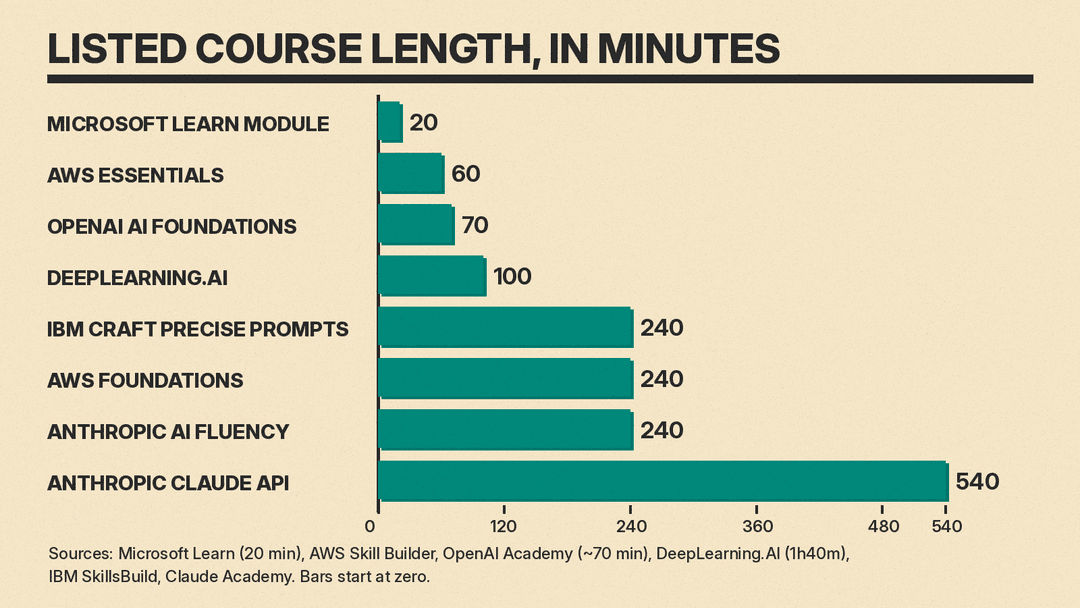
AI Fluency: Framework and foundations is the general course. Its page lists 14 lessons, 1 quiz and 4 hours, plus a completion badge. It teaches a framework with four parts: Delegation, Description, Discernment and Diligence. One lesson is titled "Effective prompting techniques," and one learning goal is to communicate clearly with AI through "foundational prompting techniques." The course was built with professors Rick Dakan of Ringling College of Art and Design and Joseph Feller of University College Cork, and the page says it is released under a CC BY-NC-SA 4.0 license.
How the badge works: the FAQ says badges are earned by passing the course's quizzes, not by finishing the lessons. Retakes are unlimited, and badges do not expire.
Our reading: this course is about working with AI in general, with prompting as one part. If you want a course that is only about prompts, see the developer options in the next section.
Anthropic for developers: Building with the Claude API and the interactive tutorial
Building with the Claude API is a much larger course on the same platform: 67 lessons, 8 quizzes and 9 hours, with a completion badge. One section, "Prompt engineering techniques," has 6 lessons on prompting strategies, evaluation and testing. The page lists three things to have before you start: proficiency in Python programming, basic knowledge of handling JSON data, and access to an Anthropic API key. It is written for software engineers who integrate Claude into applications.
Anthropic also publishes a Prompt Engineering Interactive Tutorial on GitHub. Its README says it has 9 chapters with exercises, plus an appendix on chaining prompts, tool use and search and retrieval. The chapters run from Basic Prompt Structure to Building Complex Prompts, with chapters on Using Examples and Avoiding Hallucinations along the way. There is also a Google Sheets version. The tutorial has no certificate or badge. The README says the tutorial uses Claude 3 Haiku.
OpenAI Academy: AI Foundations
The OpenAI Academy help page says courses are "available globally to anyone with a ChatGPT account," and that "Courses are free and do not require a workspace membership." It lists AI Foundations at 60 to 75 minutes. Its summary is: learn AI basics, write clearer prompts, add useful context, review outputs, and use AI responsibly.
The AI Foundations course page gives about 70 minutes, self-paced, at introduction level. It says no technical background is required. You need a ChatGPT account and a real work task to practice on.
To earn the badge, the course page lists two steps: finish the course, and pass the assessment with a score of at least 80%. Accredible then emails you a link to the digital badge, which you can share on LinkedIn.
There is a second level. The help page says you can earn a certificate of completion by finishing every course in a pathway and passing each assessment at 80% or higher. The Foundations pathway has three courses: AI Foundations, Applied AI Foundations, and Agents and Workflows. The help page lists Applied AI Foundations at 75 to 90 minutes and Agents and Workflows at 75 to 90 minutes.
IBM SkillsBuild: Craft Precise Prompts for AI Models
IBM's digital credentials page lists Craft Precise Prompts for AI Models for all learners, in English, with a duration of 4 hours. The credential text says the earner can write prompts to generate output from AI models such as large language models, and can create prompt templates with variables.
The Credly badge page lists the type as Learning, the level as Intermediate and the cost as Free. Its earning criteria are to complete the module and "Pass the assessments with a score of 80% or higher." It adds that the credential is available to registered users of IBM SkillsBuild.
To claim it, the digital credentials page says you create an account with Credly, complete a SkillsBuild activity that offers a credential, and accept the credential from your Credly dashboard. IBM shares your name, email and the badge earned with Credly to issue it.
Our reading: the focus on prompt templates with variables suits people who reuse the same prompt in a workflow or an app.
Microsoft Learn: Create effective prompts for generative AI training tools
Create effective prompts for generative AI training tools is a beginner module with 7 units. The page says it covers the basic concepts of prompt engineering, the elements of an effective prompt, and best practices in prompting. The roles listed include K-12 Educator, Business User and Higher Education Educator. The page lists 20 minutes.
The credential is a mark on your profile. The module page says: "Sign in and answer all questions correctly to earn a pass designation on your profile."
On cost, the Microsoft Learn FAQ says "Microsoft Learn training is free and available to anyone who has an interest to learn about Microsoft products." The FAQ calls the recognition for one finished module an achievement, and says credentials are different: they represent "a broader scenario-based skill" and are validated by a more robust skill assessment exam. Our reading: a pass on this module is an achievement on your profile, not a Microsoft credential.
AWS Skill Builder: Essentials and Foundations of Prompt Engineering
AWS has two prompt engineering courses, and both pages list "Access: Free."
Essentials of Prompt Engineering is the shorter one: 1 hour, Fundamental level, last updated September 22, 2026. Its objectives include the elements of a prompt, negative prompting, the effect of inference parameters, and zero-shot, few-shot and chain-of-thought prompting. The intended audience is individuals interested in machine learning and AI, independent of a specific job role. The page recommends two courses first: Fundamentals of Machine Learning and Artificial Intelligence, and Exploring Artificial Intelligence Use Cases and Applications.
Foundations of Prompt Engineering is the longer one: 4 hours, Intermediate level, last updated September 2, 2026. It moves from the basics to advanced prompt techniques and covers how to guard against prompt misuse. Its intended audience is prompt engineers, data scientists and developers. The recommended previous knowledge is three one-hour AWS courses: Introduction to Generative AI: Art of the Possible, Planning a Generative AI Project, and Amazon Bedrock Getting Started.
Both pages name Amazon Bedrock as the AWS service involved, and you need to sign up or sign in to enroll. Neither course page mentions a certificate or a badge. Our reading: take these for the content, not for a credential.
If few-shot prompting is new to you, our guide to few-shot prompting shows the technique with examples.
DeepLearning.AI: ChatGPT Prompt Engineering for Developers
ChatGPT Prompt Engineering for Developers is a short course taught by Isa Fulford of OpenAI and Andrew Ng of DeepLearning.AI. The page lists Beginner level, 1 hour 40 minutes, 9 video lessons and 7 code examples. You practice writing and iterating on prompts with the OpenAI API.
The access terms have two parts. The page says course access is free "for a limited time during the DeepLearning.AI learning platform beta". The page also marks the 1 graded assignment as PRO and says "Earn an accomplishment with PRO." Our reading: the lessons are free for now, and the graded work and the accomplishment need the paid PRO plan.
Paid certificate options to know about
Two more courses on this topic have certificates that cost money.
Vanderbilt University on Coursera: Prompt Engineering for ChatGPT. The course page lists Dr. Jules White as instructor, Beginner level, 6 modules, 7 assignments and a shareable certificate. Its schedule estimate is "2 weeks at 10 hours a week." The button says "Enroll for free," but the page's FAQ says that to access course materials and assignments and earn a certificate, "you'll need to purchase the Certificate experience." It adds that eligible learners may start with a free trial, and that some courses offer a Full Course, No Certificate option. The page also says financial aid is available.
Google: AI Professional Certificate. The old Google Prompting Essentials address, grow.google/prompting-essentials, now redirects to the Google AI Professional Certificate page. Its first course, AI Fundamentals, covers how to write prompts that deliver high-quality results. The page's cost answer says: "In the U.S. and Canada, the subscription cost is $49 per month," and that prices may vary in other countries. It says the certificate is available on Coursera, Google Skills and Udemy, and that enrolling includes three months of no-cost access to Google AI Pro.
How to choose
These are our suggestions, based on the pages above.
- You use chatbots at work and want something to show for it. OpenAI's AI Foundations (about 70 minutes, badge at 80%) or Anthropic's AI Fluency (4 hours, completion badge). Both pages say the courses are free; you sign in with a ChatGPT or Claude account.
- You want a credential issued through Credly. IBM's Craft Precise Prompts for AI Models (4 hours, free per its Credly page, 80% on the assessments).
- You want short content and no credential. AWS Essentials of Prompt Engineering (1 hour) or the Microsoft Learn module (20 minutes), which gives a pass designation on your profile.
- You write code. DeepLearning.AI's short course, AWS Foundations of Prompt Engineering, or Anthropic's Claude API course and GitHub tutorial. The Claude API course page asks for Python and an Anthropic API key.
- You need a paid certificate from a university or Google. Vanderbilt on Coursera or the Google AI Professional Certificate, with the costs their pages state.
Our reading: the free courses cover overlapping ground, so one course plus practice on your own tasks may be enough to start.
Before you enroll
- Check the account you sign in with. OpenAI's help page says badges are tied to the email you used for OpenAI Academy or for your ChatGPT account. Claude Academy imports from Skilljar only when the two emails match.
- Read the credential line, not the enroll button. "Enroll for free" on Coursera does not mean the certificate is free.
- Note the date. DeepLearning.AI's free access is "for a limited time," and Anthropic's old Skilljar site closes in early December.
- Keep your proof. Download certificate PDFs and save public badge links when you earn them.
Sources
- Claude Academy FAQ
- Claude Academy: AI Fluency: Framework and foundations
- Claude Academy: Building with the Claude API
- Anthropic Prompt Engineering Interactive Tutorial (GitHub)
- OpenAI Help Center: OpenAI Academy courses
- OpenAI Academy: AI Foundations
- IBM SkillsBuild: Digital credentials
- Credly: Craft Precise Prompts for AI Models
- Microsoft Learn: Create effective prompts for generative AI training tools
- Microsoft Learn FAQ
- AWS Skill Builder: Essentials of Prompt Engineering
- AWS Skill Builder: Foundations of Prompt Engineering
- DeepLearning.AI: ChatGPT Prompt Engineering for Developers
- Coursera: Prompt Engineering for ChatGPT (Vanderbilt University)
- Grow with Google: Google AI Professional Certificate
