
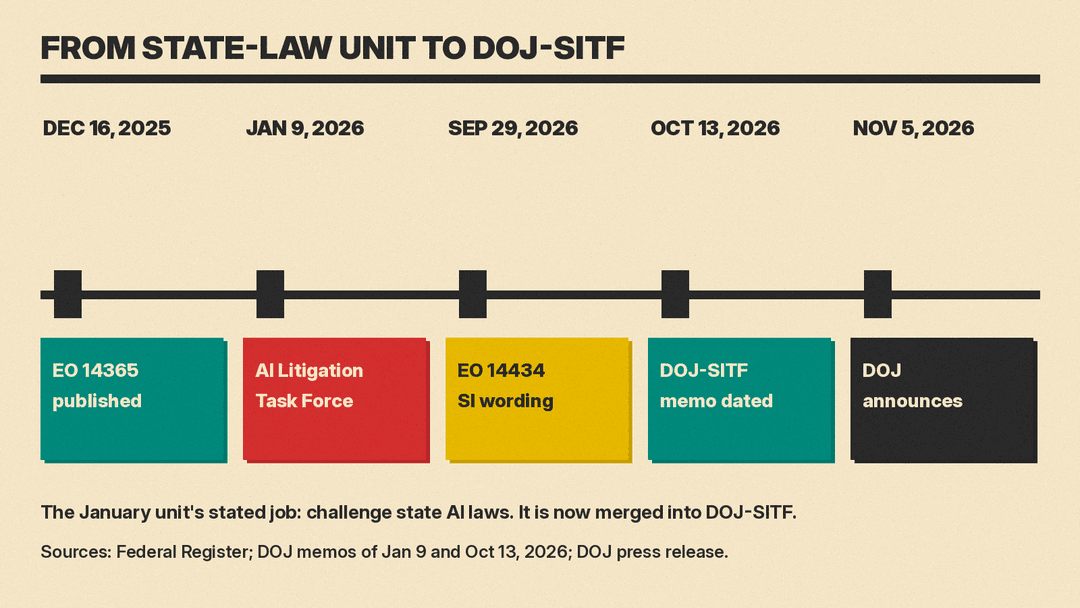
On Thursday, November 5, 2026, the Justice Department announced the Super Intelligence Task Force, or DOJ-SITF. SI stands for super intelligence. A September executive order tells federal agencies to use it in place of AI.
The task force was created by a two-page memorandum dated October 13, 2026. The memo is signed by the Attorney General, a post Todd Blanche has held since August 10, 2026. The memo also folds in the unit set up in January to challenge state AI laws.
What the Super Intelligence Task Force will do
The memo states the mission this way: "The DOJ-SITF will ensure that America's leadership in SI is not compromised by the misuse of SI by foreign state and state-sponsored actors, transnational criminal organizations, and individual or corporate actors engaged in fraud or other unlawful conduct." It adds: "The DOJ-SITF will also take affirmative measures, as appropriate, to promote American SI dominance."
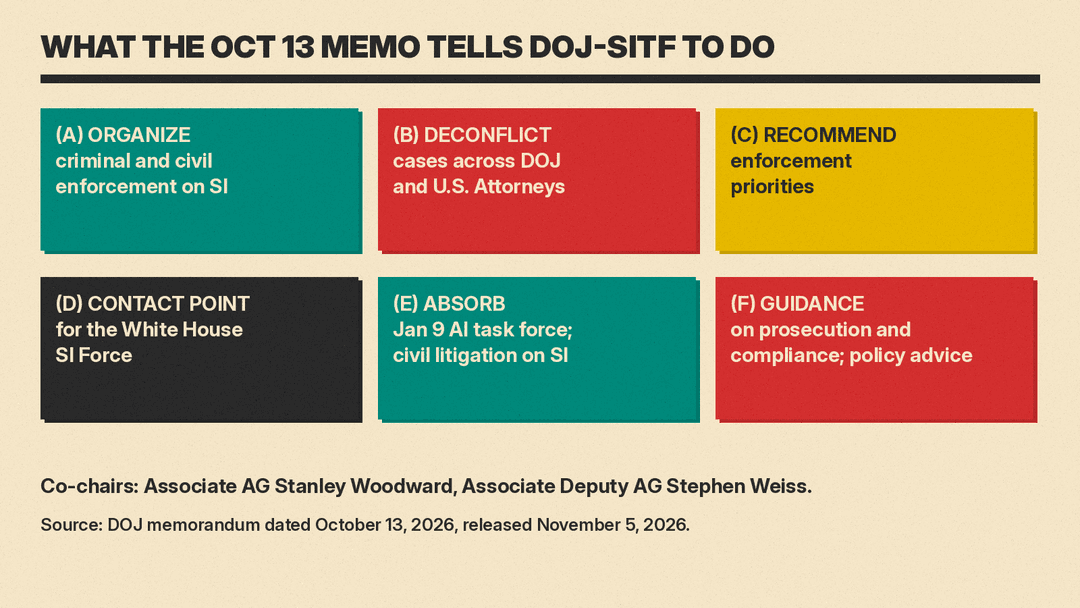
It then lists six functions:
- organizing the department's criminal and civil law enforcement efforts involving SI
- deconflicting investigations, cases and other matters among department components and U.S. Attorneys' Offices
- recommending enforcement priorities to preserve public safety and to prevent the misuse of SI
- serving as the department's principal point of contact with the Super Intelligence Force (SIF) and, as appropriate, other agencies
- incorporating the work of the Artificial Intelligence Task Force announced on January 9, 2026, and coordinating the department's affirmative civil litigation with respect to SI
- developing guidance on prosecuting unlawful SI-related conduct and evaluating compliance measures, and advising, through the Offices of Legal Policy and Legislative Affairs, on legislative or regulatory proposals "that promote SI innovation without burdensome regulation"
Who leads it and who sits on it
The memo names the Attorney General or his designees, Associate Attorney General Stanley Woodward and Associate Deputy Attorney General Stephen Weiss, as co-chairs. The DOJ release says Woodward and Weiss lead the task force. Members come from eight named components: the Antitrust Division, the Attorney General's Advisory Committee, the Civil, Criminal and National Security Divisions, the FBI, the National Fraud Enforcement Division and the Office of the Solicitor General. The Attorney General can add others.
"The SI Task Force at the Department of Justice will facilitate our partnership with SI Force Chair Jay Clayton as we ensure critical SI technologies serve the American people and are not manipulated by bad actors at home or abroad," Blanche said in the release. Nextgov/FCW reported that the SI Force is led by National Intelligence Director Jay Clayton and "coordinates the government's engagement with various organizations and AI companies."
Blanche also said in the release: "The Department of Justice will continue identifying and prosecuting individuals whose use of SI violates the law, including by maliciously targeting American taxpayers, critical U.S. infrastructure, or other aspects of our national security." The same day, federal prosecutors in Manhattan announced charges in an alleged $129 million voice-clone fraud. Neither release links that case to the task force.
"The Department also has a responsibility to utilize law enforcement tools at our disposal to deter improper use of SI, harden regular reporting on SI risk and response, and ensure companies exercise vigorous internal controls so that SI technology behaves as intended," Weiss said in the release.
The state AI law unit it absorbs
A memo footnote says the Artificial Intelligence Task Force announced on January 9, 2026 "shall cease to operate as a separate body and is hereby merged into the DOJ-SITF." Its matters, work product, personnel details and reporting obligations transfer to the new task force.
The January 9 memo from then Attorney General Pam Bondi established "an AI Litigation Task Force (Task Force) whose sole responsibility shall be to challenge State AI laws inconsistent with the policy." It said the Task Force shall challenge such laws "on grounds that such laws unconstitutionally regulate interstate commerce, are preempted by existing Federal regulations, or are otherwise unlawful." It cites Executive Order 14365, "Ensuring a National Policy Framework for Artificial Intelligence," which the Federal Register published on December 16, 2025.
The text of the October 13 memo does not mention state laws. It does give the task force the job of coordinating the department's affirmative civil litigation on SI. It also calls for advice on proposals "that promote SI innovation without burdensome regulation."
What prosecutors must tell the task force
Components and U.S. Attorneys' Offices "should, from time to time at the request of the DOJ-SITF, notify the DOJ-SITF upon seeking to open an investigation and before seeking charges or otherwise finalizing a resolution in matters involving SI."
A footnote says the task force shall develop that notice process, "which should not delay action and not be necessary in exigent circumstances, including imminent threats to public safety or risk of loss of evidence."
What the SI label covers
The memo does not define SI. It cites Executive Order 14434 of September 29, 2026, which defines the term as "the technologies and systems encompassed by the term 'artificial intelligence' as defined in section 9401(3) of title 15, United States Code." Our explainer on the SI wording covers that order.
What is still unknown
The Next Web reported that "The DOJ did not say how many staff the task force will have or what it will cost." The announcement does not include the prosecution and compliance guidance the memo calls for. The memo is dated about three weeks before the public release, and neither document explains the gap.
Separately, AP reported on November 8 that staff at the federal AI testing center were asked to report informally to a White House office.
Sources
- U.S. Department of Justice: Department of Justice Launches Super Intelligence Task Force (Nov. 5, 2026)
- DOJ memorandum establishing DOJ-SITF (dated Oct. 13, 2026)
- DOJ memorandum: Artificial Intelligence Litigation Task Force (Jan. 9, 2026)
- Federal Register: Executive Order 14365, Ensuring a National Policy Framework for Artificial Intelligence
- Federal Register: Executive Order 14434, Inaugurating the Era of Super Intelligence
- Nextgov/FCW: Department of Justice forms AI task force
- The Next Web: US Justice Department sets up an AI task force under its new SI name
