
AI agents are models that call tools, keep memory and work through a task in steps. Books on building them now run from free primers to guides on multi-agent systems in production. This list groups nine of them by where you are, from first concepts to framework-free builds.
Each pick below was checked on the publisher's or author's own page on November 9, 2026: author, publisher, audience, and what the book builds. We left out prices, since publisher pages run frequent discounts. Only one book here is free, and the publisher's page says so in its FAQ.
New to the idea of an agent? Start with our plain-English explainer, What Is an AI Agent?, then come back. Two terms show up in nearly every book below: MCP, the Model Context Protocol, a standard way to connect agents to tools, and RAG, retrieval-augmented generation, which feeds an agent the documents it needs.
Start here: the concepts
1. Principles of Building AI Agents, by Sam Bhagwat (free)
Sam Bhagwat is the CEO of Mastra, a company that makes an agent framework. His book is the one free pick on this list. The book page answers the obvious question in its FAQ: "Principles of Building AI Agents is free. Enter your email to get your copy."
The page, which now carries a 3rd Edition label, says the book "opens with LLM fundamentals and prompt engineering before moving into agents, tool calling, memory, workflows and RAG," and that later chapters cover multi-agent systems, observability and evals, deployment, coding agents and multimodal capabilities. The FAQ also draws a line between the book and the company's docs: the docs cover details specific to the Mastra framework, while "The book explains the underlying patterns and principles."
Who it suits: developers who want a short map of the whole field before they pick a framework.
2. Artificial Intelligence: A Modern Approach, by Stuart Russell and Peter Norvig
This is the long-standing university textbook, and agents sit at its center. In the 4th US edition table of contents, chapter 2 is "Intelligent Agents," chapter 7 is "Logical Agents," chapter 11 covers automated planning and chapter 18 is "Multiagent Decision Making." The book's site calls it "The authoritative, most-used AI textbook, adopted by over 1500 schools."
Its table of contents has no chapter on today's language-model agent frameworks, so it will not teach you an agent SDK. What it gives you is the classic vocabulary: what an agent is, what an environment is, and how planning and search work. Planning, for example, also gets its own chapter in Agentic Design Patterns and a section in AI Engineering, both below.
Who it suits: students and anyone who wants the theory under the buzzword.
Build your first agent
3. Building Applications with AI Agents, by Michael Albada
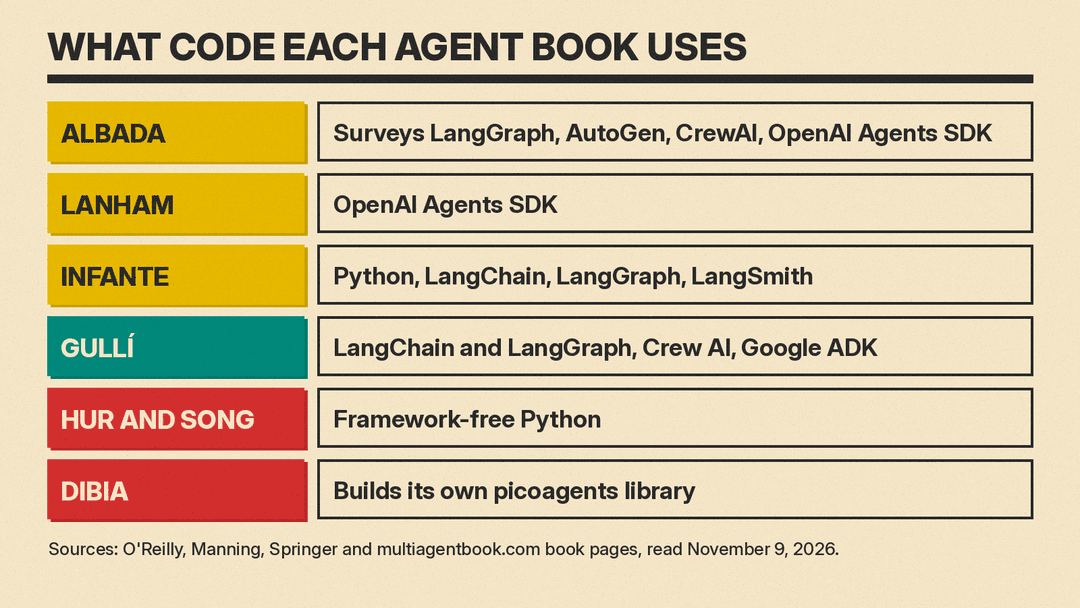
O'Reilly lists this book, published September 2025, as "Beginner to intermediate" on its book page. The table of contents starts with a definition of AI agents and a tour of frameworks (LangGraph, AutoGen, CrewAI and the OpenAI Agents SDK). It then moves on to designing agent systems, user experience design for agents, tool use (including the Model Context Protocol) and orchestration. The publisher says Albada takes "a practical and research-based approach to designing and implementing single- and multiagent systems."
In an O'Reilly interview Albada is described as a machine learning engineer whose employers have included Uber, ServiceNow and Microsoft. He said his target readers are "software engineers who want to increasingly use AI and build increasingly sophisticated systems."
Who it suits: software engineers who want a broad, design-first book, including a full chapter on user experience design for agents.
4. AI Agents in Action, Second Edition, by Micheal Lanham
Manning's book page dates this edition June 2026 (392 pages) and calls it "a substantial revision and update of the first edition." The book is built around five functional layers of an agent: "persona, actions and tools, reasoning and planning, knowledge and memory, and evaluation and feedback." Its practical chapters use typed outputs, tracing, tool use and the OpenAI Agents SDK, and the page singles out its treatment of the Model Context Protocol.
Manning's "about the reader" line: "For intermediate Python programmers. No experience with AI agents and agentic systems required."
Who it suits: Python developers who want one guided project path from a minimal agent to a deployable one.
5. AI Agents and Applications, by Roberto Infante
This Manning title (book page, February 2026, 448 pages) carries the subtitle "With LangChain, LangGraph, and MCP." The page lists prompt and context engineering, advanced RAG, multi-step workflows with LangGraph, tool-based agents, multi-agent systems and MCP integration. For the examples, "the book uses Python, LangChain, LangGraph, and LangSmith," though the publisher says readers will be able to generalize to other frameworks.
Who it suits: developers who already picked the LangChain stack, or whose team uses it.
Go under the hood
6. Build an AI Agent (From Scratch), by Jungjun Hur and Younghee Song
This Manning title, dated July 2026 on its book page (336 pages), skips frameworks entirely. Readers build a research agent in Python aimed at tasks from the GAIA (General AI Assistants) benchmark. The page lists "End-to-end construction of a framework-free, autonomous AI agent in Python," then RAG, long-term memory, MCP, sandboxed code execution, multi-agent orchestration over the A2A protocol, and an LLM-as-a-judge evaluation pipeline.
The book's about page sets the bar: "a grasp of Python basics and some experience calling APIs. A deep background in machine learning or natural-language processing isn't required." The store page aims it at "Python developers with some knowledge of machine learning," so expect some ML vocabulary.
Who it suits: developers who want to know what a framework is doing for them before they trust one.
7. Agentic Design Patterns, by Antonio Gullí
Springer's book page describes 21 agentic patterns, each with runnable code and one pattern per chapter. The chapter list runs from prompt chaining, routing, parallelization and reflection through tool use, planning, multi-agent collaboration, memory management and the Model Context Protocol. The code examples use three frameworks: LangChain with LangGraph, Crew AI, and the Google Agent Developer Kit (ADK). Springer lists the author's affiliation as Google.
The publisher says the chapters build on each other, but you "can also use the book as a handy reference, jumping to patterns that address your specific challenges."
Who it suits: builders who already have one agent running and want names and fixes for the problems they hit next.
Production and multi-agent systems
8. AI Engineering, by Chip Huyen
This is not an agents-only book, but it earns a place for its chapter 6, "RAG and Agents." The O'Reilly table of contents shows that chapter's agent sections: agent overview, tools, planning, agent failure modes and evaluation, and memory. Chapter 10 adds agent patterns to a full application architecture. O'Reilly rates the book, published December 2024, "Intermediate to advanced."
It also appears in our broader list, Best Books to Learn AI. Read it for the parts around the agent: evaluation, prompt defense and cost.
Who it suits: engineers shipping an AI product where the agent is one piece of a larger system.
9. Designing Multi-Agent Systems, by Victor Dibia
Dibia is a Principal Research Software Engineer at Microsoft Research and the creator of AutoGen Studio, according to the book site. The book teaches by building a Python library called picoagents, and the site lists 15 chapters on fundamentals, building from scratch, evaluation and real-world applications. The preview PDF dates the first edition November 2025 and adds a caution: multi-agent systems are "not the right solution for every problem."
The preview's copyright page lists Dibia himself as the publisher, and the book is updated over time. The site says it was "Last updated August 2026," and its changelog notes that chapter 12 was rewritten for the July 2026 MCP specification. Digital editions are sold through the book's own site; the site lists print editions at Amazon, Bookshop and Barnes & Noble.
Who it suits: teams deciding whether they need several agents at all, and how to run them if they do.
How to pick your first book
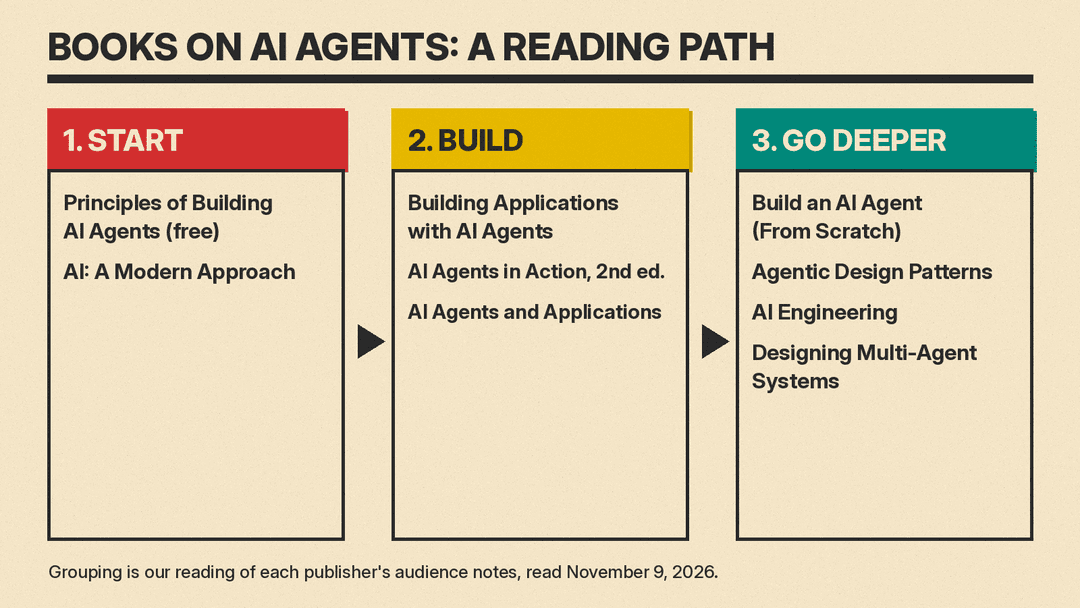
Our reading of the publishers' own audience notes suggests this order:
- You have never built an agent: read the free Principles of Building AI Agents, then Building Applications with AI Agents (rated "Beginner to intermediate" by O'Reilly).
- You write Python and want one guided project: AI Agents in Action, Second Edition, whose page says no agent experience is required.
- Your team uses LangChain: AI Agents and Applications.
- You distrust frameworks: Build an AI Agent (From Scratch), then Designing Multi-Agent Systems, which builds its own small library.
- You keep hitting the same problems: Agentic Design Patterns as a reference.
- You want the theory: Artificial Intelligence: A Modern Approach, chapters 2 and 18.
Agent tooling changes fast. Dibia's changelog notes that the July 2026 MCP specification is wire-incompatible with 2025-era MCP, so any chapter written against the older protocol can go stale. Several books here teach patterns rather than one SDK (Gullí, Hur and Song, Dibia), and two (Bhagwat's and Dibia's) have been updated since first release. Whatever you read, keep the official docs for your framework open alongside it.
Sources
- Mastra: Principles of Building AI Agents
- Artificial Intelligence: A Modern Approach, 4th US ed.
- O'Reilly: Building Applications with AI Agents
- O'Reilly Radar: interview with Michael Albada
- Manning: AI Agents in Action, Second Edition
- Manning: AI Agents and Applications
- Manning: Build an AI Agent (From Scratch)
- Manning liveBook: about Build an AI Agent (From Scratch)
- Springer: Agentic Design Patterns
- O'Reilly: AI Engineering
- Designing Multi-Agent Systems book site
- Designing Multi-Agent Systems preview PDF
