
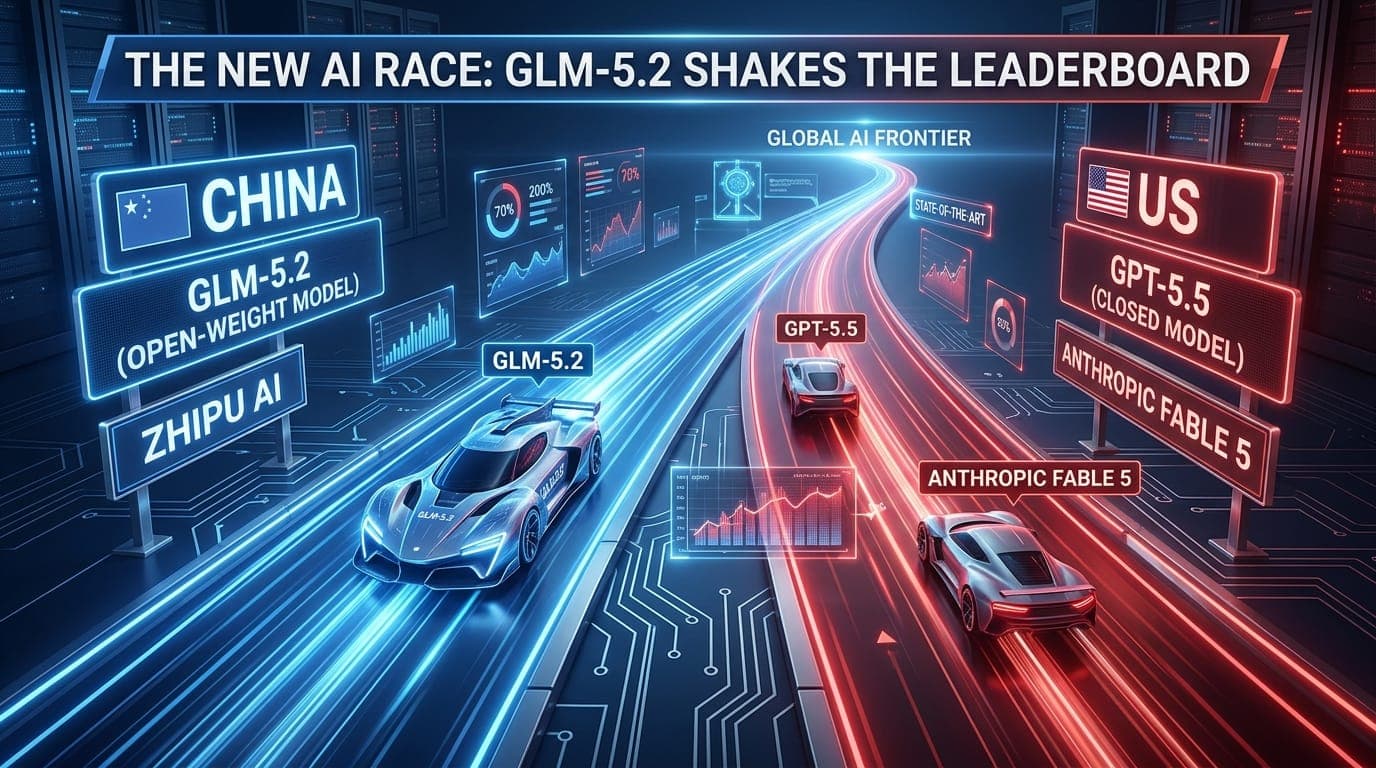
Zhipu AI's open-weight GLM-5.2 model has placed second globally on the Code Arena coding benchmark, trailing only Anthropic's Claude Fable 5 and sitting within one point of Claude Opus 4.8 on the hardest agentic tasks. The result, recorded after the model's June 13 release under an MIT license, signals a fast-closing capability gap between Chinese open-weight systems and the leading U.S. frontier models.
Benchmark Performance
On Code Arena's front-end coding leaderboard, GLM-5.2 places second globally, behind only Anthropic's Claude Fable 5. It trails Claude Opus 4.8 by approximately one point on the most difficult agentic coding tests, while outperforming OpenAI's GPT-5.5 on practical bug-fixing tasks and achieving a near-perfect 99.2% score on a major mathematics benchmark.
The model's architecture—a 744B-parameter mixture-of-experts design built for extended coding runs—launched on June 13 under a permissive MIT license with a 1-million-token context window. Weights are freely downloadable and can be fine-tuned and deployed without regional restrictions.

Market Reaction and Pricing Pressure
Zhipu's Hong Kong-listed shares jumped as much as 42% following the benchmark result, lifting the company's market capitalization past 1 trillion Hong Kong dollars (approximately $128 billion). The stock has climbed more than 800% since its January listing. One major bank raised its target and labeled the stock an AI winner; another initiated coverage with a buy rating.
Subscription access starts near $10 per month—roughly one-tenth the price of comparable Western frontier tiers—and per-token API rates undercut Anthropic's Opus pricing by a similar margin.
Geopolitical Context: Export Controls Reset the Race
The benchmark moment arrives against a shifting policy backdrop. On June 12, the U.S. Commerce Department ordered Anthropic to cut foreign access to its Fable 5 and Mythos 5 models within 48 hours, citing a narrow security concern. Both models went dark worldwide for all customers, foreign and domestic. Zhipu released GLM-5.2 the following day.
Washington's pressure on Chinese AI has been building for months. Lawmakers opened a House inquiry in May into PRC-origin models deployed near critical infrastructure, naming Zhipu among the firms under review. Cloud users also face China's intelligence law, which can compel access to data routed through Chinese services.
Stanford's 2026 AI Index pegged the gap between the best American and Chinese systems at 2.7 percentage points, though the lead remains wider on the toughest reasoning tasks. Zhipu founder Tang Jie publicly disputed Elon Musk's estimate that a Chinese rival to Fable 5 would not arrive until Q1 2027, stating it would come sooner.
Safety and Governance Gap
SaferAI's evaluation of GLM-5.2 via Z.ai's public API found the model refused none of the offensive cyber or biology tasks it was given. By comparison, Claude Opus 4.7 refused so consistently that SaferAI could not complete the CyberGym benchmark on it at all. Z.ai has not published a safety framework, pre-deployment testing commitments, or risk assessment for GLM-5.2.
The safety gap is structural: safeguards applied to a hosted API become unenforceable once weights are downloaded and run locally, where they can be removed, modified, or fine-tuned away. Pre-training data filtering—removing offensive cybersecurity information from training data—has shown promise for reducing hazardous biological knowledge but is far less practical for cybersecurity, where coding capability and offensive hacking ability are deeply intertwined.
Chinese President Xi Jinping emphasized the importance of open-weight models at the World AI Conference last month while also stressing the necessity of ensuring AI remains a tool under strict human control. Stanford Cyber Policy Center researcher Graham Webster noted that China's AI regulations have historically focused on politically sensitive content, misinformation, and social stability rather than catastrophic risks like offensive cyber capabilities and biological misuse.
Sources
- Yellow.com: Zhipu's GLM-5.2 Just Beat GPT-5.5 — Is Anthropic Next? (June 23, 2026)
- TechCrunch: Open-weight AI models are catching up to the frontier. The safety gap remains. (August 4, 2026)
- SaferAI evaluation via Z.ai public API
- Stanford 2026 AI Index
- U.S. Commerce Department order on Anthropic model access (June 12, 2026)



