
United Airlines now bars unauthorized personal AI agents from booking, changing or managing its flights. The airline explains the change on a new help page about third-party AI agents, and it reaches past united.com to travel agencies and booking sites. AI tools can still help you research a trip. They just cannot finish the job on United's systems.
What did United change?
On its help page, United says it "is taking steps to restrict access - directly within our digital platforms and indirectly via travel agencies and aggregators - prohibiting use by unauthorized third-party AI agents or assistants."
The rule is also in writing. Gary Leff of View from the Wing reports that United's November 11 contract of carriage revision adds Rule 6.J.6, which bans "The use of AI Agents to make, modify or service a Ticket, and/or to purchase any service or product." Leff writes that human supervision or approval does not get around it, and that Rule 5.H gives United the right to cancel reservations made, modified or serviced by such agents.
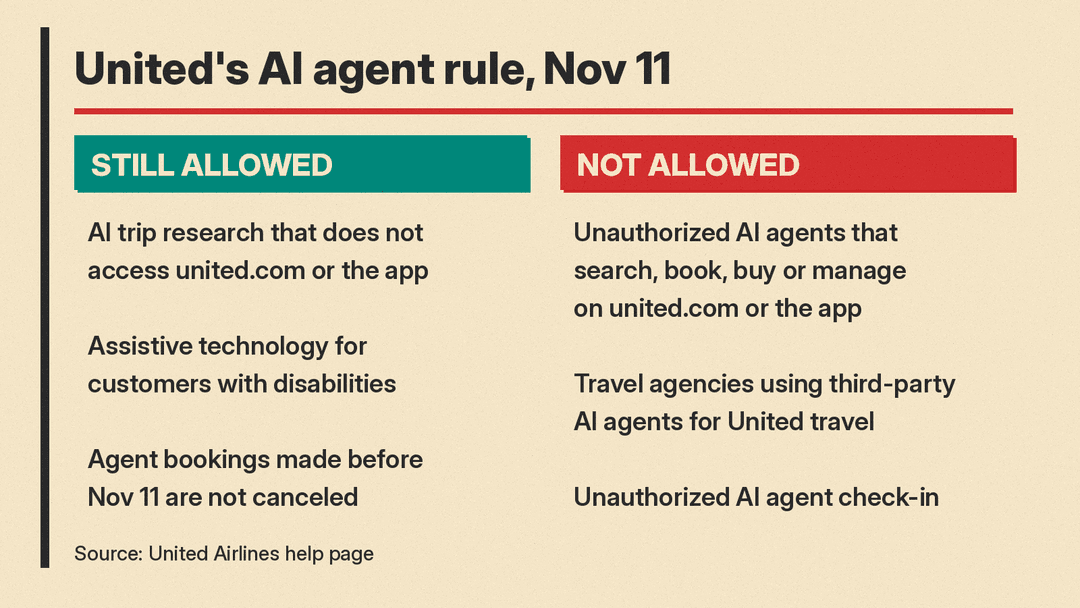
United gives a broad test for what counts. If a third-party AI agent, bot, browser extension or browser feature searches, books, buys, manages or collects information on united.com or the United app for you, and United has not given permission, United calls it unauthorized. Asked whether it works with any third-party AI agents, United answers "Not yet."
Can I still use AI to plan a United trip?
Yes, within limits. United says you can still use AI to research and plan trips, as long as the tool does not access united.com or the United app. The Verge, citing The Wall Street Journal, reports that agents can still show users United flights but cannot complete the transaction for them.
A few other points from United's page:
- Assistive technology for customers with disabilities is not affected.
- Agent bookings made prior to November 11, 2026 will not be canceled. United recommends you review recent travel plans to make sure they were booked and ticketed correctly.
- If you shared your MileagePlus login with a third-party AI agent, United recommends you change your password immediately.
- United suggests giving AI tools only general planning questions, not confirmation numbers, MileagePlus details or identity information.
United also makes clear that your own consent does not settle it: "Just because you've given access to AI assistants doesn't mean United will permit an AI assistant to transact with United."
Why United says it did this
United's stated reasons are privacy, unwanted purchases and regulation. Its page says giving an agent that much access "has the potential to expose personal information or result in bookings, account changes, or use of MileagePlus miles without your approval."
On check-in, United says an agent that checks you in automatically "could result in you missing important safety content." It adds that these automated actions have the potential to violate FAA and DOT regulations, because check-in requires human acknowledgment that bags do not contain banned substances like explosives.
There is also a business angle. The Verge reports that United CEO Scott Kirby said at an event on Tuesday, as quoted by the Journal: "To be honest, I don't want to create another middleman." The Verge also reports that, according to the Journal, United has not yet seen many people try to use AI agents to book flights.
What it means for AI agents
Personal agents that act inside a browser or an app are the products most affected. (For background, see our explainer on how computer-use AI agents operate a computer.) The Verge says decisions like United's could limit the usefulness of newer personal AI assistants like Meta's Muse and OpenAI's Dots. We covered Meta's Muse Ember agent model earlier this week.
Companies are split. Reuters, as published by CNBC, reports that Amazon has blocked Meta's AI agent Muse, while Walmart has partnered with it, and that online travel firms such as Expedia and Booking are working with OpenAI. The Verge says eBay appeared to block agents from browsing its site and that several major banks have restricted them. Engadget notes that not every airline agrees: Southwest created a plugin so users can book flights with ChatGPT.
How this affects travel agencies and booking sites
United's page says travel agencies and booking platforms cannot use third-party AI agents to search for, book or manage United travel on direct or indirect channels. Agencies can only use their own third-party AI tools with United's permission. Reuters reports that United said the steps include updates to its booking, ticketing and distribution policies.
Leff questions how well this can be enforced. He writes that a contractual ban is not a technical one: if an agent completes a purchase on Expedia, United sees an Expedia booking, not how the booking was made.
People on X and Hacker News are split on the ban, from fare motives to whether it can be enforced. See our roundup of reactions to United's AI agent ban.
What happens next
United leaves the door open. Its page says: "As third-party AI agents advance, we see the opportunities they present." It says it wants "standardized, secure technology integrations with privacy, security, authorization and accountability protections in place" first, and that it will update the page if it starts working with any third-party agents.
For travelers, the practical change is simple. Use AI to compare options and plan, then book and check in yourself on United's site, in its app, or through an agency that follows the new rules.
Sources
- United Airlines: Unauthorized third-party AI agents or assistants
- View from the Wing: United Airlines CEO Scott Kirby Bans AI Agents From Booking Tickets, Doesn't Want "Another Middleman"
- The Verge: United won't let your AI agent book your flight
- Reuters via CNBC: United Airlines moves to block AI agents from its platform over security concerns
- Engadget: United Is Restricting AI Agents From Booking Flights
