
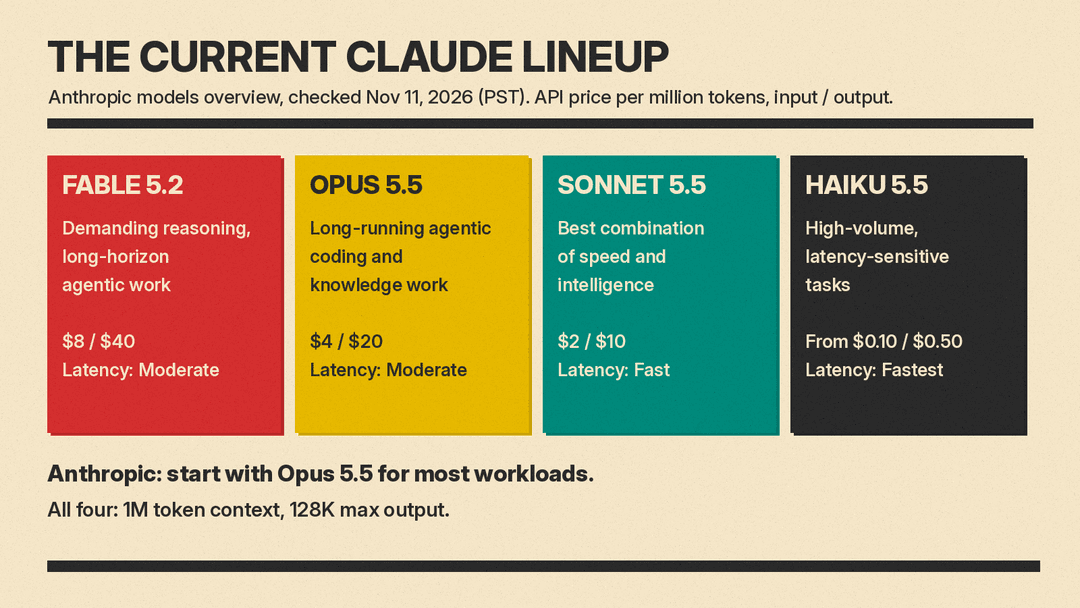
Anthropic sells four current Claude models: Fable 5.2, Opus 5.5, Sonnet 5.5 and Haiku 5.5. Its models overview gives a short rule for choosing among them: "If you're unsure which model to use, start with Claude Opus 5.5 for most workloads. Use Claude Fable 5.2 for demanding reasoning and long-horizon agentic work, or when your evals on Claude Opus 5.5 at higher effort still fall short."
This guide explains what each model is for, what it costs, which Claude plans include it, and how Fable 5.2 and Opus 5.5 compare on Anthropic's published scores. All facts come from Anthropic pages checked on November 11, 2026 (PST).
Which Claude model should I use? The short answer
- Most work: Claude Opus 5.5. Anthropic calls it "our strongest daily driver" in its Fable 5.2 launch post.
- The hardest technical work: Claude Fable 5.2, for "demanding reasoning and long-horizon agentic work," per Anthropic.
- Fast everyday answers: Claude Sonnet 5.5, which Anthropic describes as "The best combination of speed and intelligence."
- Large volumes of small tasks: Claude Haiku 5.5, which Anthropic lists "For high-volume, latency-sensitive tasks such as classification, extraction, and routing."
- Free plan users: Sonnet and Haiku only. Opus and Fable need a paid plan, per the Claude pricing page.
What do all four models have in common?
Anthropic's models overview lists the same core specs for all four:
- A 1M token context window. Anthropic says 1M tokens "is roughly 555k words" on its current tokenizer.
- 128K max output tokens on the standard API.
- A reliable knowledge cutoff of Jun 2026.
- Text and image input, and text output.
- Adaptive thinking, where the model decides how much to think, "steered by effort."
So the choice is not about how much text a model can read. It is about depth of reasoning, speed and price.
What is Claude Fable 5.2?
Claude Fable 5.2 was released on November 9, 2026, per its model page. Anthropic describes it as built "For demanding reasoning and long-horizon agentic work." The page lists typical uses as "agent sessions that run for hours, multistep deep research, and analysis carried through to a finished document, spreadsheet, or deck."
- API price: $8 per million input tokens and $40 per million output tokens.
- Latency label: "Moderate."
- Thinking: "Adaptive (always on)." The page says it "can't be turned off."
- Default effort on the API: high.
Anthropic says Fable and Claude Mythos 5.2 "are the same underlying model." Mythos goes only to organizations verified through Anthropic's programs. Fable has safeguards that block some high-risk requests. The launch post says: "When a query is blocked, users will instead receive a response from Opus 4.8 for cybersecurity and Opus 5 for biology."
The launch post says Fable 5.2 and Mythos 5.2 "generate outputs up to 30% faster than Claude Fable 5.1 and Claude Mythos 5.1."
What is Claude Opus 5.5?
Anthropic lists Claude Opus 5.5 "For long-running agentic coding and knowledge work" on the models overview.
- API price: $4 per million input tokens and $20 per million output tokens.
- Latency label: "Moderate."
- Thinking: "Adaptive (always on)."
- Default effort on the API: medium.
The Fable launch post says: "For most coding and knowledge tasks, we recommend that users start with Claude Opus 5.5, our strongest daily driver, and then switch to a different model as required." For more detail, see our Claude Opus 5.5 explainer.
What is Claude Sonnet 5.5?
Anthropic describes Claude Sonnet 5.5 as "The best combination of speed and intelligence."
- API price: $2 per million input tokens and $10 per million output tokens.
- Latency label: "Fast."
- Thinking: "Adaptive." Unlike Fable and Opus, the overview does not mark it as always on.
- Default effort on the API: high.
Sonnet models are included on every individual Claude plan, including Free, per the pricing page.
What is Claude Haiku 5.5?
Anthropic lists Claude Haiku 5.5 "For high-volume, latency-sensitive tasks such as classification, extraction, and routing." The Haiku 5.5 model page adds "subagent tasks," meaning small jobs that a larger agent hands off.
- API price: the overview shows "From $0.10" input and "From $0.50" output per million tokens. The model page explains the "From": $0.10 input and $0.50 output "for prompts up to 100,000 tokens," and $0.50 input and $2.50 output "for prompts over 100,000 tokens."
- Latency label: "Fastest."
- Default effort on the API: medium.
- Released October 7, 2026, per the model page.
The Haiku page also notes that Haiku 5.5 uses a newer tokenizer, "so the same text counts as approximately 30 percent more tokens than on Claude Haiku 4.5." For more, see our Claude Haiku 5.5 explainer.
How do Fable 5.2 and Opus 5.5 compare on scores?
Anthropic's Fable 5.2 launch post, published November 9, 2026, has a benchmark table with both models. Anthropic says the scores are "with safeguards on unless otherwise noted" and "show each model's highest-available effort unless otherwise noted." The post does not name the harness for each test. It points to the Claude Fable 5.2 and Claude Mythos 5.2 System Card for method. The table does not include Sonnet 5.5 or Haiku 5.5.
Fable 5.2 first, then Opus 5.5:
- FrontierCode 2.0 (agentic coding): 49.1% at Xhigh effort; 45.5%.
- FrontierSWE v2 (agentic coding): 69.9%; 62.3%.
- AutomationBench (business workflows): 51.4%; 42.5%.
- OSWorld 2.1 (computer use): 89.3%; 87.2%.
- Humanity's Last Exam, with tools: 74.2%; 67.7%.
- Chartography, no tools (reading charts): 73.4%; 64.4%.
- AA-Briefcase v1.1 (knowledge work): 66.1% rubric and 1785 Elo; 61.2% rubric and 1800 Elo.
Fable 5.2 scores higher on most rows. On AA-Briefcase, Opus 5.5 has the higher Elo and Fable the higher rubric score.
Anthropic also compares cost per task. It says that at High effort, Fable 5.2 scores "about the same as Opus 5.5's best score (45.3% vs. 45.5%) for roughly half the cost per task" on FrontierCode 2.0. Anthropic says that on Humanity's Last Exam, "At Low effort, Fable 5.2 matches Opus 5.5's top score for less than one-tenth of the cost per task." These are Anthropic's measurements. A higher price per token does not always mean a higher cost per task, because a model can use fewer tokens.
For the full launch, see our post on Claude Fable 5.2 and Mythos 5.2.
Which Claude models are free?
The Claude pricing page lists model access by plan:
- Free ($0): Sonnet and Haiku. No Opus, no Fable.
- Pro ($20 if billed monthly, or $17 per month with an annual subscription): Opus, Sonnet and Haiku. Fable is "paid with usage credits."
- Max ($100 per month): all four. Fable is included for "50% of weekly limits."
- Ultra ($200 per month): all four. Fable is included for "50% of weekly limits."
The pricing page lists model families (Fable, Opus, Sonnet, Haiku), not version numbers. The page also says: "How fast you reach a limit depends on the model you use, how long your chats are, and how large your files are."
What is effort, and does it change the answer?
Effort controls how much a model thinks before it answers. Anthropic's models overview says adaptive thinking is "steered by effort," and lists a default effort for each model on the API: high for Fable and Sonnet, medium for Opus and Haiku.
The apps use a different default. The Fable launch post says Medium effort is "the default in Claude apps and Claude Code."
Higher effort can raise quality and cost. Anthropic's advice to move from Opus 5.5 to Fable 5.2 applies "when your evals on Claude Opus 5.5 at higher effort still fall short." In practice, that means trying Opus at a higher effort before you pay for Fable.
How do developers pick a model?
Developers choose a model by its ID in each API request. The models overview lists:
claude-fable-5-2claude-opus-5-5claude-sonnet-5-5claude-haiku-5-5
The same page says: "Batch API requests are 50% off." The Fable page adds that Fable 5.2 "requires 30-day data retention and isn't available under zero data retention unless expressly authorized by Anthropic."
Which Claude model is best for coding?
Anthropic lists Opus 5.5 "For long-running agentic coding and knowledge work," and recommends it as the starting point. Fable 5.2 has the higher coding scores in Anthropic's table: 49.1% at Xhigh effort against 45.5% on FrontierCode 2.0, and 69.9% against 62.3% on FrontierSWE v2. For short edits and quick questions, Sonnet 5.5 is the model Anthropic labels "Fast."
A simple decision list
- You are not sure: start with Opus 5.5.
- Opus 5.5 at higher effort still fails your task: try Fable 5.2.
- You want quick replies on the Free plan: Sonnet 5.5.
- You run thousands of small, similar jobs through the API: Haiku 5.5.
- Your work involves security testing or lab biology: Fable may block some requests and hand them to another model, per Anthropic.
Caveats
- Scores come from Anthropic only and cover Fable 5.2 and Opus 5.5, not Sonnet or Haiku.
- The launch post does not name the harness for each test.
- Prices, plans and limits were checked on November 11, 2026 (PST) and can change.
Sources
- Anthropic: Models overview, checked on November 11, 2026
- Anthropic: Claude Fable 5.2 model overview, checked on November 11, 2026
- Anthropic: Claude Haiku 5.5 model overview, checked on November 11, 2026
- Anthropic: Claude Fable 5.2 and Mythos 5.2 launch post, checked on November 11, 2026
- Claude: Plans and pricing, checked on November 11, 2026
