
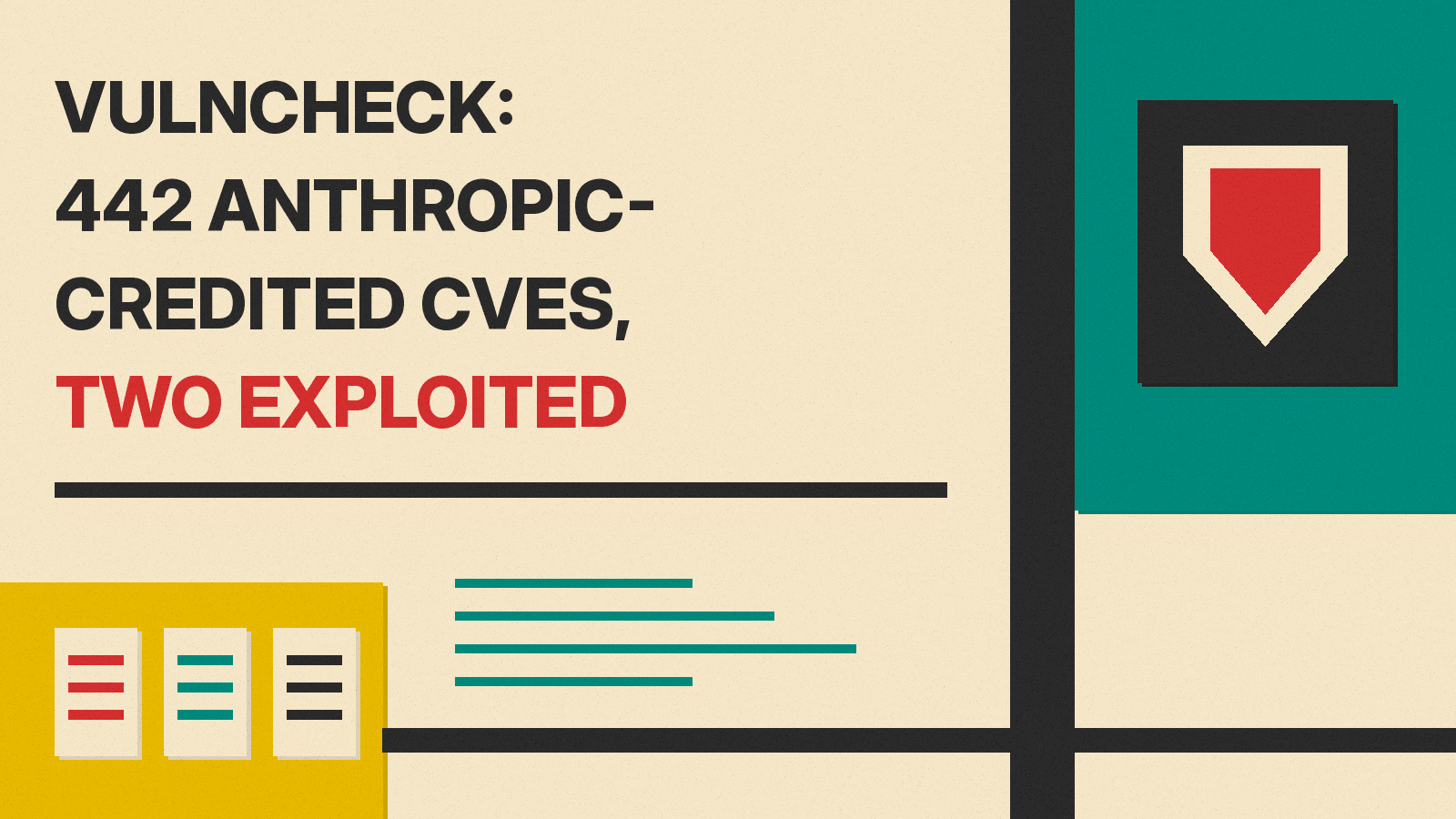
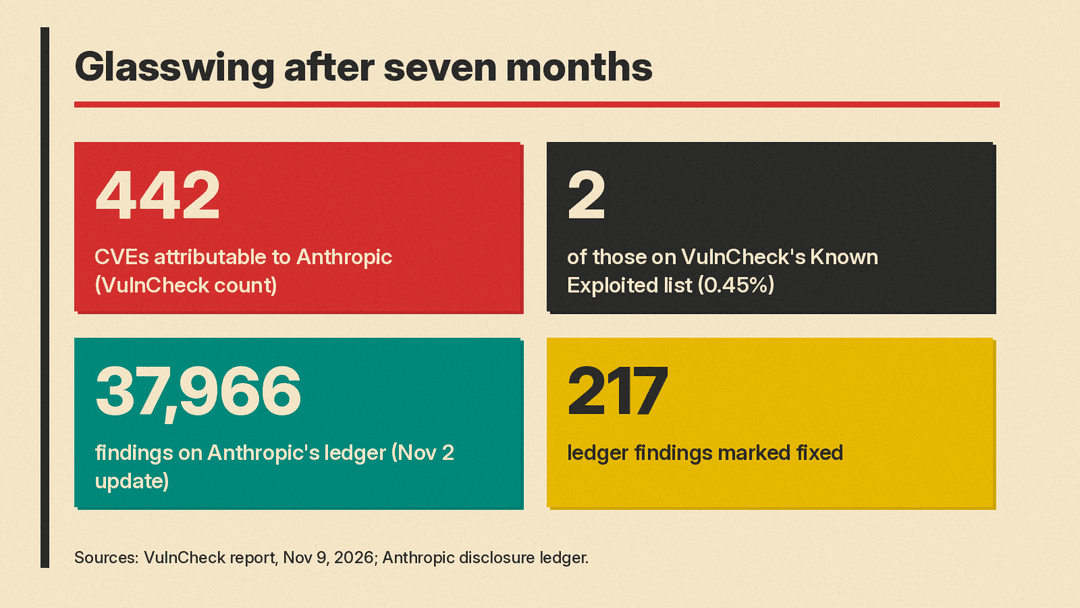
Seven months after Anthropic launched Project Glasswing, a security researcher who has tracked every bug credited to the company says the results still do not match the launch message. In a November 9 report, Patrick Garrity of VulnCheck counts 442 CVEs attributable to Anthropic. Two of them are known to be exploited in the wild. Anthropic's own disclosure ledger marks 217 entries as fixed, out of 37,966 findings counted on its CVD dashboard.
The report got a second round of attention on November 12, when The Stack covered it. Here is what the numbers say, what they do not say, and how Anthropic describes the same work.
What Project Glasswing is
Anthropic launched Glasswing on April 7. According to The Register, the program gives vetted partners access to Claude Mythos Preview for defensive security work, such as finding and fixing flaws in their own products and in open-source code they depend on. At launch, Anthropic said it had found "thousands of additional high- and critical-severity vulnerabilities" and was disclosing them to maintainers, according to the VulnCheck report.
Garrity started tracking Anthropic-credited vulnerabilities on April 17 in a public repo, Anthropic Credited CVEs. He pulls from CVE records, GitHub security advisories, Linux kernel commits and Anthropic's ledger, and audits advisories by hand to catch missed entries.
The headline numbers
From the VulnCheck report:
- 442 CVEs attributable to Anthropic after seven months, an average of 63 a month.
- That is about 0.5% of the 93,450 CVEs published so far this year.
- 2 of the 442 are on VulnCheck's Known Exploited Vulnerabilities list: CVE-2026-61500 and CVE-2026-26980. That is 0.45%.
The two exploited bugs are serious ones. CVE-2026-61500 affects Rejetto HFS 3.0.0 through 3.2.0, where a weak random number generator let a remote attacker forge an administrator session cookie and reach remote code execution, per its NVD entry. CVE-2026-26980 let unauthenticated attackers read arbitrary data from the database in Ghost versions 3.24.0 through 6.19.0. Ghost fixed it in 6.19.1.
In September, The Register reported Garrity's count at 225 CVEs with one exploited. Garrity told The Register that historically "just under one percent to two percent of vulnerabilities" get weaponized and used in the wild.
The ledger: findings grow, fixes barely move
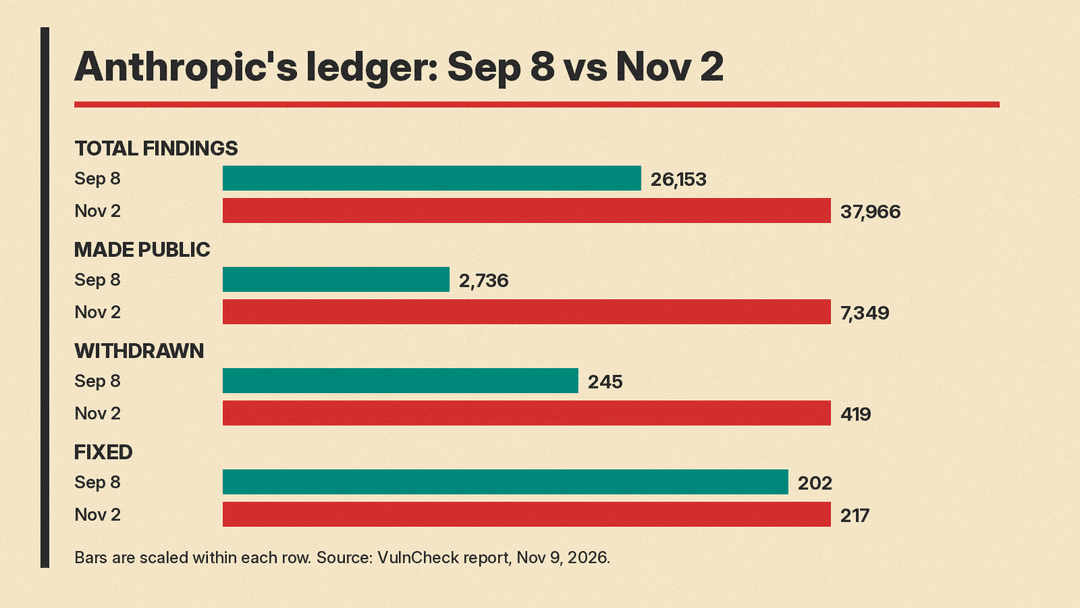
The sharper part of the report is about the ledger. Anthropic's ledger publishes a hash for each finding and reveals more detail as disclosure moves forward. VulnCheck compared its September 8 snapshot with the November 2 update:
- Total findings: 26,153 to 37,966, up 11,813.
- Made public: 2,736 (10.5%) to 7,349 (19.4%).
- Fixed: 202 to 217, up 15.
- Withdrawn: 245 to 419.
- Claimed true positive rate: 91.4% to 94.2%.
The live ledger today shows 7,349 revealed entries, 217 fixed, 419 withdrawn and 1,654 duplicates. VulnCheck says duplicates were at two in September. Garrity's reading is that findings left waiting get found and fixed by someone else first. He also questions how the true positive rate can rise while more findings are withdrawn or marked duplicate than fixed.
One caution on the math. The 442 CVEs and the 217 fixes are different measures. The CVE count comes from public records across many sources. The fixed count is a status field in Anthropic's own export. Garrity notes that he has tracked more than twice as many CVEs as the ledger marks fixed. Anthropic's dashboard overview, last updated November 2, gives a different count: it says 629 of the 5,087 vulnerabilities it has disclosed have been patched, to its knowledge, and that 230 CVE records have been issued.
The curl test
The report also looks at OSS Scanner, the opt-in service Anthropic launched on October 8. Projects that join get scans from Anthropic's strongest models at no cost. Anthropic says the reports are "fully model-generated, without human review or triage" and that "it is possible reports will be incorrect or invalid."
According to VulnCheck, curl maintainer Daniel Stenberg received a batch of 45 OSS Scanner reports. Anthropic rated one as medium and the rest as low. Of the 34 published so far, 19 were marked not a vulnerability, 6 were confirmed as low severity and 9 were still pending. VulnCheck puts the false positive rate at 55.9% on that slice. In May, Stenberg wrote that five Mythos findings came down to one confirmed curl vulnerability.
Garrity's point is that triage did not go away. It moved to maintainers.
Anthropic's side of the numbers
Anthropic's October 8 post gives its own account. Over six months it found "over 29,000 candidate vulnerabilities" but had manually reviewed about 6,000, and said it remains "bottlenecked on our human capacity to validate these findings." It said it had sent nearly 5,000 unverified reports to maintainers who asked for everything at once.
The same post quotes maintainers who liked the reports. wolfSSL's Todd Ouska said that of 74 reports, "all but two were valid, and five became CVEs." Stenberg himself is quoted saying OSS Scanner found "one of the worst curl vulnerabilities reported in the last few years." Anthropic also said expert penetration testers checked 97 critical and high findings across 48 projects, and 85 (88%) met the bar for its disclosure process. On November 11, Apache patched a critical HTTP Server flaw that it credits OSS Scanner with reporting first.
So both sides agree on one thing: finding bugs is now cheap, and checking and fixing them is the slow part.
Why it matters
Glasswing was pitched as proof that frontier models change the security picture. The exploitation data so far points to a smaller effect on attackers than the launch message suggested. The fix data points to a real cost for open-source maintainers, who now get more reports than they can triage. Neither number says AI bug finding is useless. Garrity writes that AI "is a valuable tool for finding vulnerabilities." The open question is who pays for the validation work.
For more on how Mythos is being used, see our posts on Cisco and IBM adding Claude Mythos to security products, Anthropic's $35M open-source defense fund and Darktrace's Claude Code lab test.
Sources
- VulnCheck: After 7-months, Glasswing Overwelms Maintainers with Underwhelming Findings (Nov 9, 2026)
- Anthropic: Disclosure ledger
- Anthropic: Coordinated vulnerability disclosure dashboard (updated Nov 2, 2026)
- Anthropic: Launching an opt-in vulnerability-finding service for open-source software (Oct 8, 2026)
- Anthropic Credited CVEs repo (Patrick Garrity)
- The Stack: Seven months on, Anthropic's Project Glasswing finds just two exploited CVEs and a lot of slop (Nov 12, 2026)
- The Register: Anthropic-linked CVEs pile up, attackers mostly shrug (Sep 21, 2026)
- NVD: CVE-2026-61500
- NVD: CVE-2026-26980
- Daniel Stenberg: Mythos finds a curl vulnerability (May 11, 2026)
