
Apache has fixed a critical flaw in its HTTP Server, and the first report came from Anthropic's automated scanner. The Apache HTTP Server 2.4 vulnerability page lists "Anthropic's OSS Scanner, as vulnerability ANT-2026-MAPKT6MZ" as a finder of CVE-2026-119618, a bug in the module that handles HTTP/2 traffic. Two Google researchers reported the same bug on their own eight days later.
Apache released the fix in version 2.4.71 on November 11. Per Apache's advisory, the flaw affects Apache HTTP Server 2.4.55 through 2.4.70. If you run one of those versions with HTTP/2 enabled, update to 2.4.71 or your vendor's patched package. If you cannot update yet, Red Hat says servers that serve only HTTP/1.1 are not vulnerable.
What the flaw is
Apache rates CVE-2026-119618 critical. Its advisory describes a "Concurrent Execution using Shared Resource with Improper Synchronization vulnerability in Apache HTTP Server's mod_http2 in assign_headers()" that "can lead to RCE," which means remote code execution.
Red Hat's CVE page explains it in plain terms. HTTP/2 lets a client send many requests at the same time over one connection, and mod_http2 handles them with several threads. Because of a thread-safety flaw, "one thread can modify memory that belongs to another thread, corrupting the server's internal memory." Red Hat says a remote attacker who can reach the server could use this to run commands "without any authentication."
Red Hat gives the flaw a CVSS 3.1 score of 9.8 out of 10. It also sets a clear limit: "Only servers that have HTTP/2 enabled are affected; servers configured to serve only HTTP/1.1 are not vulnerable."
Who reported it, and when
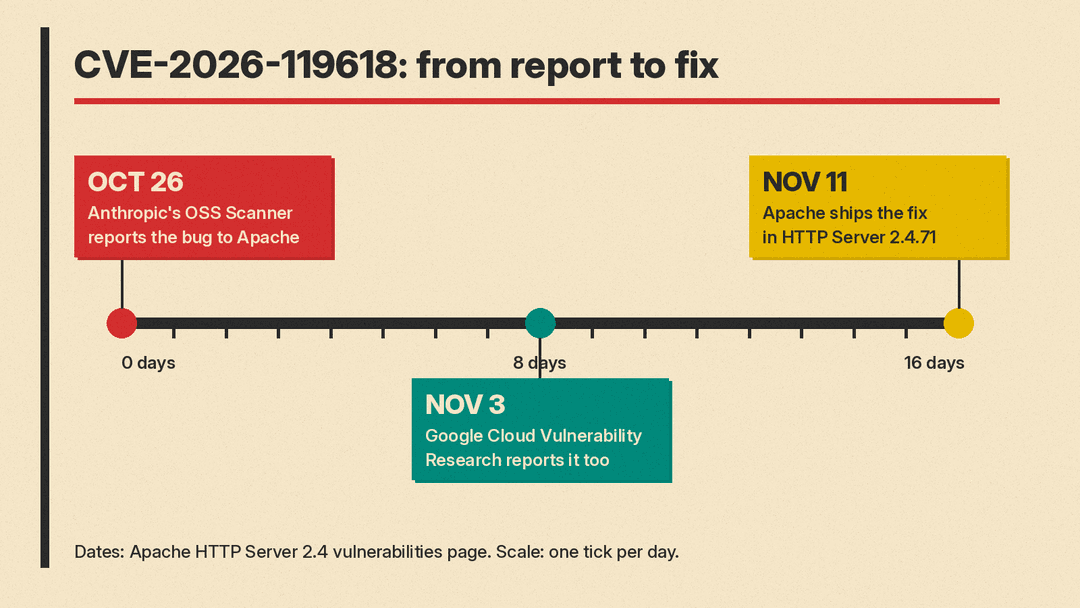
Apache's advisory gives these dates:
- October 26: Anthropic reported the bug to the Apache security team.
- November 3: Anthony Weems and Simon Scannell of Google Cloud Vulnerability Research reported it.
- November 11: Apache committed the fix and released 2.4.71.
That is 16 days from Anthropic's report to a public fix. SecurityWeek describes the two reports as "independent discoveries by Anthropic and Google researchers."
Anthropic launched OSS Scanner on October 8. In its launch post, it calls the tool "an opt-in vulnerability scanner for the open-source ecosystem" that gives projects "thorough, periodic security scans by our strongest models at no cost." Anthropic says the reports are "fully model-generated, without human review or triage," and that its strongest models, "including Claude Mythos," write them. Each report comes with a reproducer, an explanation and, when available, a candidate patch.
Anthropic also says model-written reports can be wrong. In its own test, expert penetration testers checked 97 critical and high-severity findings from an early version of the scanner. Of these, 85 (88%) met the bar for its disclosure process, 11 were real but duplicates, and one was a false positive. In this Apache case, a second team found the same bug, and Apache rated it critical.
Which versions are affected
Per Apache, the flaw affects:
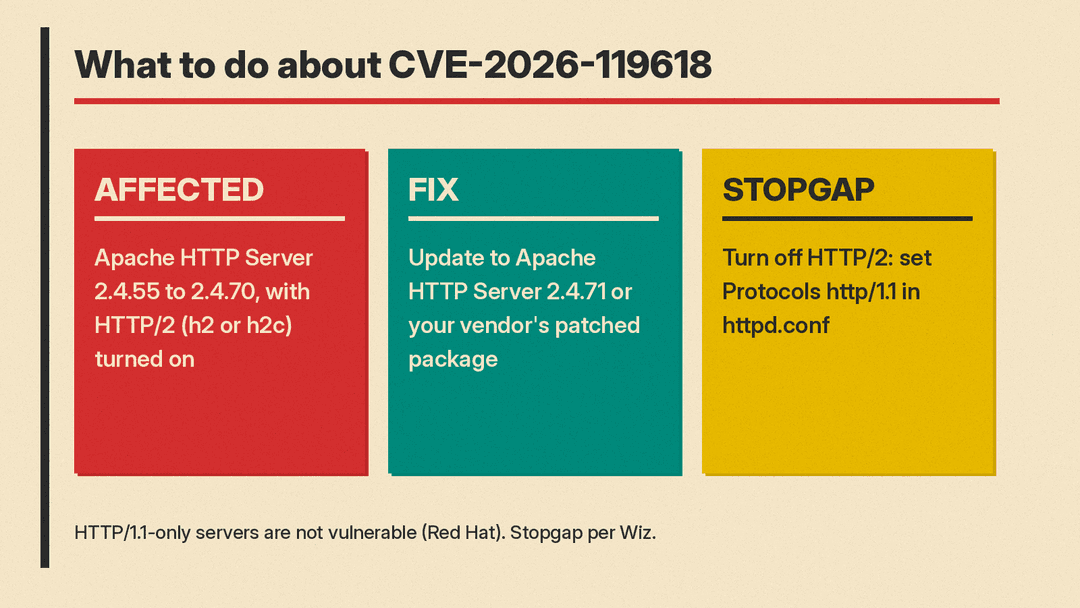
- Apache HTTP Server 2.4.55 through 2.4.70
- Standalone mod_h2 releases from GitHub, 2.0.8 through 2.0.42
Red Hat says mod_http2 versions before 2.0.8 do not contain the affected code, and Red Hat Enterprise Linux 8 and earlier are not affected. It rates the flaw Important, not Critical, for RHEL 9 and RHEL 10. Their mod_http2 packages give each HTTP/2 stream a separate allocator, which Red Hat says "substantially increases the complexity of exploiting the flaw."
Cloud security firm Wiz wrote on November 11 that, in its data, 64% of cloud environments have resources vulnerable to the flaw, and 51% have publicly exposed instances. Wiz adds that "this does not take configuration into account." SecurityWeek notes that the figures "do not necessarily represent exploitable installations."
Is anyone exploiting it?
The sources do not agree on how close attackers are. Wiz wrote that at publication on November 11, "no exploit is available and there are no reports of exploitation in the wild." Red Hat's statement says "public research has demonstrated a reliable exploit against a default-configured server with the mod_http2 module enabled." SecurityWeek notes that Red Hat does not name that research. It also reports that a public proof of concept on GitHub reproduces memory corruption and process crashes but does not show remote code execution.
What to do
- Update. Install Apache HTTP Server 2.4.71 or your vendor's patched package. Per Apache's advisory, the same release also fixes CVE-2026-106023 (important, mod_md) and CVE-2026-109163 (low, mod_vhost_alias). Wiz says standalone mod_h2 builds should move to a version newer than 2.0.42.
- If you cannot update yet, turn off HTTP/2. Wiz suggests removing
h2andh2cfrom theProtocolsdirective in httpd.conf, so it readsProtocols http/1.1. Red Hat confirms that servers serving only HTTP/1.1 are not vulnerable. - WordPress sites: SecurityWeek reports that Defiant warned WordPress security updates cannot fix this, because the bug is in the web server, not in WordPress.
Why it matters
Red Hat says this bug needed no login and could give an attacker control of the server process. The credit line shows Anthropic's scanner reporting a critical bug in a widely used open-source project eight days before Google's researchers did. It adds to Anthropic's record of credited bugs, which VulnCheck counted at 442 CVEs after seven months of Project Glasswing. Anthropic has also put its Mythos model into partner security tools, as in the recent Cisco and IBM products. For a related look at how attackers can turn Claude tools against defenders, see our report on Darktrace's Claude Code lab test.
Anthropic's launch post also flags the other side: "exploits can now be developed in minutes," so projects that fix bugs faster "can better secure their software." Here, Apache shipped the fix 16 days after Anthropic's report.
Sources
- Apache HTTP Server 2.4 vulnerabilities (Apache, CVE-2026-119618 entry)
- Apache httpd 2.4 CHANGES file
- CVE-2026-119618 (Red Hat Customer Portal)
- CVE-2026-119618: RCE in Apache HTTP Server (Wiz, Nov 11, 2026)
- Apache Patches Critical HTTP Server RCE Found by Anthropic, Google (SecurityWeek, Nov 12, 2026)
- Launching an opt-in vulnerability-finding service for open-source software (Anthropic, Oct 8, 2026)
- Apache core Protocols directive (Apache docs)
