
An AI model learns from a large collection of text gathered up to some point in time. The end of that collection is the model's knowledge cutoff. OpenAI's help center puts it this way: "The models are trained on data up to a certain point and responses do not incorporate information about events beyond that, unless tools are used" (OpenAI Help Center).
This guide explains what a knowledge cutoff is, why vendors list more than one kind, why the real boundary can be blurry, and how search tools let a chatbot answer questions about events that came later.
What is a knowledge cutoff?
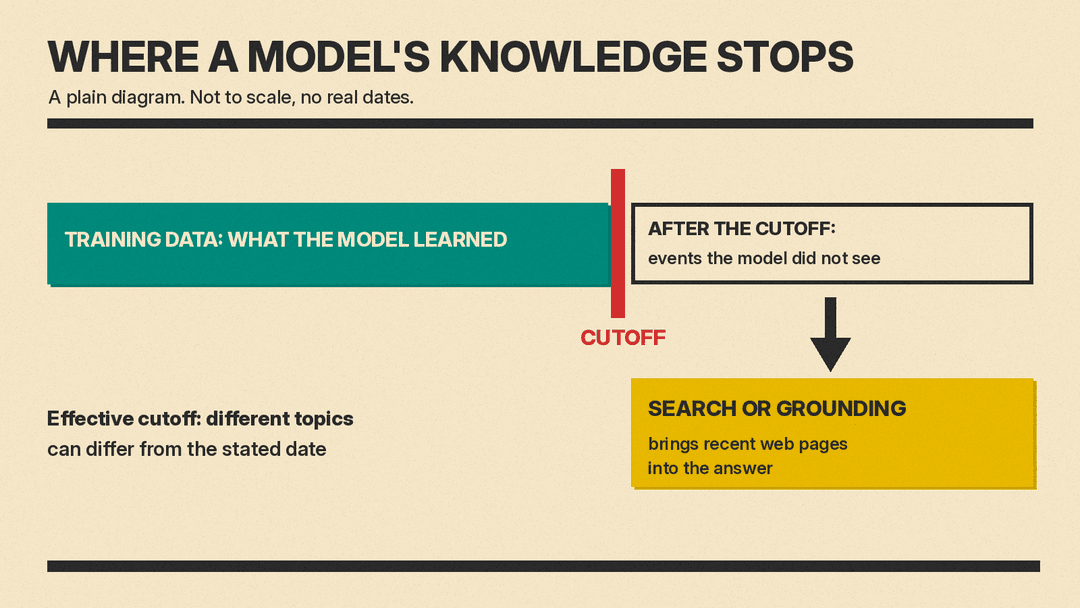
A knowledge cutoff is the point after which a model has no training data. Everything the model "knows" without help comes from text it saw during training. If something happened after that point, the model did not see it.
That is why a chatbot can explain a well-known topic in detail and still miss recent news. It is not hiding the news. The text about it was not part of what it learned.
Two things follow from this:
- A model with no tools cannot know about events after its cutoff.
- A model can still produce an answer about those events. The answer will be built from older patterns, not from the new facts.
OpenAI lists a related warning on the same help page: "Confidence isn't reliability: The model may express high confidence even in incorrect answers." A confident reply about a recent event is not evidence that the model knows about it.
For more on why models produce wrong answers in a fluent tone, see our guide to AI hallucinations.
Is there more than one kind of cutoff?
Yes, at least for some vendors. Anthropic's models overview lists two dates for each model:
- Reliable knowledge cutoff: Anthropic's Transparency Hub says a model's knowledge base is "most extensive and reliable on information and events up to" its knowledge cutoff date.
- Training data cutoff: listed as a separate date. The models overview does not define it.
Listing both dates shows that Anthropic treats them as separate measures.
Other vendors list a single date. OpenAI says "The extent to which OpenAI API models have knowledge of current events depends on the specific model," and points readers to its models overview for "the knowledge cutoffs for each model" (OpenAI Help Center).
Which questions does a knowledge cutoff affect?
A cutoff matters most when the right answer changes over time. Questions like these are the most exposed:
- News and events: anything that happened after the cutoff.
- Current status: who runs a company, which version of an app is current, whether a product is still sold.
- Numbers that move: prices, exchange rates, scores, rankings and statistics.
- New products and terms: a tool, model or word that appeared after the cutoff may be unknown, or the model may confuse it with an older name.
Questions about stable topics, such as how photosynthesis works or what a word means, are less exposed. The model can still be wrong about those, but the reason is not the cutoff.
Why does the real cutoff differ from the stated one?
Researchers have tested whether a model's knowledge actually stops where its makers say. In the paper Dated Data: Tracing Knowledge Cutoffs in Large Language Models, Jeffrey Cheng and colleagues define an "effective cutoff." The paper says this "is distinct from the LLM designer reported cutoff and applies separately to sub-resources and topics."
The authors studied open models whose training data is described in public, including Pythia, Falcon, OLMo and the original LLaMA. They report that "effective cutoffs often differ from reported cutoffs."
The paper names two reasons:
- Old pages in new web crawls. Much training text comes from CommonCrawl, a large public archive of web pages. The authors point to "temporal biases of CommonCrawl data due to non-trivial amounts of old data in new dumps." A crawl gathered at a late date still contains a lot of older text.
- Deduplication problems. Training pipelines remove repeated text. The paper points to "complications in LLM deduplication schemes involving semantic duplicates and lexical near-duplicates."
The practical point: a cutoff date is a label for a whole training set, but different topics inside that set can be fresher or staler than the label. The paper concludes that "knowledge cutoffs are not as simple as they have seemed."
Why doesn't a model know its own cutoff?
A model's cutoff is a fact about how it was trained, not a fact the model looks up. A model can report its cutoff only if that information reaches it, for example in instructions an app sends with each chat. Without that, a model asked "what is your cutoff?" answers from patterns in its training text, which may not match the vendor's figure.
The safer source is the vendor's documentation. The vendor knows what data went into training. Ask the vendor's page, not the chatbot.
How do chatbots answer questions about recent events?
They use tools that fetch new information at the moment you ask. The model itself does not change. It reads fresh text alongside your question and writes an answer from both.
Each major vendor documents this:
- OpenAI (ChatGPT): Without search enabled, "Responses are based on what the model has learned during training." With search or deep research, ChatGPT "can access and cite real-time web sources to answer questions with more recent information" (OpenAI Help Center).
- Anthropic (Claude API): The web search tool "gives Claude direct access to real-time web content, allowing it to answer questions with up-to-date information beyond its knowledge cutoff."
- Google (Gemini API): Google says Grounding with Google Search "allows Gemini to provide more accurate answers and cite verifiable sources beyond its knowledge cutoff."
Search does not always run. Google says the model "analyzes the prompt and determines if a Google Search can improve the answer." OpenAI says ChatGPT "may search the web automatically when your question would benefit from current information" (OpenAI Help Center). In both cases the model decides, so a question about recent events can still get an answer from training data alone.
Search results can also be wrong. OpenAI says: "Search results and citations can be incomplete, outdated, or incorrect."
A related method is retrieval-augmented generation, where an app looks up passages from your own documents and hands them to the model. Our RAG explainer covers how that works.
How do I check a model's knowledge cutoff?
Use the vendor's own documentation:
- Claude: Anthropic's models overview lists a reliable knowledge cutoff and a training data cutoff for each current model.
- OpenAI models: OpenAI's help center points to its models overview, which lists the knowledge cutoff for each model.
- Other vendors: look for a model card or model page. If the vendor does not publish a cutoff, treat any date the model gives you as unverified.
Keep in mind which model you are using. In a chat app, the model behind the chat can change when the vendor ships a new one, and the cutoff changes with it.
How can I get up-to-date answers?
- Turn on search when it is offered. If an answer depends on recent facts, ask the chatbot to search, or use its search option.
- Ask for sources and open them. OpenAI advises: "Open a cited source to check that it supports the answer, review when it was published or updated, and use an authoritative source when accuracy matters."
- Paste or upload the current facts yourself. If you already have the latest document, give it to the model. It can work from text you supply even if that text is newer than its cutoff.
- Say what today's date is when it matters. A model without tools has no calendar of its own. Stating the date helps it frame the answer, though it still cannot know events it never saw.
- Check numbers that change often. Prices, product versions, rankings and office holders change. Confirm these against a live source.
Does a newer model always know more recent things?
A newer model often has a later cutoff, but the research above shows the stated date is not the full story. Some topics in the training data may lag behind the label.
Caveats
- Cutoff definitions differ by vendor. Anthropic lists two dates; other vendors list one or none.
- The effective cutoff research studied open models with public training data. Closed models were not part of its main results.
- Search and grounding help, but the model decides when to use them, and results can be wrong.
- This guide was checked on November 11, 2026 (PST) against the pages below.
Sources
- OpenAI Help Center: Does ChatGPT tell the truth?, checked on November 11, 2026
- OpenAI Help Center: Do the OpenAI API models have knowledge of current events?, checked on November 11, 2026
- OpenAI Help Center: Searching the web with ChatGPT, checked on November 11, 2026
- Anthropic: Models overview, checked on November 11, 2026
- Anthropic: Transparency Hub, checked on November 11, 2026
- Anthropic: Web search tool, checked on November 11, 2026
- Google: Grounding with Google Search, checked on November 11, 2026
- Cheng et al.: Dated Data: Tracing Knowledge Cutoffs in Large Language Models (arXiv), checked on November 11, 2026
