

Tencent has launched Yuanbao Search, an AI search engine for ordinary users. It went live on Nov 11, 2026 at so.qq.com, and users can also pick it as the default engine in the latest QQ Browser, IT Home reports, citing an announcement from Tencent Cloud.
It is Tencent's first standalone consumer web search product of its own since it folded its Soso engine into Sogou in 2013, per Time Weekly (see below). It also brings Tencent's own content, such as WeChat Official Account articles and Channels videos, into a public search page that anyone can open in a browser.
What Yuanbao Search does
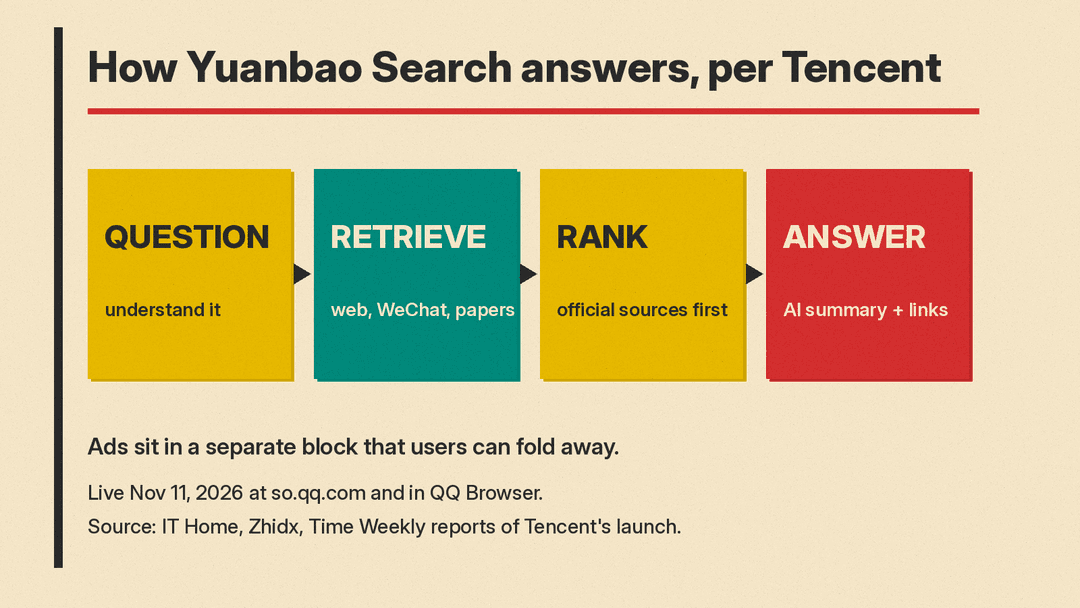
Tencent says the product rebuilds every step of search, from understanding the question to retrieval, ranking and writing the answer, on the large models behind its Yuanbao assistant, according to IT Home. The claimed features, as reported by IT Home and Zhidx:
- An AI summary at the top of results, with follow-up questions and links back to the original sources.
- An index Tencent puts at the hundred-billion scale, covering the open web, WeChat Official Accounts, Channels videos and academic papers.
- Priority for official and authoritative sources. Tencent says it connects 157 authoritative sources, per IT Home.
- Separate channels for academic and science content, organizations and mainstream media, plus structured cards for topics such as cars, film and TV, and health, per Zhidx.
- Paper results that keep the original citation, with one-click translation of English titles and abstracts.
- Search by typing, voice or photo.
- Ads shown apart from answers, with a button to fold the whole ad block away.
Tencent also says the engine improves itself over time through what it calls a recursive self-improvement (RSI) mechanism that finds weak results from real use and feedback, IT Home reports.
Tencent's numbers, and what they do not show
At a media briefing on launch day, Tencent gave performance figures that Time Weekly reported (republished by Southern Finance). These are Tencent's own claims:
- Recall above 94% for long-tail questions across the index.
- Index retrieval that stays at the millisecond level.
- End-to-end latency cut by 40% to 78% across scenarios.
- Unit inference cost down 90%.
Tencent did not say what these figures are measured against, and no outside test has been published. Product lead Li Ruizhang also said that active user numbers are not the main goal for now, and that the team cares more about whether people come back, according to Time Weekly.
Same name, two products
Yuanbao Search already existed as a business product. On Oct 20, Tencent upgraded a developer version that sells search through Tencent Cloud as an API, an MCP server and a Skill for AI apps and agents, Zhidx reports.
Tencent says the two share the same retrieval and AI systems but serve different users, per Time Weekly. The company stressed that they are not two versions of one product. Li told Zhidx that the consumer site will add features but will not turn into an AI assistant. It will stay focused on search.
A return to search after Soso and Sogou
Tencent has been here before. Time Weekly recounts the history: Tencent launched its own search engine, Soso, in 2006, folded it into Sogou in 2013, and took Sogou fully private in 2021. Since then its search work has lived mainly inside QQ Browser and WeChat Search.
Li told Time Weekly that the team can return to search as a reformer or challenger and fix problems users often complain about in current search. He named Baidu as a company that has held Chinese users' habits for many years. He said QQ Browser will bring the product a base of traffic.
On ads, Li said ad blocks and organic results will be physically separated and that paid content cannot change the ranking of natural results, per Time Weekly.
Why it matters
The launch lands in a busy week for Chinese AI. Baidu used its Baidu World 2026 event on Nov 12 to launch a marketplace for AI model tokens. Tencent itself is denying a 50% layoff rumor after founder Pony Ma urged staff toward AI-native work, and it recently shut down its Yuanqi agent builder.
The product puts Tencent in direct contact with Baidu in web search. Its main point of difference is WeChat content, which Li called an important supplement to whole-web results, per Time Weekly. For background on the models behind Yuanbao, see our Tencent Hy (Hunyuan) explainer.
What to watch: whether Tencent publishes user numbers or outside tests of its accuracy claims, and how the product sits next to Sogou and QQ Browser, which Time Weekly flags as an open question of fit inside Tencent.
