
OpenAI has pledged $2 million to a research network that studies how AI affects children, and it has signed a voluntary charter on safer AI for kids at the Paris Peace Forum. The money is meant to pay for measurement tools, so researchers can track AI's risks and benefits for children with shared methods.
The company announced the pledge in a post dated November 12. It is one part of a wider set of child-focused commitments made at the forum in Paris this week.
What OpenAI committed
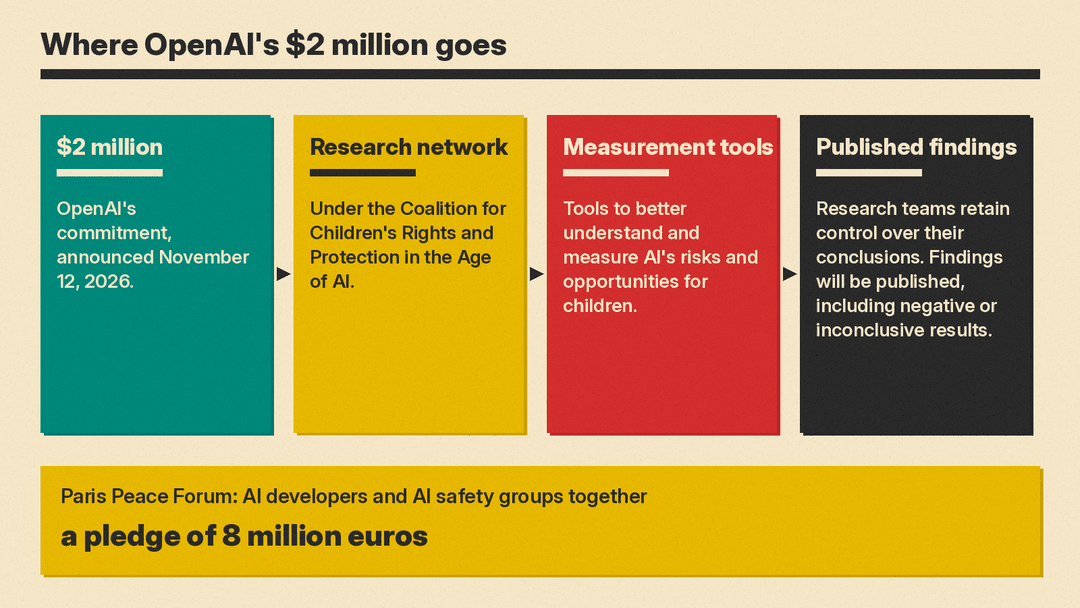
OpenAI says that "earlier this week at the Paris Peace Forum" it signed the Charter of Engagement for Safer AI for Children. It also committed $2 million to support the scientific research network under the Coalition for Children's Rights and Protection in the Age of AI.
According to OpenAI, the money "supports shared measurement work." The company describes this as building tools researchers can use to better understand and measure AI's risks and opportunities for children. OpenAI says the goal is to help inform safer products and better policy.
OpenAI did not name the research teams that will receive the money, the payment schedule, or a date for first results.
What the charter says
OpenAI summarizes the charter as a set of shared principles for safe, age-appropriate AI, plus a research programme and safeguards for that research's independence. Two of those safeguards stand out. OpenAI says research teams "retain control over their conclusions," and that findings "will be published, including negative or inconclusive results."
The full text, published in French by the French presidency on November 10, says the charter aims to strengthen independent scientific knowledge about AI's risks and opportunities for children's development. It also aims to bring that knowledge into product design, evaluation and public policy.
The text lists guiding principles for AI systems that children may access. In short, they are:
- Safety by design and by default. Measures may include age-appropriate time management tools, to prevent excessive or compulsive use and services that encourage emotional attachment.
- The child's best interest first. This covers transparent practices and appropriate parental controls. It also covers support for international research on anthropomorphism, over-reliance and emotional dependence.
- Ethical, fair and inclusive AI. Systems should aim to benefit all children and reduce the digital divide.
- Age-appropriate design. Products should fit children's stages of cognitive and social-emotional development.
- Design that involves families. Parents and guardians should get effective, easy-to-use tools and support resources.
- Real participation by children. Children and young people should take part in research in an age-appropriate and ethical way.
These are voluntary commitments, not law. For practical steps parents can take today, see our guide to AI chatbot parental controls.
Who else is involved
The Paris Peace Forum said on November 10 that key AI developers "like OpenAI and Anthropic," and AI safety groups such as Common Sense Media, would commit to fund research and tools on how AI interacts with child development. The forum said that "altogether, a pledge of 8 million euros will be made." OpenAI's $2 million is part of that wider effort.
According to the French text, the coalition is led by France, Spain and Kenya and involves ten United Nations bodies. It brings together governments, researchers, civil society and companies. French President Emmanuel Macron launched the coalition's roadmap at the United Nations in September.
Macron set out a firm line in the forum's release: "no AI should be placed in the hands of children without first being tested, evaluated, and therefore authorized." That is his statement, not a rule in force, and OpenAI's post does not repeat it.
Paris Peace Forum President Philippe Etienne said the aim is "to protect children from the risks of technologies such as AI by equipping researchers with the right resources to understand the impact these technologies have on children's development, and inform science-based policy work".
The AI charter is separate from the Children First Declaration, which was also presented at the forum. Under that declaration, more than 50 countries, 7 international organizations, and 20 NGOs, philanthropies and businesses pledged to put children's rights and wellbeing at the heart of their work. It covers five pillars: health, nutrition, education, protection, and psychosocial wellbeing in the digital age. OpenAI is not on the declaration's signatory list as of November 10.
Why it matters
The French text says protective measures should be put in place now, in proportion to the risks already identified, and then refined as gaps in knowledge are filled. The research network is the part meant to fill those gaps, with shared measures, independent teams, and a promise to publish results even when they are negative or inconclusive. That gives parents, schools and regulators a route to evidence that sits outside any single company.
OpenAI also uses the post to restate its policy position. It says it supports "comprehensive youth AI safety legislation" that "establishes strong, enforceable protections while preserving access to tools for learning, creativity and opportunity." It says such frameworks "should include age-appropriate safeguards by default, tools for parents, regular risk assessments and mitigation, and meaningful accountability."
The company says it looks forward to engaging with European policymakers "as the EU Kids Act develops." That proposal is separate from the EU AI Act, which we cover in our EU AI Act explainer. For OpenAI's own product steps for younger users, see our earlier coverage of ChatGPT for teens.
What we don't know yet
- Which research teams will get OpenAI's $2 million, and on what timeline.
- What the shared measurement tools will measure first.
- When the network will publish its first findings.
