
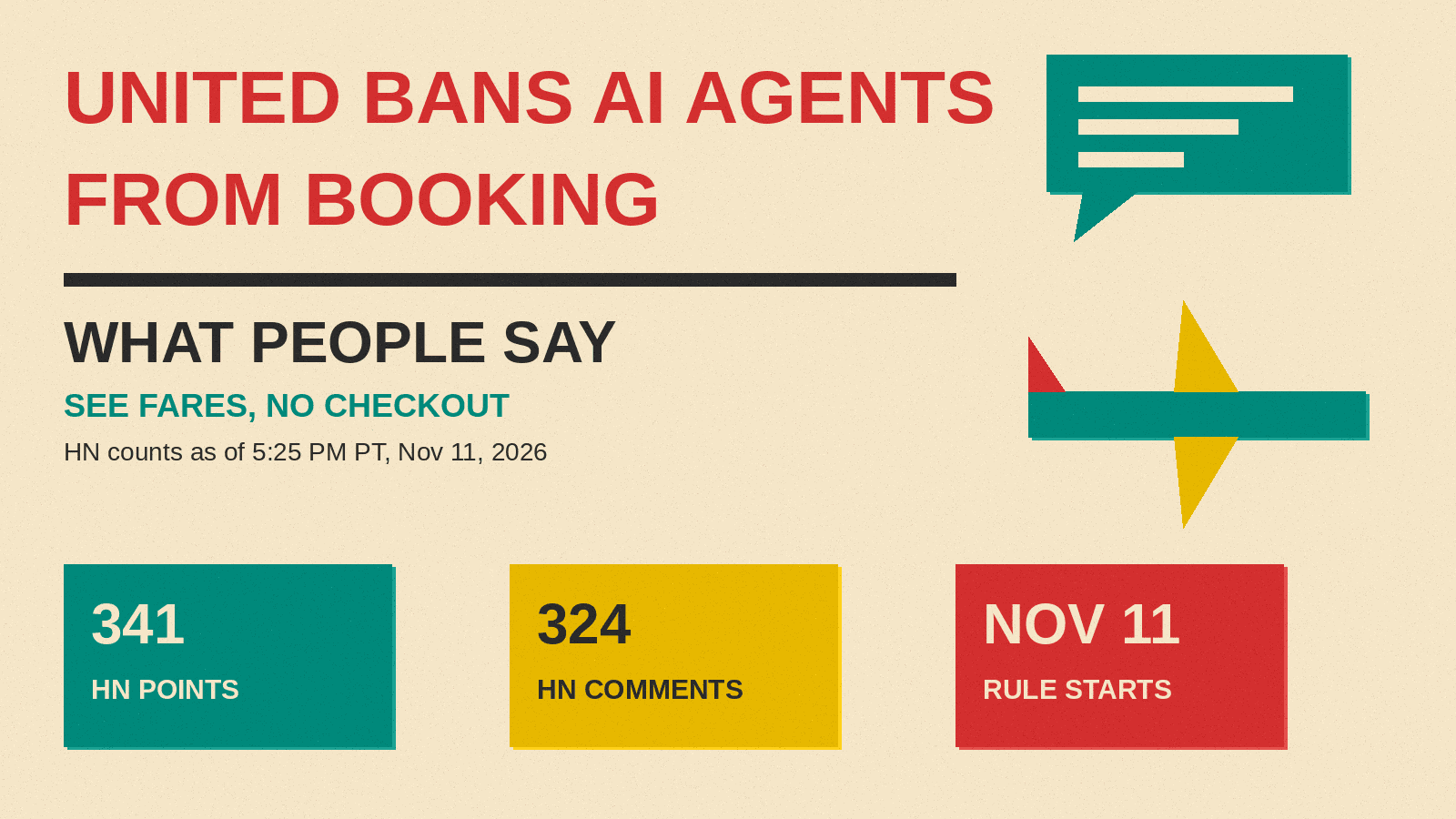
United Airlines now bars unauthorized personal AI agents from booking, changing or managing its flights. The move landed on Wednesday, Nov 11, and it set off a long argument online. The Hacker News thread passed 340 points and 320 comments, and a one-line "JUST IN" post from Kalshi on X drew about 690 likes. Here is what people on X and Hacker News are saying about it. Counts are as of 5:25 PM PT on Nov 11.
What United changed
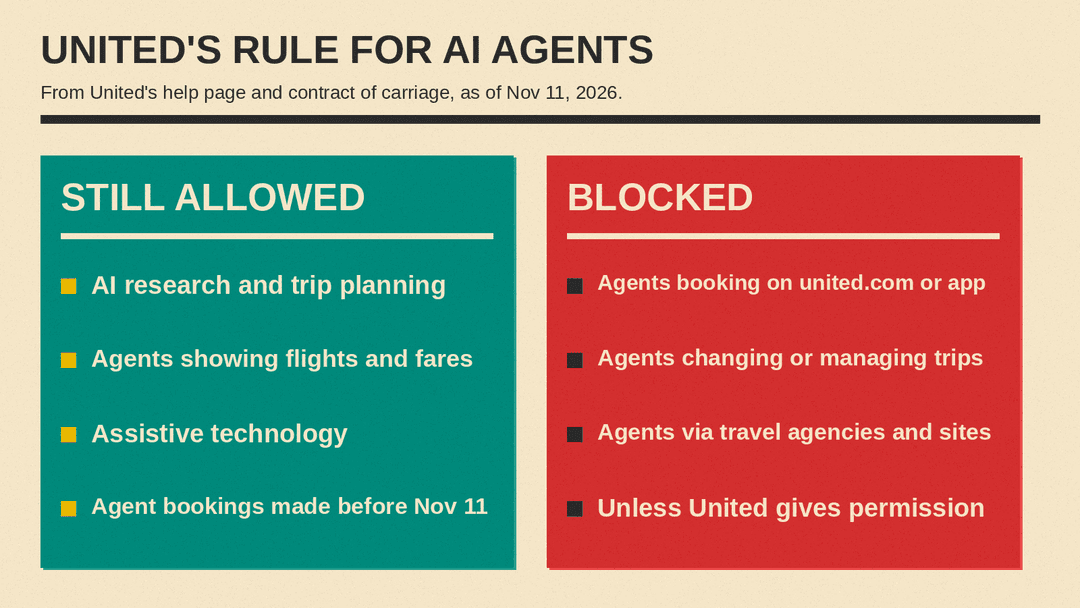
United explains the rule on a new help page about third-party AI agents and in its contract of carriage. Agents can still show you United flights and fares, but they cannot complete the purchase on united.com, in the United app, or through travel agencies and booking sites. Bookings made before Nov 11 will not be canceled. Our news report on United's AI agent ban has the full details.
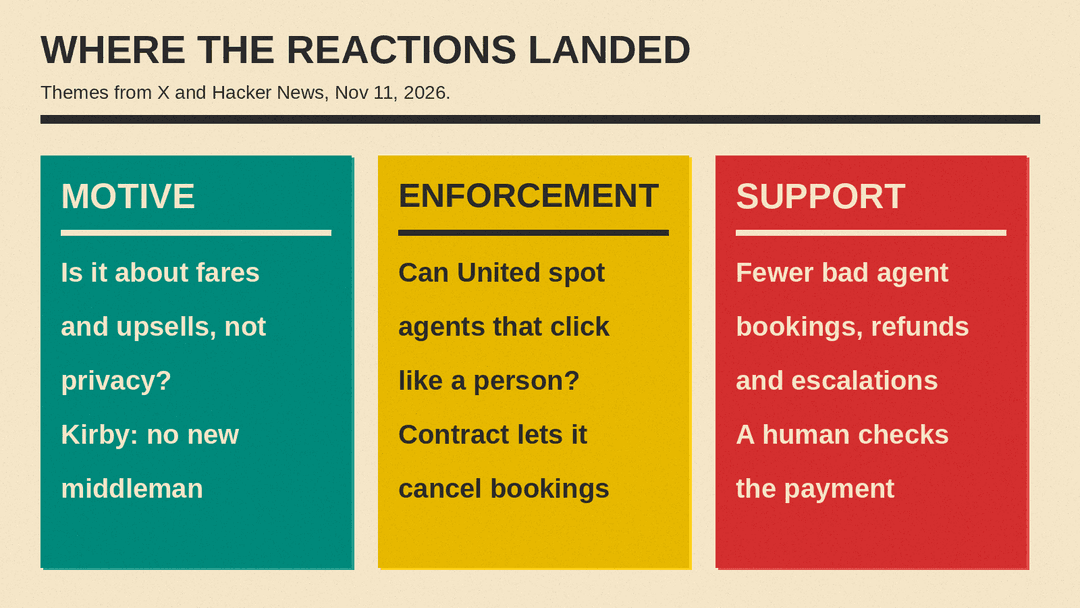
United's stated reasons are privacy, unwanted purchases and regulation. As quoted by the New York Post, United said: "Sharing account credentials with personal, third-party, AI assistants can expose sensitive information, and actions taken by these tools may result in unintended purchases, account changes, or use of MileagePlus miles." CEO Scott Kirby gave a more direct reason earlier in the week: "To be honest, I don't want to create another middleman."
That second quote is the one most people reacted to.
The middleman argument
@pitdesi wrote, in a post with about 210 likes: "United is blocking AI agents from booking tickets on its system. CEO Scott Kirby says 'I don't want to create another middleman'". He then pointed out that agents can still book through an online travel agency (OTA), which he called "still a middleman" and which, he said, costs United a little more than an agent booking direct.
Replies under that post pushed the point further:
- @nitaidean: "the OTA still walks you past the extra legroom screen and the bag fees tho. an agent books the cheapest fare and skips every upsell.. pretty sure thats the middleman Kirby is actually worried about"
- @naman03malhotra: "blocking agents doesn't kill the middleman, it just picks which middleman gets paid"
- @CarinaRealtorSF: "airlines spent years pushing everyone off the OTAs and onto their own apps. an agent booking direct is kind of what they asked for, just not the customer they pictured"
- @chrishacken: "How is an AI agent a 'middleman'.. it's more like an arm."
The pricing debate on Hacker News
The biggest argument on Hacker News was about fares. Many commenters read the ban as a way to protect airline pricing. alienbaby wrote: "The cynic in me thinks this is to prevent agents hunting and findingthe best deals". aucisson_masque called the regulation argument about check-in "ridiculous" and said United wants "to keep their price list miserable to compare so they can overcharge people."
ProblemExplorer argued the other side: "The airlines are trying to reduce prices for everyone without giving specific people (atleast those who they don't deem 'worthy') an edge." The comment says personal agents "cause a local optima while overall increasing cost for rest of the travelers." That comment drew pushback. maccam912 replied: "I don't follow why an mcp server buying a 50 dollar flight would make costs to up?" QGQBGdeZREunxLe asked: "Why is the flight even offered if it's such an issue for the airline?" In answer, _diyar gave a short example that ProblemExplorer also linked: if Alice will pay $100 and Bob $50, an airline that can no longer charge them differently "has to charge $75 per seat, excluding Bob from participating in this market."
bz_bz_bz raised a different cost. On United, the comment says, you can rebook when a fare drops and keep the difference as travel credit (not on basic economy), and most travelers never check. The comment says "AI agents threaten to reduce this 'laziness tax'" and that other industries are worried about the same thing.
Can United even enforce it?
The top Hacker News comment by replies, from doctoboggan, asked: "How do they plan on stopping me from using Claude code with the Claude in chrome plugin, or some other computer use agent?" The same comment says: "I will continue to access online merchants in the way I prefer and will do my best to avoid detection or blocking."
Others agreed detection is hard. olouv, who built a tool that lets Claude drive a Mac, wrote that it "can drive a regular Safari exactly like I would." On X, @heysamir_ wrote: "I wonder if United can tell really good computer use apart from humans though." @pitdesi replied "Agree".
The reply that cut against this came from otterley: "They might not be able to stop you, but they can cancel your flight if they determine later that you violated the ToS or contract of carriage." Our news report notes that the contract change lets United cancel reservations made by AI agents.
A few startups used the moment to pitch. @soupsranjan wrote: "We can tell agents apart from bots. We identify about 80 agents by names now." @Andy_Mindtrip, replying to @pitdesi, wrote: "Our approach runs right inside your phone and is going to be almost impossible to distinguish from a human pressing the buttons." We could not verify either claim.
People who think United got it right
Not everyone objected. jeremyjh, replying to doctoboggan, said it is not hard to see why an airline "would get tired of getting more refund requests and customer service escalations" from customers who will not accept the results of decisions their agent made for them. A full ban, the comment says, lets the airline "cut those processes short".
On X, @FranciswongCro wrote: "I think United Airlines got this one right." The post adds: "Let the agents see what you sell. But when orders and money go through, a human still checks first." @JRichDaDon1 replied to @pitdesi: "These agents will absolutely screw up bookings. The OTAs can deal with that instead of the airline." @memphyssk framed it as liability: "who eats the refund when a personal agent books the wrong flight, united, the model company or the guy who typed the prompt?"
Some doubted the use case itself. cmpolis wrote that "it was always odd to me that 'booking a [flight|hotel|concert tickets]' is the canonical example of a task that can be automated by an agent," because those tasks are already quick and involve a large payment.
The market angle
The New York Post tied the news to Meta. It said the ban removes "a highly touted use case" for Meta's new Muse agent. It reported that Meta shares "fell about 2%" on Wednesday. The paper's headline says the move sent Meta shares "tumbling". We covered the Meta Muse Ember launch reactions earlier this week.
Why it matters
United joins other companies that block AI agents, and its rule tests who controls the checkout when an agent shops for you. Many of the comments quoted here question the motive, not the privacy risk, and ask whether a contract rule can stop an agent that clicks like a person. As @vargasjmh put it in a reply to Kalshi: "Capability is not the bottleneck anymore. Permission is."
For travelers, the practical advice stays the same: use AI to compare flights, then book on United's site or app yourself.
What to watch
- Whether other airlines follow United or, like Southwest with its ChatGPT plugin, go the other way.
- Whether United cancels any bookings under the new contract rule.
- Whether United announces an approved agent partner, which its help page leaves open.
- How agent makers such as Meta and OpenAI respond.
Sources
- Hacker News discussion
- United Airlines: Unauthorized third-party AI agents or assistants
- New York Post: United Airlines bars AI agents from booking tickets, sending Meta shares tumbling
- Engadget: United Is Restricting AI Agents From Booking Flights
- llms.blog: United Airlines Blocks AI Agents From Booking Flights
- @Kalshi on X
- @pitdesi on X
- @pitdesi reply on X
- @heysamir_ on X
- @nitaidean on X
- @naman03malhotra on X
- @CarinaRealtorSF on X
- @chrishacken on X
- @soupsranjan on X
- @Andy_Mindtrip on X
- @FranciswongCro on X
- @JRichDaDon1 on X
- @memphyssk on X
- @vargasjmh on X
