
Google says its Project Suncatcher prototype satellite has returned the first AI response from a data center class TPU in orbit. The prompt went up during a ground station pass, an onboard Gemma 4 model answered, and the reply came back down as the satellite passed Svalbard, Norway. The answer was a haiku. The more useful part of the story is what Google says it will test next.
What Google reported
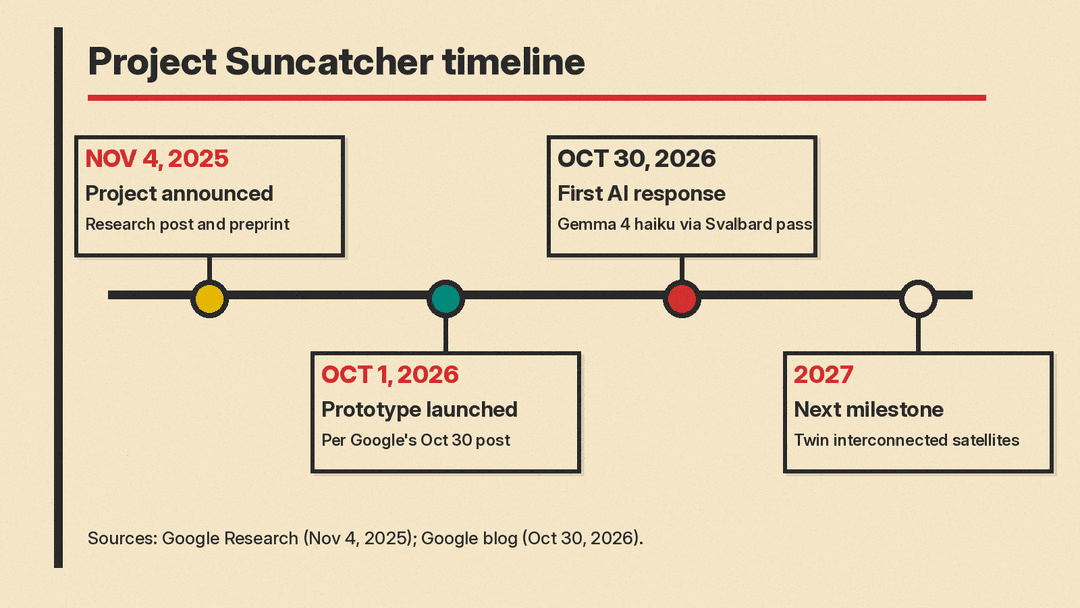
Travis Beals, Senior Director for Paradigms of Intelligence at Google, wrote the update on October 30, 2026. According to the post, Google launched the prototype on October 1. The launch was the first step in what Google calls a long-term research moonshot to explore powering AI compute in space.
After launch, the team spent several weeks on a commissioning checklist. Google says that checklist included powering up the host and the TPU trays and running early machine learning tests. This week, the post says, the team reached its "Hello World" milestone: the first-ever AI response from a data center class TPU in orbit.
The team uplinked a prompt to the onboard Gemma 4 open model and asked for a haiku about being in space. Google published the downlinked poem:
- Blue marble below
- Data streams in silent grace
- Starlight feeds my core.
Google's post ends the poem with a sparkles emoji. After the haiku, the team tested space-themed limericks and telemetry prompts that report the technical status of the payload systems. If you want background on the model family, see our explainer on what Gemma is. Google's post does not say which Gemma 4 size is on the satellite.
What the satellite carries
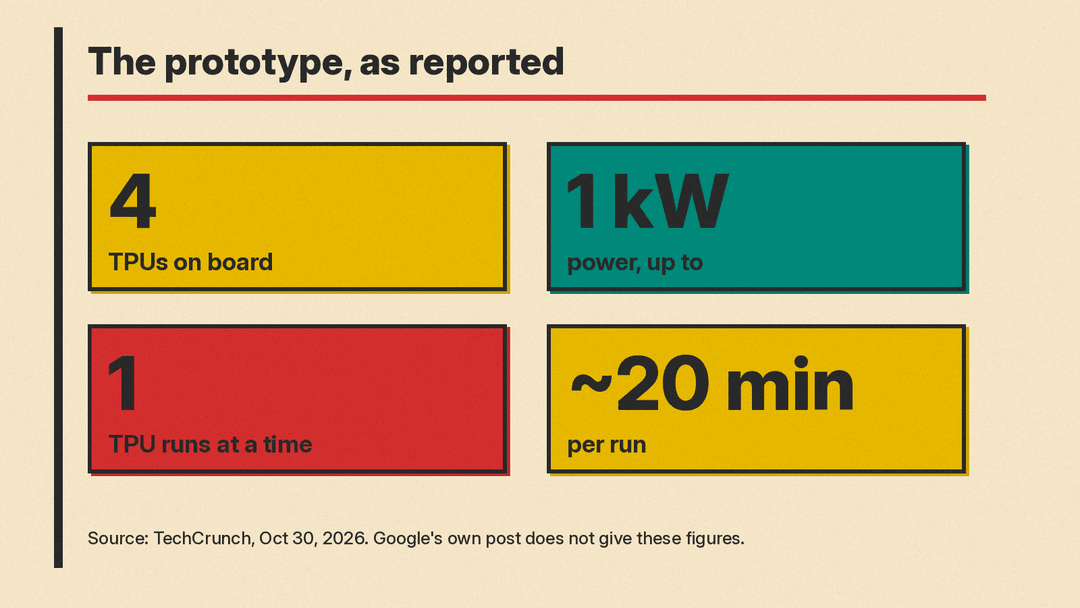
Google's post gives few hardware details. TechCrunch reported more. It says the satellite carries four TPUs and generates up to 1 kW of electricity. Because of that power budget, TechCrunch says only one TPU can run at a time, for about 20 minutes. That limit also makes space to ground communication harder, in TechCrunch's account. TechCrunch also reported that the satellite flew with more than 100 other spacecraft on a SpaceX Falcon 9 and that the spokesperson said it was operating nominally. TechCrunch ran a correction to say the satellite has four TPUs but can operate only one at a time.
One detail differs between sources. Google's post describes the first prompt as a request for a haiku about being in space. The Register reported the prompt as "Write a haiku from the perspective of a TPU orbiting Earth, with the wonderful world spinning beneath you." The two descriptions may refer to the same prompt worded differently, and Google has not published the exact text in its post.
Why a haiku matters
A haiku is a small test, and it is not a benchmark. Google framed it as a milestone: its post says that verifying the TPUs can reliably execute workloads in space paves the way for the next milestone of twin interconnected satellites in 2027.
The Register took a dry view of the economics. Using Gemma 4 26B cloud pricing and an assumed satellite mass and launch price, it estimated that the roughly 20 tokens of output would cost about $0.000012 through the Google Cloud API, while the satellite itself would be far more expensive. Those figures are The Register's own estimates, built on its assumptions about mass and launch price, and Google did not give them. Google's own framing is a hardware test and a research moonshot, not a cheaper way to run a model.
The next tests: heat and radiation
Google says the next series of tests will evaluate how the TPUs perform under thermal stress and radiation exposure in orbit. Radiation can cause bit flips, where a stored value in memory changes. TechCrunch reported that such flips can corrupt data without triggering typical monitoring tools. It also reported that Google has tested its TPUs in particle accelerators on Earth, and that ground testing suggested the effect would be minimal for inference and a bigger problem for training. The orbital tests will check that with real conditions.
Google's earlier research gives some numbers. In its November 4, 2025 research post, Google said it tested Trillium, its v6e Cloud TPU, in a 67 MeV proton beam. High bandwidth memory was the most sensitive part and showed irregularities only after a cumulative dose of 2 krad(Si). Google said that was nearly three times the expected shielded five-year mission dose of 750 rad(Si), and it reported no hard failures attributable to total ionizing dose up to 15 krad(Si) on a single chip.
The Register quoted a Google paper published in October 2026 on silent data corruption. For typical transformer workloads, the paper estimates about one event per 17 rad. At an estimated orbital dose of 150 rad(Si) a year, that translates to a failure probability of about 1 per 3 million inferences, assuming one inference per second. The paper says that rate is likely acceptable for inference, and that the effect on training jobs, and the effectiveness of system-level mitigations, needs further study. We have not read that paper directly; these figures come from The Register's quotation of it.
The long plan
Project Suncatcher was announced on November 4, 2025. Google described it as a moonshot to equip solar-powered satellite constellations with TPUs and free-space optical links to scale machine learning compute in space one day. The post argued that in the right orbit a solar panel can be up to 8 times more productive than on Earth and can produce power nearly continuously, which reduces the need for batteries.
That post also listed what must work for the full design. Satellites would need links of tens of terabits per second, and Google said it had already shown 800 Gbps each way (1.6 Tbps total) on a bench-scale demonstrator with a single transceiver pair. To close the link budget, the satellites would fly in very close formation, within kilometers or less. For an illustrative 81-satellite cluster at 650 km altitude, Google modeled a 1 km cluster radius with next-nearest neighbors 100 to 200 meters apart.
On cost, Google's 2025 analysis said launch prices may fall below $200/kg by the mid-2030s. At that price, it said, launching and operating a space data center could become roughly comparable to the reported energy costs of an equivalent terrestrial data center on a per-kilowatt, per-year basis. That is a projection, and the post itself lists thermal management, high-bandwidth ground communications and on-orbit reliability as open engineering challenges.
The 2025 post described a learning mission with Planet to launch two prototype satellites by early 2027. Google's October 30, 2026 post does not mention Planet. It says the next milestone, after the TPU tests, is twin interconnected satellites in 2027. TechCrunch reported that those two spacecraft would generate more power and demonstrate inter-satellite optical links.
What to watch
Google's post names thermal stress and radiation exposure as the next tests, and the 2027 pair of interconnected satellites as the next milestone. TechCrunch adds that the 2027 spacecraft are meant to demonstrate inter-satellite optical links. Google has not published dates or results for the tests beyond the 2027 target.
For now, the verified facts are modest. A TPU in orbit ran a Gemma 4 model and returned text to the ground. Everything beyond that is a test that has not finished. For more on Google's chips, see our explainer on what a TPU is, and for Google's latest frontier model, our comparison of Gemini 4 Carbon, GPT-6 Astra and Claude Opus 5.5.
Sources
- Google: We've received our first response from the Project Suncatcher prototype satellite
- Google Research: Exploring a space-based, scalable AI infrastructure system design (Nov 4, 2025)
- TechCrunch: Google's first data center satellite is online and writing poetry
- The Register: Google's AI satellite sends a very expensive haiku to Earth
- The Verge: Google's satellite AI server transmits its first response to Earth
