
A Y Combinator startup called The Subvocal Company opened preorders for glasses that turn silent mouthing into typed text. The pitch, on its product site, is to input text at the speed of speech, silently and invisibly, so you can dictate to an AI chatbot on a train or in an open office without anyone hearing you. The glasses are not finished: the company says it expects to start shipping in the first quarter of 2027, and the images on its page show a design direction, not final specifications. When we checked on November 4, 2026 (Pacific time), the preorder page said Early Bird preorders are closed and offered a free waitlist instead.
The idea drew a lot of attention in early November. The founders' Show HN post had 830 points and 390 comments when we read it, and The Register covered it on November 2, 2026.
How the glasses work
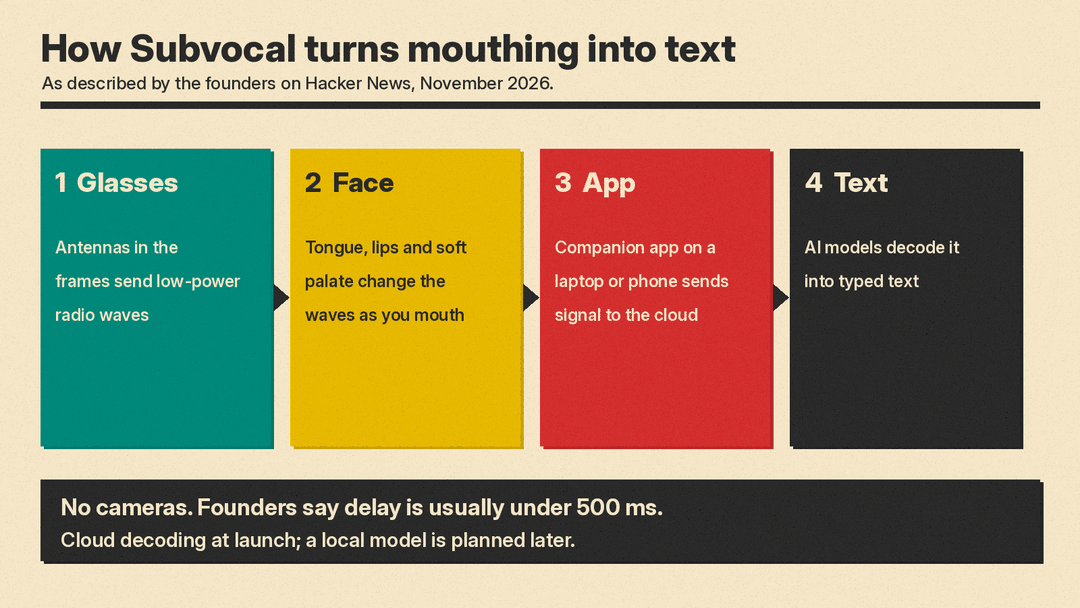
Subvocal does not use cameras. According to the founders' Hacker News post, the frames hold antennas that send out low-power radio waves, similar to Bluetooth, that pass through the face. The tongue, lips and soft palate change those waves as you silently mouth words, and AI models trained on that data decode the changes into text.
The company says the current prototypes decode open-ended speech at more than 200 words per minute. The founders say in their Hacker News post that they paid people to read prompts while wearing the glasses to build pretraining data, which they say lets a new user get by with a short calibration. The Register, citing the company, says YC partner Dave Lieb read only 20 sentences to calibrate the headset.
The founders also say you do not have to open your mouth. They describe a mode they call internal speech, which is closer to mouthing with your lips closed. They say it is a bit weird to do, that it gets easier with practice, and that they do not often lead with it. On the site's FAQ, the company says that at normal conversational distance the movement is designed to be invisible.
What it will cost and when
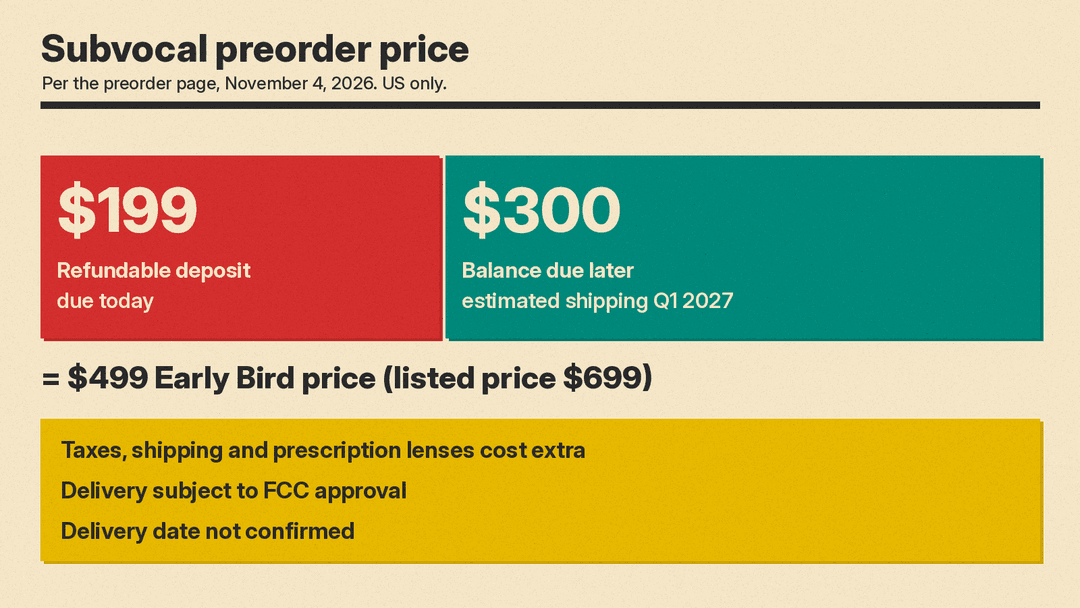
The preorder page listed a $199 deposit, which it says is fully refundable before you make the final payment. The Early Bird price is $499, shown next to a crossed-out $699, so the remaining balance is $300. Taxes, shipping and optional prescription lenses cost extra. Paid preorders were open only in the United States, and delivery is subject to FCC approval. In the Hacker News post, the founders say the first batch is 500 units. On November 4, 2026 (Pacific time), the page said Early Bird preorders are closed, and its button read "Sold out" with a free waitlist. The page does not say how many units were reserved.
The page says plainly that a delivery date for your order has not been confirmed. The Register notes that the final full price is not clear.
Open questions before you reserve
Several details are still missing. The Register notes that key details such as the accuracy rate and battery life are not known yet. The site's own FAQ says only that accuracy keeps improving as more data comes in, and that the product uses context and easy corrections instead of pretending errors never happen.
Privacy drew the most pushback in the Hacker News thread. In replies there, a founder said decoding happens through a companion app on a laptop or phone, with the processing done in the cloud and an end-to-end delay usually under 500 milliseconds. The founder said the data is processed with encryption in hardware isolation and only kept and used for anonymized training with the user's consent. The founder said a small local model is planned a few months after the glasses ship. Several commenters said they would wait for local processing before buying.
The founder also said there will be a free tier with a cap on dictated words and a paid tier of about $20 per month for unlimited dictation. At launch the glasses support English only, with Spanish planned as the second language. Those pricing and language details come from a comment, not from the company's site.
A few readers asked about the health effects of a radio transmitter near the face. The founder replied that the radio signal is very low power and only turns on while you are dictating. A commenter asked for documented research, and we did not find any published safety testing in the sources we read.
Why it matters
Voice typing is moving into everyday apps: Granola added a free Mac beta on October 29, 2026, and Raycast shipped an iPhone keyboard with dictation the same day. The founders' pitch is that the awkward part is doing it around other people, and Subvocal is a bet that a quiet input method can fix that. The company's FAQ says it is meant to work as an input method for the apps you already use, such as ChatGPT, Claude, Slack and email, not as a separate app.
The catch is that this is a preorder for an early product from a young team, with open questions on accuracy, privacy and FCC approval. A refundable deposit lowers the risk, but nothing has shipped yet. Brilliant Labs launched another pair of AI glasses, Halo, on October 27, 2026 at $399, and our post covers its privacy pitch and fine print. In the Y Combinator launch post, the founders say they are starting with people who already use voice heavily and wish they could use it in places where speaking out loud does not work.
