
Nothing, the phone and earbuds maker, says its first AI device ships in December and has no screen. On November 4, 2026, CEO Carl Pei posted on X that "our first AI-native product ships next month. It's a tool, but one built with the personality and care that have come to define a Nothing product. It has no new screen, and it couldn't have been an app." That is all Nothing has said about the product itself. There is no name, price, spec list or exact date yet.
What Nothing has confirmed
Per The Verge, Pei shared an image with the post that reads "NOTHING(R)" in the top left corner above an ambiguous black rounded corner. Beebom describes the teaser as a matte, dark object with rounded corners labelled "Coming Soon." The picture does not show the full shape.
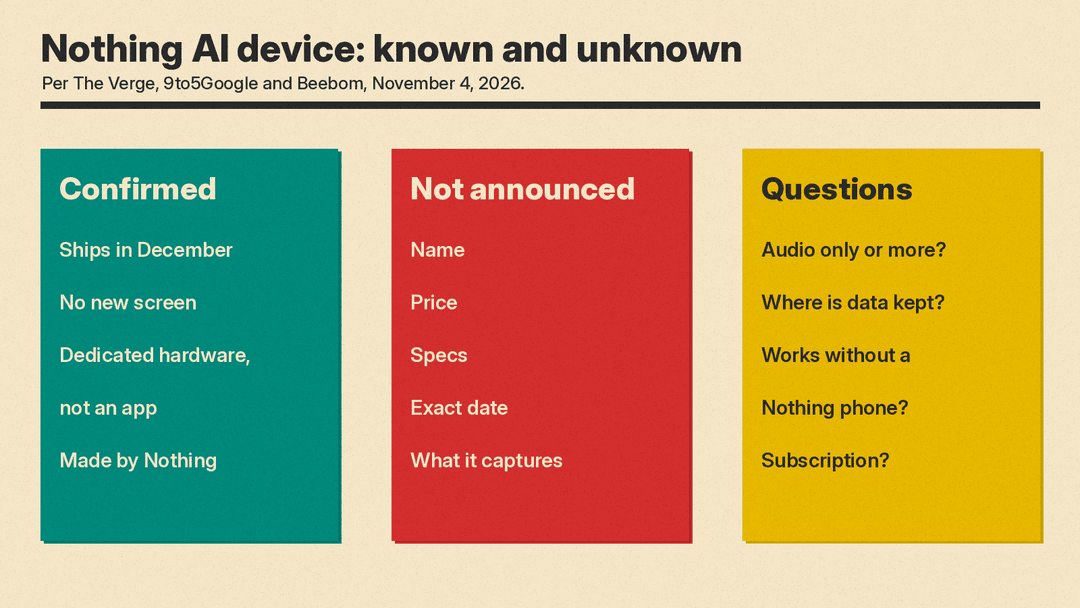
Three facts are solid. The device ships in December 2026. It has no new display. It is dedicated hardware, not an app. 9to5Google points out that "couldn't have been an app" is a common line among dedicated AI recorders, and it calls the exact meaning unclear. Everything beyond those three facts is a guess, so treat any spec or price you see this week as a rumor.
The essay behind the teaser
The announcement came with an essay from Pei titled "Toolmakers." Its main argument is that the industry is searching for an AI "iPhone moment" too early. In the words The Verge quotes, "the whole industry is hunting for its iPhone moment: the pendant, the pin, the glasses, the companion, some magical consumer device that makes AI part of everyone's life." Pei adds that "Looking for the iPhone of AI today is a dead end."
His alternative starts with work. According to Beebom's summary, Pei says new technology usually spreads through productivity first, as PCs and mobile phones did, before it reaches everyday consumers. He cites coding as more than half of company spending on job-specific AI, followed by IT, customer support and legal. That is why he calls the new device a tool rather than a consumer gadget.
The "context gap"
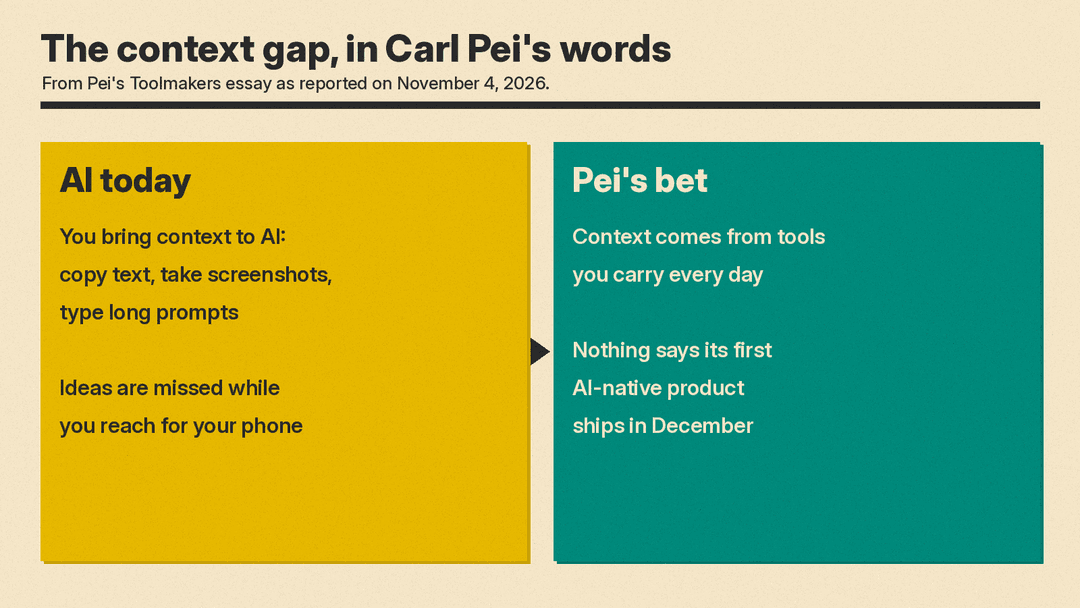
The core idea in the essay is what Pei calls the context gap. AI models are already capable, he argues, but they know very little about your day. Ideas from conversations and quick remarks in meetings rarely reach them, because people either do not note them down or miss the moment while reaching for a phone. In his words, "the intelligence is already here, and the context is what's missing."
Europa Press reports (translated from Spanish) that Pei says using AI today mostly means typing context into a text box, and that the context actually lives in the tools you use and carry every day, not in a chat window. It also reports that he expects AI to move from something you work with to something that works for you, handling routine tasks so people can spend time on creative and strategic work.
For an everyday user, the point is simple. Right now you have to copy an email, take a screenshot or type a long prompt before an assistant can help. Nothing is betting that a device which captures that context for you, without you reaching for your phone, is a better way in.
What it could be
Nothing has not said what the product is, so this part is informed speculation from other outlets. Beebom reads the context gap language as pointing to an ambient capture device, such as an AI recorder or note-taker, and names Plaud, Anker and NeoSapien as companies that already sell that kind of product. It also suggests the "no new screen" wording could mean the device relies on a paired Nothing phone to show and organize what it captures.
There is a software precedent. Beebom notes that the Nothing Phone 3a series introduced the Essential Key, a dedicated button that sends screenshots, voice notes and photos to Essential Space, Nothing's AI hub. A long press records a voice memo, which Essential Space transcribes and analyzes, and the app can turn saved items into task checklists. The weakness Pei points at is that this still needs you to pick up your phone in the middle of the moment.
Other reporting adds context but not confirmation. The Verge says a rumor last month claimed Nothing plans two pairs of AI smart glasses, including one without cameras, and an earlier rumor said the company is "repositioning itself as an AI-first company" with a shift to AI accessories. Beebom adds that Bloomberg's Mark Gurman reported in March that Nothing's first AI-focused hardware would arrive before the end of 2026, with smart glasses planned for 2027. Nothing has not confirmed that either rumor relates to the December device.
For recent AI glasses that are already shipping or announced, see our posts on Brilliant Labs Halo and Rokid Glasses 2.
Why it matters for everyday buyers
Screen-free AI gadgets have a mixed record. The Verge lists the Humane AI Pin, the Friend and AI stuffed animals as earlier examples, and notes that OpenAI is reportedly working on an AI smart speaker with Jony Ive. Nothing is entering that group while arguing against the idea that one magic device will win.
We covered another ambient AI wearable in this category in our Amazon Bee Frontier and Bee Eclipse guide.
It also has an advantage the earlier startups lacked. Per Pei's essay as summarized by Beyond Pixels, Nothing has tens of millions of devices already in people's pockets and ears, plus hardware and software skills under one roof and a distinct design language. Pei also uses the Olivetti Valentine typewriter as an example of a work tool that carries real design personality.
If you are thinking of buying, the useful questions are the ones Nothing has not answered yet:
- What does it capture: audio only, or more?
- Where is the data processed and stored?
- Does it work without a Nothing phone?
- What does it cost, and is there a subscription?
Nothing says more details should come closer to the December launch. Until then, Nothing's own words point to a work tool rather than a phone replacement, and the rest is speculation.
Sources
- Nothing teases a screen-free AI device ahead of launch next month, The Verge
- Nothing teases a new, screen-less product coming in December, 9to5Google
- Nothing Confirms Its First AI Device Is Coming in December and It Has No Screen, Beebom
- Carl Pei (Nothing) defiende cerrar la brecha del contexto, Europa Press
- Nothing-CEO Carl Pei stellt seine Vision fuer die Zukunft der KI vor, Beyond Pixels
