

Plurai, a startup founded by two former autonomous driving researchers, launched Plurai Simulation on November 11 and opened it to every developer with a free tier. On the same day it announced $13M in seed funding led by Team8.
The product tests an AI agent in a mocked copy of its world before real users reach it. You start it from inside a coding agent: Plurai ships it as a plugin for Claude Code, GitHub Copilot CLI and OpenAI Codex, with Cursor support listed as "coming soon" in the integrations docs.
What Plurai Simulation does
In its launch post, CEO Ilan Kadar says the product "creates a digital twin of an agent and its world from the company's own knowledge base, tools and policies." It then fills a sandbox with simulated users that cover "the full range of intents, personas and edge cases," and flags failures such as policy violations, hallucinations, broken tool calls and sensitive data leaks.
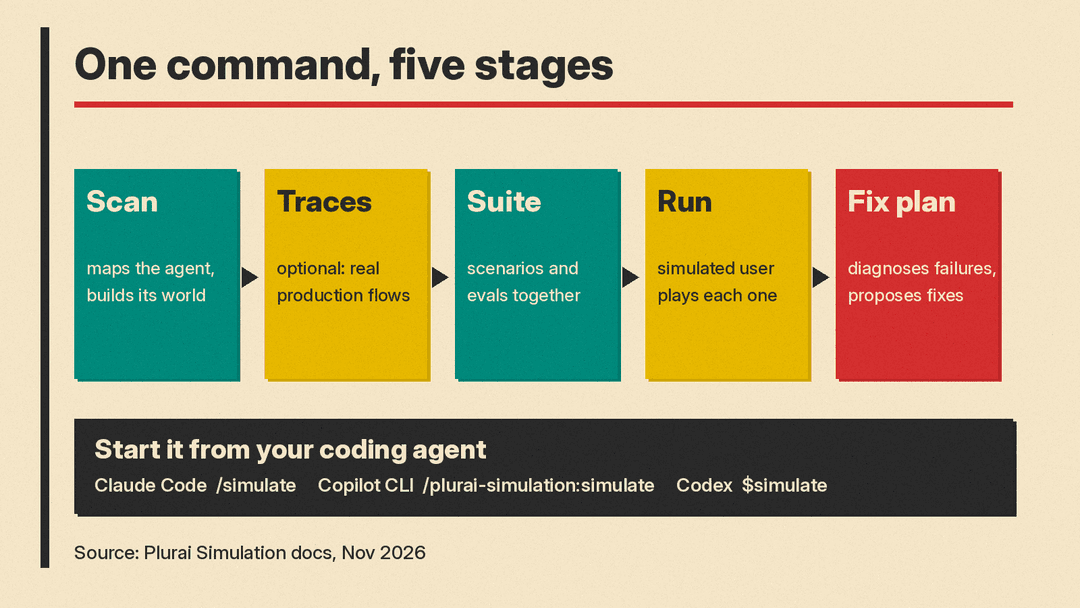
Plurai says each failure comes back with an explanation and a generated fix. The docs describe one command that runs the whole flow, from a scan of the agent to a fix plan. They say your agent's source code stays untouched because everything runs through a generated harness file, simulate.py. The docs list five stages, and each one is also a command of its own:
- Scan: maps every tool, sub-agent and data store the agent uses, decides what to mock and writes the harness.
- Ground (optional): learns tool traffic, anomalies and failures from your production traces.
- Build the suite: stands up the mock environment, then generates the scenarios and the evals that score them.
- Run: a simulated user plays every scenario, and every eval is scored.
- Fix: traces each confirmed failure to the code that causes it and proposes a fix. Nothing changes in your code until you accept one.
The docs say the final run plays each scenario three times to separate real failures from flaky ones, and writes are mocked unless you opt in.
Which agents and tools it works with
According to the integrations page, the harness can drive Python agents built with LangGraph, Claude Agent SDK, Google ADK, CrewAI, OpenAI Agents SDK, LlamaIndex, Strands or LangChain, or with no framework. Node agents run through a bridge. The same page says it works with LangSmith, Langfuse, Arize and Braintrust for production traces.
If you are new to tools like Claude Code and Codex, our explainer on what a coding agent is covers the basics. Plurai installs through the same plugin marketplaces those tools use, the way Apple's Xcode plugin reached Claude Code.
What data leaves your machine
The data and privacy page says data leaves your machine only through the SDK's upload commands, and that your data source credentials never leave it. While a simulation runs, each conversation is also sent to the Plurai backend, including the user's messages, your agent's replies, its tool calls and what they returned.
Uploads are raw by default. You can turn on local anonymization, which replaces personal data with a one-way keyed hash before upload. The page says agent description files are sent as written in both modes, and it says the plugin and SDK send no usage telemetry.
Price
The pricing page lists three Simulation plans as of November 2026:
- Free, $0: a one-time allowance of 12,300 credits, 2 agent setups, 7 scenarios, 3 runs and 10 sandbox hours. It has no overage and never charges you. Simulations pause when the allowance runs out.
- Base, $60 per month: 28,710 credits every month, 3 agent setups, 14 scenarios, 20 runs and 30 sandbox hours a month. Extra use is pay-as-you-go at $0.02 per credit.
- Business, $210 per month: 65,570 credits every month, 3 agent setups, 28 scenarios, 60 runs and 100 sandbox hours a month. Extra use is $0.015 per credit.
Plurai defines one Sim credit as one cent of model-provider usage at list price. Overage is off until an admin sets a limit, and extra credits and sandbox hours are billed after the billing period ends, up to that limit. Members are free on every plan. The same page lists separate pricing for Plurai's post-training product.

What Plurai says about results
Plurai's numbers come from its own design partners and are not independently verified. In the press release, Plurai says it cut design partners' agent development cycles "from months to hours," reduced failures reaching real users by 82% and lowered the cost of running reliable agents by 97%.
It also says that, in joint work with NVIDIA and Nebius, models it post-trained for a global enterprise customer outperformed OpenAI and Anthropic frontier models on accuracy at 40x and 44x lower cost, respectively. The release does not name the customer, the task or the models compared. TechCrunch described the comparison as one against midtier frontier models.
That claim ties to Plurai's second product. The release says Plurai uses simulation data to build small language models tailored to each agent, which can run the agent or act as "always-on evaluators and guardrails." We made a related argument in our opinion piece on why most agent work doesn't need the biggest model.
The round and the team
TechCrunch reports that co-founders Ilan Kadar and Elad Levi previously worked at Nexar, and that Kadar worked with Waymo to simulate and evaluate its driving software. The press release names U&I, Velocity and Mercer as other investors, plus more than 20 angels, including CyberArk founder Udi Mokady. Microsoft 365 Copilot CTO Dr. Eyal Carmi has joined Plurai's advisory board, per the release.
Kadar told TechCrunch that however smart OpenAI and Anthropic models get, "they will not know your business and your policy."
