
Thomas Dohmke, the former GitHub CEO, now runs a company that pitches its product as "a GitHub alternative," built especially for AI-native teams. On October 26, Entire announced what it calls "the first Git forge built for agents and humans to work together." A Git forge is the service that hosts your repositories and handles review and merging, the job GitHub and GitLab do today. Entire says the product is "available to every developer today."
The pitch rests on three parts: Trails, which replace the pull request; its own Git hosting; and Continuous Memory, a way to keep what agents learned in past sessions. Here is what each one does, what it costs, and what to check before you move a repo.
Why a new forge, according to Entire
In his launch post, Dohmke argues that the pull request no longer works when agents do the writing. Coding agents and review agents fill the timeline with long comments, and "the pull request has become an audit log that only the agent reads." His answer is to put a small set of scores at the top of the page and let agents loop until those scores settle.
The same problem drives other tools we have covered. GitHub added assisted permissions to Copilot so an AI review step can approve agent actions, and the Claude Code team described its own AI-first review loop. Entire goes further and rebuilds the review screen itself.
Trails: evals instead of a diff
A Trail is Entire's replacement for the pull request. Per Entire's Trails docs, it collects the intent, the code, the agent sessions and the review evidence for one task, from the first bug report to the merge. A Trail can span several repositories, so a change to an API, its client and its docs stays in one place.
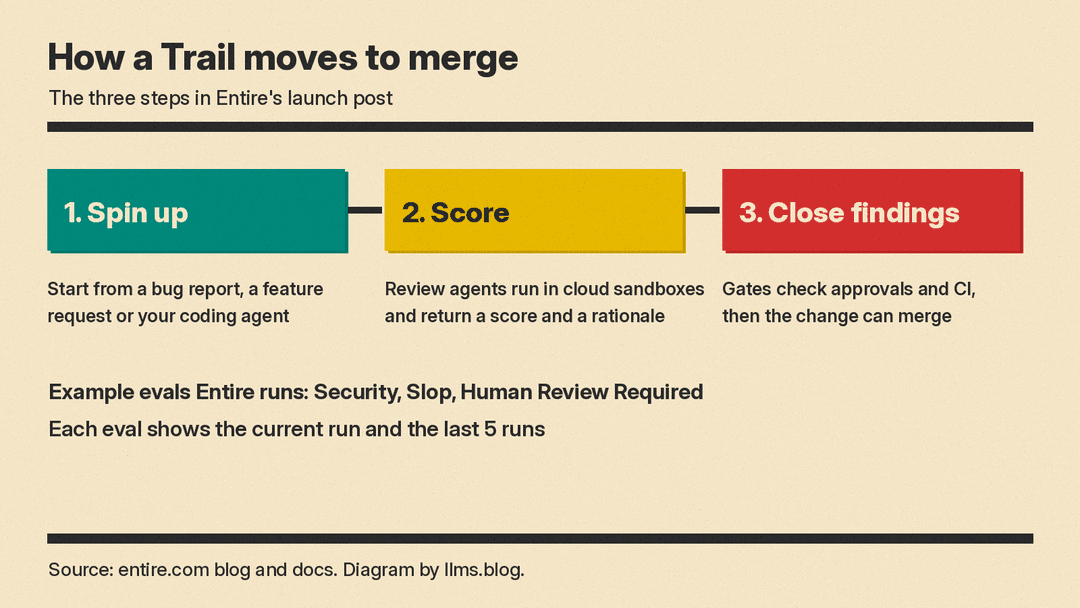
The launch post describes three steps:
- Spin up. You start a Trail from a bug report, a feature request, or straight from your coding agent.
- Score. On every push, Entire triggers review agents. Each one "runs independently in a cloud sandbox and submits a score and a rationale." Entire says it uses Security, Slop and Human Review Required evals across many of its own repositories, and each eval shows the current run next to the last five.
- Close findings, then merge. Agents can return findings with severity levels and suggested fixes. Gates, set per repo, can require human approvals and passing CI checks before merge.
Under the hood, the launch post says, Entire "utilizes Claude Code and Codex with the latest models," running in sandboxes from Daytona and E2B. Each project comes with preset agents for code quality, security and slop, and you can define your own in the web interface or as a .json config in the repo.
The press release goes further: when all evals are satisfied, developers "can merge the code without needing to look at the code itself." Note the word "can". Gates, set per repo, can still require a human approval before merge.
Git hosting and the speed claim
Entire runs its own source control server that stays compatible with Git. You can create repositories natively, or keep GitHub as the source of truth and mirror a repo by authorizing Entire's GitHub App. Hosting regions live today are the US, EU, Australia and India, per the launch post.
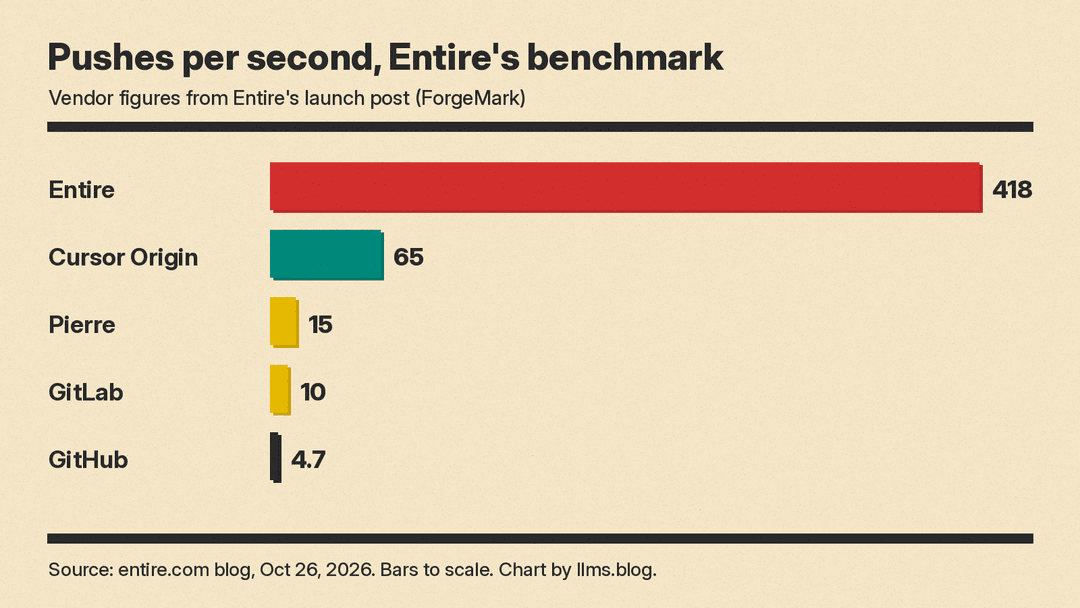
Entire says pushes are "up to 89x faster than GitHub and 6x faster than Cursor Origin," citing its own open-source benchmark. The chart in the launch post lists pushes per second of 418 for Entire, 65 for Cursor, 15 for Pierre, 10 for GitLab and 4.7 for GitHub. These are vendor numbers from a benchmark Entire wrote, so treat them as a claim to test, not a settled result.
Mirroring has limits. Entire's docs say changes in mirrored GitHub repositories still use a linked GitHub pull request for CI and merging, and that "GitHub branch rules can still block merging after Entire's gates pass." The blog says you can detach a mirror and move it fully to Entire when mirroring in the United States, or use the entire-migrate plugin.
Continuous Memory
The third part tries to stop agents from re-learning a codebase every session. It uses two open-source, local-first plugins for the Entire CLI, per the launch post:
- entire-graph maps how the code fits together, with definitions, callers and file:line locations. Entire says it "saved up to 71% on tokens" in its testing.
- entire-brain indexes past agent sessions recorded in Git history and turns them into memories the agent can query. It can connect to the Entire backend so a team shares one memory space, and each Trail shows the memories the agent created.
This overlaps with tools like Beacon, which also shares lessons between Claude Code, Cursor and Codex. Entire's version stores that memory next to the code.
CI: Buildkite and Depot
For CI, Entire launched with two partners, Buildkite and Depot. Teams on GitHub Actions can convert workflows with Buildkite's bk pipeline convert or migrate with depot ci migrate, per the blog. Build results show up as checks on the Trail, and a failing build blocks the merge.
What it costs
Entire's billing docs say it "bills only for Agent usage, using prepaid usage credits," and that you "can continue using other features for free." The details:
- What is billed: the model tokens your review Agents use, deducted from a prepaid credit balance.
- Free trial: a one-time $100 credit per billing account, no card required. It ends after $100 of usage or 90 days, whichever comes first.
- Top-ups: you buy credit by card or Link. Purchased credit expires 365 days after purchase. Automatic top-up is off by default; when turned on, it tops up to $50 when your balance falls below $10 by default.
- At zero: Agents stop until you add credit.
The same page lists per-million-token prices for each model Agents can use, at the providers' published rates; the default Claude Opus 5.5 is listed at $4 input and $20 output per million tokens (prices Entire says it verified on October 25, 2026). The real cost depends on how many evals you run per push and which models they use.
What to check before you switch
- Who reviews. Decide whether your Gates require a human approval. Gates are configured per repository, so merging on eval scores alone is a choice each team makes.
- What is still missing. The press release lists self-hosting of Git nodes, public repositories and live-streamed sessions as upcoming. Open-source projects that need public repos will have to wait.
- The benchmark. Run your own push and clone tests before you rely on the speed numbers.
- Mirror first. Mirroring a GitHub repo lets you try Trails on top of existing pull requests without moving your source of truth.
Entire raised $60 million in February, which it calls "the largest seed round in developer tools history," and says it has a team of 50. The Verge framed the launch as a competitor to GitHub from its former CEO. For more on how coding agents are being built and run, see our explainer on the Cursor Agent SDK.
