
Two amateur astronomers say AI coding agents helped them find possible planets in public NASA data that they could not find in any catalog. Neither planet is confirmed. What makes the claims worth a look is not the AI. It is that both published dated predictions that the telescope will either meet or miss in the coming months.
The newest case landed on October 18. Rishit Vora posted a long write-up, Searching for a World That Doesn't Exist, describing a candidate planet around the star TIC 402710280, along with a preprint on Zenodo and the full code on GitHub. The post opens with a disclaimer: "I'm no astronomer and would appreciate a professional pair of eyes."
What Vora found
The star is a K dwarf, smaller and cooler than the Sun, in the southern constellation Triangulum Australe, 218 light-years away. According to the preprint, it dims by about 0.21% for 5.27 hours every 36.34 days. Four of those dips appear in NASA's TESS data between 2021 and 2026, in Sectors 39, 93, 100 and 102.
If a planet causes the dip, the preprint puts its radius at 3.75 times Earth's, close to Neptune's 3.88, with an equilibrium temperature of 498 K. The blog post puts that at about 227 °C. A standard vetting tool, TRICERATOPS, gave a false-positive probability of 0.003. Vora is clear that this is not enough: formal validation also needs a high-resolution image of the star, and none exists.
Vora flags loose ends too. The four dips arrive up to 36 minutes off a fixed schedule, and the light curve also holds a weaker 3.78-day signal whose source the data cannot identify.
How Claude was used
According to the write-up, the analysis "ran in a single Claude Code cloud session over 8 days." Claude (Opus 5.5) "ran most of the research, paperwork and execution (under my direction)," Vora writes, and GPT (6, Astra) was used "for some independent checks and validations." The GitHub README says the code and manuscript were developed with Claude's help and that the author "directed the work and is responsible for its content."
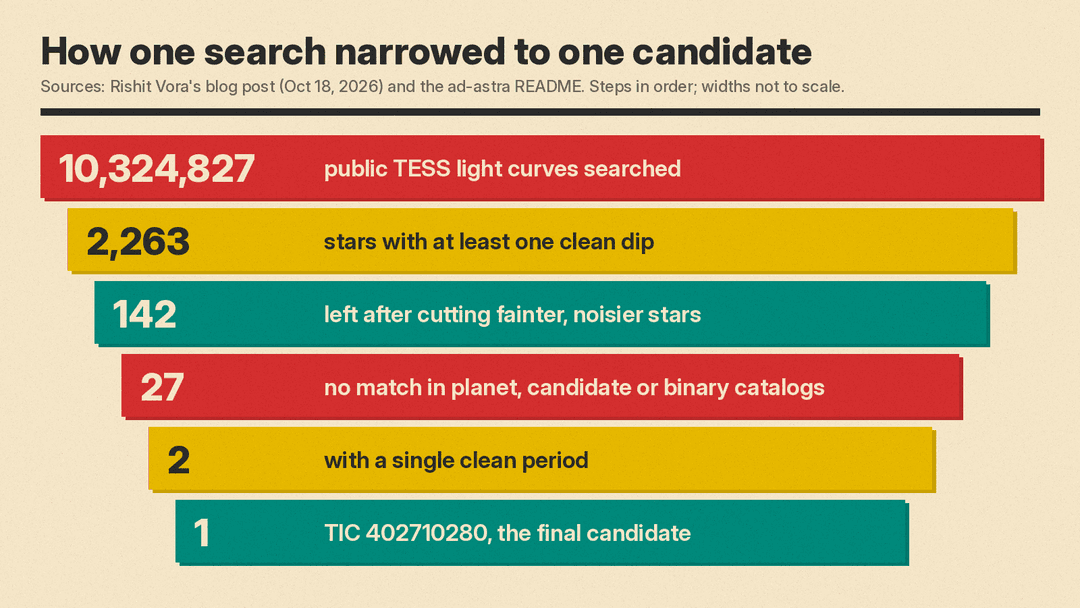
The search was large. The README says it covered 10,324,827 public light curves, plus its own processing of the 2026 full-frame images. The blog describes how that narrowed:
- 2,263 stars with at least one clean dip
- 142 left after cutting fainter, noisier stars
- 27 with no match in planet, candidate or binary-star catalogs
- 2 with a single clean period
- 1 left after a grazing candidate, TIC 447447071, was dropped
One check stands out. Every search was also run on light curves flipped upside down. As the blog explains, noise makes fake dips and fake peaks about equally often, but a flipped curve cannot contain a real transit. So whatever turns up in the flipped data measures how often noise alone fakes a signal.
The first case: TIC 4206066
Vora credits a thread by Pavel Rabtsevich, whom the blog calls "a fellow amateur astronomer," as the inspiration. On October 7, Rabtsevich wrote that a star in TESS data "kept getting a little dimmer every 3 days, for about two hours each time." Going back to 2018 and 2020 data, Rabtsevich timed 22 dips and says every one came on schedule. The thread estimates a planet about 1.4 times Earth's size, plus a possible second one, a bit over twice Earth's size, that Rabtsevich is "less sure about."
The checks, the thread says, took "74 separate analyses and over 1,000 scripts, built with Claude Code and Codex." In one test, each year of data was hidden and the other two years were used to predict when the star would dim. Rabtsevich reports it was right 3 times out of 3.
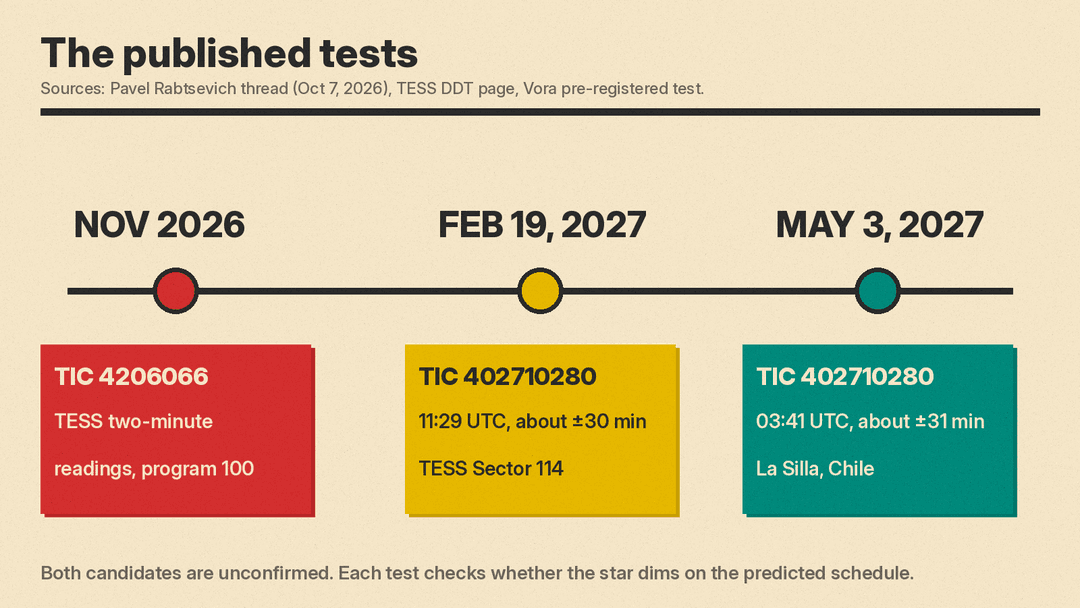
Rabtsevich also got further with NASA. A proposal to the TESS mission was approved, and the TESS Director's Discretionary Targets page lists it as program 100: "Two-minute cadence for TIC 4206066, a nearby K-dwarf with a 1.4R planet candidate." According to the thread, when the telescope returns to that part of the sky in November, it will record the star every 2 minutes.
The tests ahead
Both fixed their predictions in public before the data exists. Rabtsevich says the exact November dip times were published on October 6. Vora's pre-registered test freezes the code and sets rules for four outcomes: recovered, inconsistent, excluded, or not enough data. The registered dates:
- February 19, 2027, 11:29 UTC, give or take about 30 minutes, in TESS Sector 114
- May 3, 2027, 03:41 UTC, give or take about 31 minutes, observable from La Silla Observatory in Chile
"None of this confirms it yet," Rabtsevich wrote. Vora says a request has gone to TESS for two-minute readings in February, and is asking for help with arXiv endorsement, because NASA's ExoFOP list, by Vora's account, needs a peer-reviewed paper before it accepts a community candidate.
Why it matters
The TESS archive is public, and the telescope has been collecting since 2018. What changed is the labor. Rabtsevich's count of over 1,000 scripts shows the scale: a coding agent like Claude Code or Codex can write and run analysis code for a person who knows what to ask.
That also makes it easy to produce a confident, wrong result, the failure covered in our explainer on AI hallucinations. Citing MIT's TESS planet count page, Vora notes that about 70% of settled TESS candidates turn out to be false positives. The useful part of these two projects is the guard against that: flipped-data controls, rebuilt analyses, and predictions that can fail in public. If the stars dim on time, professional astronomers have a reason to look. If they do not, both have said they will report that too.
For more on the model Vora used, see our Claude Opus 5.5 explainer.
