
OpenAI now runs API requests inside India, not only stores the data there. On November 12, 2026, the company announced local processing and inference for its API in India for eligible businesses and developers, The Hindu BusinessLine reported. The option starts with one model, GPT-6 Luna, and comes with a list of conditions in OpenAI's API documentation.
What OpenAI announced
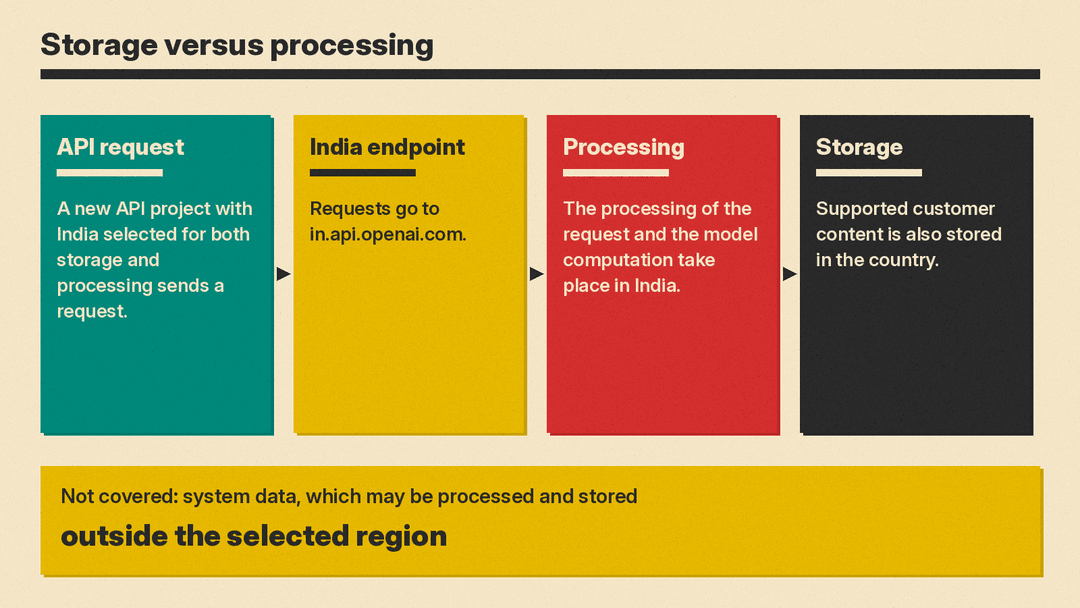
According to the Economic Times, the new option builds on the data residency options OpenAI already offered in India. For supported workloads, both the processing of an API request and the model computation that produces the answer take place in India. Supported customer content is also stored in the country.
OpenAI pointed to text-based work as the use case: summarising documents, drafting responses, and helping employees analyse information.
Nitin Bawankule, Head of Enterprise, India, at OpenAI, explained the reason in the announcement as quoted by both outlets:
"Some Indian businesses have not fully deployed AI for important work because they need the information involved to be processed within the country."
He added: "Local inference gives them more control over where supported workloads run and helps address a practical barrier to adoption."
Storage versus processing: why the difference matters
Until now, an Indian API project could keep its stored data in India. That is storage. Processing is the step where the model reads a prompt and computes the reply. OpenAI's docs say plainly that "support for regional storage does not imply support for regional processing."
The new launch closes that gap for one model. When a project uses a region that supports regional processing, OpenAI's docs say the services "will perform inference for your Customer Content in the selected region as well." The Economic Times framed the point this way: it matters for businesses that need information to stay in India during processing, not only when stored. Moneycontrol reported that the offering is aimed at organisations in sectors such as financial services that have specific data localisation requirements.
How to turn it on
Per the announcement, this covers direct API usage only. For now, local processing supports GPT-6 Luna input and output through the Responses and Chat Completions APIs. To start, a customer creates a new API project, selects India for both storage and processing, and sends requests to the India regional endpoint, which the docs list as in.api.openai.com.
Access is not automatic. OpenAI's docs say customers should contact the sales team to see if they are eligible for data residency controls. To use any region other than the United States, a customer "must be approved for abuse monitoring controls, and execute a Modified Retention amendment."
The limits in OpenAI's docs
The documentation sets these conditions for Australia, India and Japan:
- Organizations with active Zero Data Retention (ZDR) can use gpt-6-luna for regional processing. "Modified Abuse Monitoring (MAM) alone is insufficient."
- These regions support Standard pay-as-you-go only.
- The Responses and Chat Completions APIs support text and image inputs and text output.
- Image support in these regions requires approval for enhanced Zero Data Retention or enhanced Modified Abuse Monitoring.
- Hosted tools are unavailable for regional processing in these three regions.
There is also a price note. The docs say "data residency endpoints are charged a 10% uplift for models released on or after March 5, 2026, that are eligible for data residency."
And there is a scope note. Data residency "does not apply to system data, which may be processed and stored outside the selected region." The docs define system data as account data, metadata, and usage data that do not contain customer content. Residency also does not cover transfers or storage of customer content outside the region caused by where an end user or the customer's own infrastructure sits, or products from parties other than OpenAI offered through the services.
Where OpenAI offers in-region processing
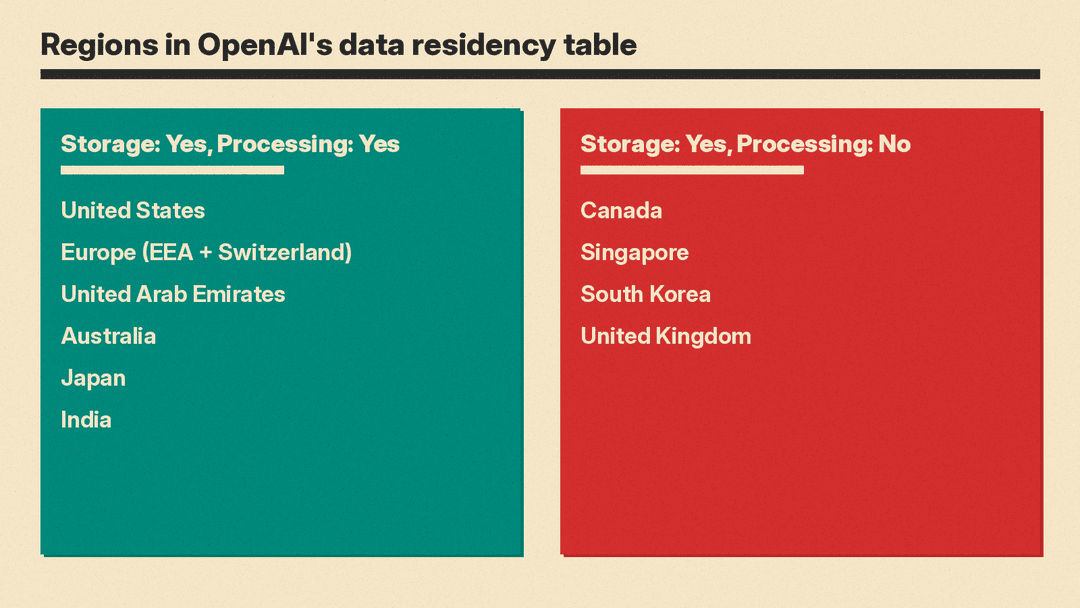
India joins a short list. In the region table of OpenAI's docs, these regions show "Processing: Yes":
- United States
- Europe (EEA + Switzerland)
- United Arab Emirates
- Australia
- Japan
- India
Canada, Singapore, South Korea and the United Kingdom show storage but not processing. Per the Economic Times, OpenAI named India, Australia and Japan among the latest markets to get API inference residency.
Why it matters
For a developer in India, the practical change is narrow but real. A team that was blocked because prompts had to be processed in the country can now use one OpenAI model for text work without sending that content abroad for inference, if it meets the ZDR and contract conditions. Teams that need hosted tools or other models do not get local inference in India yet under the current docs.
The launch also fits OpenAI's wider push in the country. The Economic Times noted the company's OpenAI for India initiative from earlier this year, which included a partnership with Tata Group on domestic AI data centre capacity. OpenAI has made other region-specific moves, such as its Abu Dhabi government deals, and it keeps adding enterprise buying routes such as ChatGPT Enterprise on AWS Marketplace.
India is not the first in-country inference deal we have covered. Emirates NBD said in October 2026 that it will run OpenAI models on UAE-based inference, and Anthropic said it will offer Claude with in-country inference in India through Amazon Bedrock.
OpenAI said the option is available initially for GPT-6 Luna. The reports and docs do not give a date for other models.
