
Sweden's Government Offices, the body that supports the prime minister and the ministries, has blocked staff from opening Anthropic's Claude and OpenAI's ChatGPT in a web browser on their work computers. The block took effect on Monday, October 26. Staff are being sent to Microsoft's Copilot instead, and some can still use both models through an approved Swedish AI platform.
The move is narrow. It is not a ban on the models themselves. It draws a line between an AI tool covered by an agreement and a security review, which is allowed, and public chatbots used without an agreement, which are not.
What happened
Ekot, the news service of public broadcaster Sveriges Radio, reported the plan on October 23. According to Ekot, the block is meant to make sure employees use the services the Government Offices has approved, among them Microsoft Copilot.
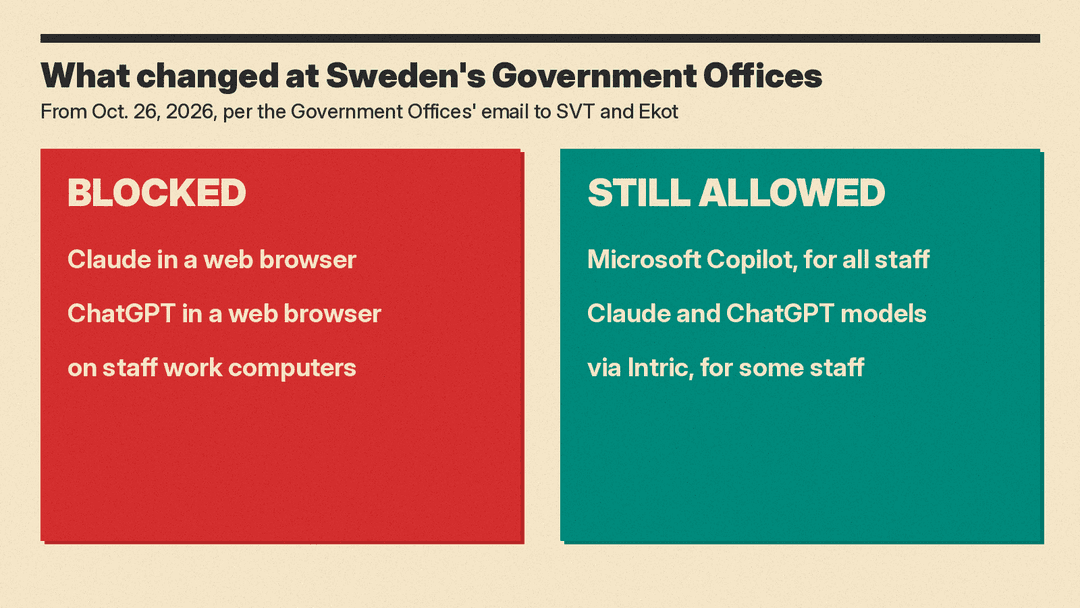
The Government Offices then confirmed the scope in an email to SVT. It wrote that the browser interface for ChatGPT and Claude would no longer be reachable from its work computers from October 26, and that within Intric, staff still have access to the ChatGPT and Claude language models. It also said all employees have access to Microsoft's AI tool.
Mikael Wettercrantz, the Government Offices' director of digitalisation, declined an interview with Ekot. In a comment on the staff intranet, he said that using AI services without an agreement can have "consequences for our information security," per Ekot's report.
Why Copilot passed and Claude did not
The reports do not say the Government Offices found a specific flaw in Claude or ChatGPT. The issue is the contract.
Euronews reports that officials were concerned that sensitive information typed into these tools without an agreement on how the data is protected could be stored and used for training. Copilot, it reports, passed a security screening and is covered by a security agreement between Microsoft and the Swedish government.
Ekot adds, citing internal information it had seen, that the Government Offices raised security in Copilot after a review. The press office would not give details, citing security reasons.
Anthropic's own terms draw a similar line. Its August 2025 consumer terms update lets users of the Claude Free, Pro and Max plans choose whether their chats are used to train future models, and extends data retention to five years for those who allow it. Anthropic says those changes do not apply to services under its Commercial Terms, including Claude for Work, Claude Gov, Claude for Education and API use. In other words, the browser chatbot a civil servant can sign up for on their own sits under different terms than a contracted business or government service.
There is also a twist. Claude is not fully absent from the approved tool. Microsoft added Anthropic models to Microsoft 365 Copilot in September 2025, starting in the Researcher agent and Copilot Studio, as an option admins must enable. Microsoft says those models are hosted outside Microsoft-managed environments and are subject to Anthropic's terms. Decrypt notes that the Government Offices has not confirmed whether Claude is switched on in its Copilot.
The Intric route
Staff who still need Claude or ChatGPT can reach the models through Intric. The Swedish company said in July that it had won the procurement to supply an AI platform to the Government Offices, initially for one year with an option to extend. Government Offices staff will use it to build and run AI assistants, for tasks such as analysing consultation responses and data, drafting reports and supporting translation, according to that post.
David Wallén of Intric told Techtidningen that the platform is model-agnostic, with ChatGPT, Claude, Gemini and other large models selectable side by side with open models that can run entirely in Sweden. Techtidningen describes it as a sovereign platform on Swedish infrastructure that does not depend on foreign cloud services.
The press office told Ekot that only part of the staff will keep this access. The press office has not said how many people that covers, Decrypt reports.
Not only one office
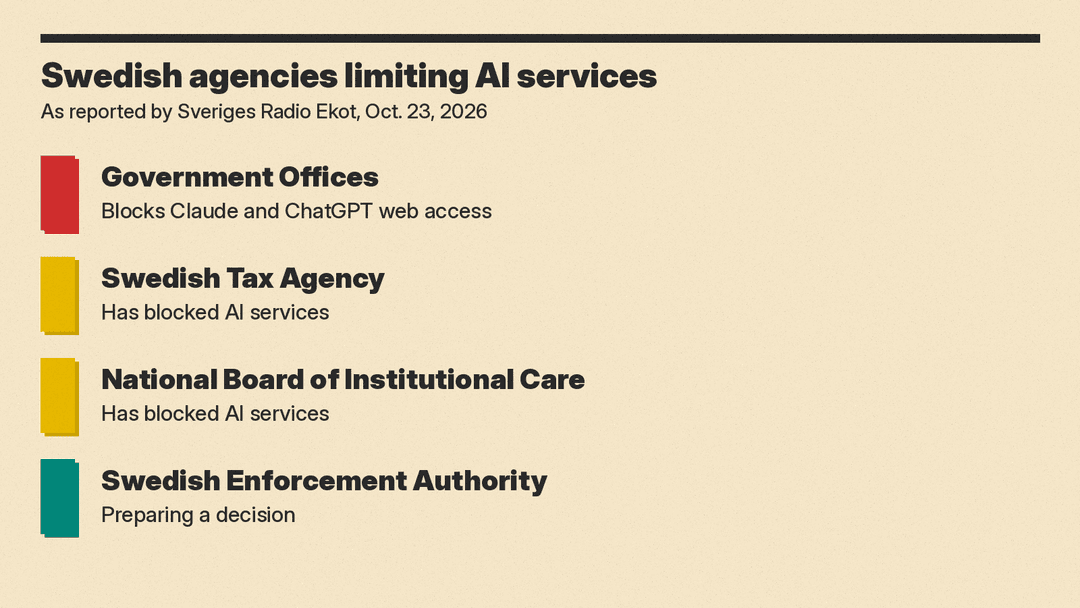
Ekot found that the Swedish Tax Agency and the National Board of Institutional Care have already blocked AI services, and that the Swedish Enforcement Authority is preparing its own decision. The Government Offices had earlier restricted DeepSeek.
The reporting also points to an internal audit at the Swedish Transport Administration earlier this year. It found widespread and risky use of about ten AI services. The auditors wrote that they had seen several examples of problematic use of open AI services, involving both how sensitive the information entered was and how the AI-generated answers were handled.
Why it matters
The block covers browser access in one office. Some staff keep access to the models through Intric, per the Government Offices' email to SVT. The stated reason is the lack of an agreement on how data is handled, not a flaw in either model. Decrypt notes that the European Parliament went further in February, disabling AI features on its work devices, ChatGPT, Claude and Copilot included, and that Sweden draws a narrower line.
Anthropic faces other scrutiny in the US. We covered the FTC's demands for Anthropic executives to testify in its consumer harm investigation, a separate case in which Claude pulled fee-gated Georgia vote counts without being asked, and the risks Anthropic lists in its S-1 filing.
The Next Web reports that OpenAI and Anthropic have not publicly commented on the Swedish decision.
Sources
- Sveriges Radio (Ekot): Regeringskansliet spärrar AI-tjänsterna Chat GPT och Claude, Oct. 23, 2026
- SVT: AI-tjänster spärras på Regeringskansliet, Oct. 23, 2026
- Euronews: Swedish government blocks ChatGPT and Claude, Oct. 26, 2026
- The Next Web: Sweden's Government Offices block ChatGPT and Claude, Oct. 26, 2026
- Decrypt: Sweden's Government Offices block ChatGPT and Claude, keep Microsoft Copilot
- Intric on LinkedIn: Regeringskansliet har valt Intric som AI-plattform, July 2026
- Techtidningen: Regeringskansliet väljer svensk AI-leverantör
- Anthropic: Updates to Consumer Terms and Privacy Policy, Aug. 28, 2025
- Microsoft: Expanding model choice in Microsoft 365 Copilot, Sept. 24, 2025
