
Anthropic opened a research preview of Claude Duet on October 21, 2026. It is a separate app where Claude acts as a proactive agent: it sends you a morning brief, watches your connected apps, takes on tasks you hand it by message, and keeps working after you put your phone down. Anthropic says it built Duet "for professionals and small business owners with more on their plates than they can track."
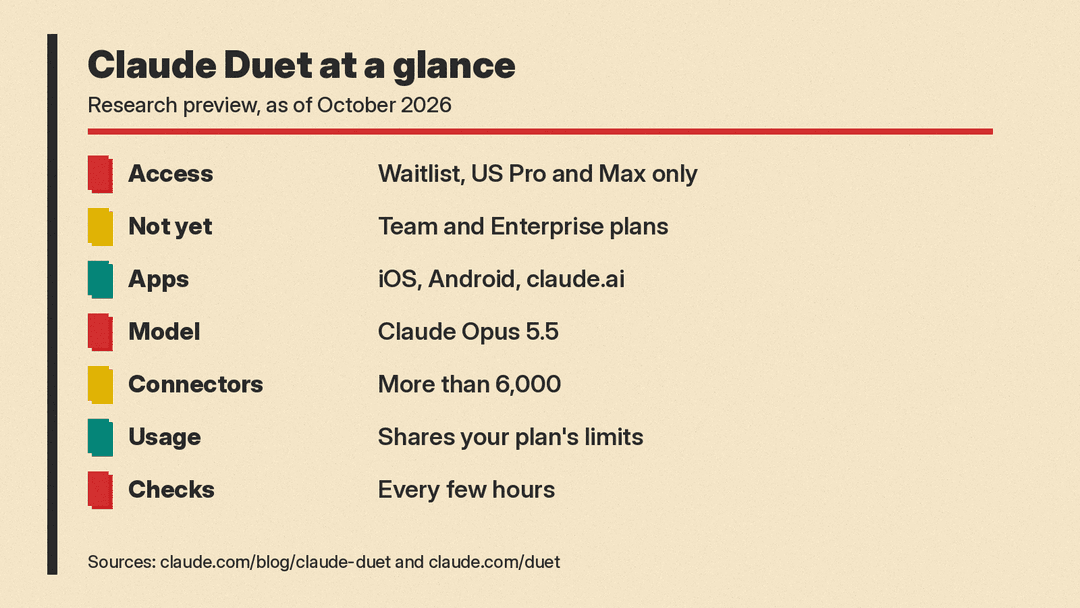
Access is by waitlist, and only for Claude Pro and Max subscribers in the US. This explainer covers what Duet does, how it handles approvals and sensitive data, what it costs in usage, and how it lines up against the agents Meta and OpenAI launched in recent weeks.
What Claude Duet does
Anthropic describes four jobs in its launch post:
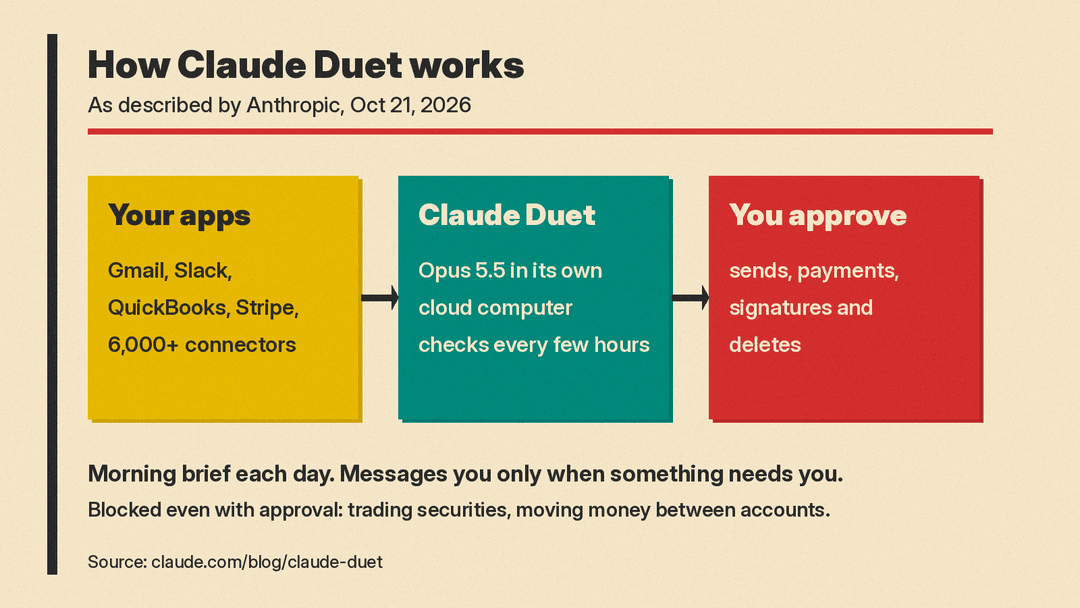
- A morning brief. Each morning it sends "a short brief on the most important items across your connected apps."
- Watching your apps. Through the day it keeps tabs on those apps and messages you "only when something needs your attention."
- Tasks of any size. Anthropic's examples run from scheduling meetings to building dashboards, financial or sales forecasts, prototypes and web apps.
- Finished work for review. The product page says it returns work "like a doc, sheet, or deck for your review."
Duet runs on Claude Opus 5.5. Anthropic says Duet's judgment is what makes it helpful, and that it built Duet to decide "what needs you, what can wait, and when to check with you first."
How it differs from the Claude app
The main Claude app waits for you to open a chat. Duet comes to you, the product page says. In Anthropic's launch post, you message it by typing or voice in one ongoing thread, so "a quick reply and a weeklong project both start in the same place."
Setup is light because Duet carries over the memory, skills and connected apps from your Claude account. It also has a virtual machine with its own browser, so it does not need your laptop or phone to stay on. You get a notification when a task is done or needs review.
For now Duet lives in its own app, on iOS and Android and on the web at claude.ai, separate from the main Claude app. Anthropic says what it learns from early users "will shape how the two work together."
What it connects to
Duet can use the more than 6,000 connectors and plugins in the Claude Marketplace. The examples Anthropic lists are business tasks:
- Find missed Gmail and Slack messages and help you reply.
- Check Intuit QuickBooks or Stripe for unpaid invoices and draft reminders.
- Prepare and run payroll in Gusto.
- Draft a job post and, after you edit and approve it, post it to LinkedIn.
- Prepare agreements and send them for signature through Docusign.
- Draft follow-ups from HubSpot contact and deal history.
- Turn a product launch into a social campaign in Canva.
- Set up and manage a Shopify store.
It can also buy things for your business through Link, Stripe's digital wallet. Duet confirms the item with you, Link asks you to approve the spend, and payment goes through a virtual card so your real card number is not shared. It can use Shop Pay at online stores. Anthropic says signing in to sites with logins saved in 1Password is coming, with your permission.
Approvals and sensitive data
Duet reads, drafts and prepares work on its own. Before it sends a message, makes a payment, signs a document or deletes anything, Anthropic says it "shows you exactly what it's about to do and waits for your approval." Some actions are blocked even with approval, including trading securities and moving money between accounts. You can disconnect any app at any time.
Anthropic lists the safeguards behind this:
- Credential handling follows the design used for Claude Managed Agents, so Duet "never directly sees your passwords or sign-in tokens."
- Actions pass through the auto mode classifier that Claude Code also uses.
- Prompt injection defenses come from Anthropic's browser-use research.
- Red teams and an external firm ran penetration tests, and Duet is covered by Anthropic's public bug bounty.
Duet also ships with a new classifier and safety system prompt that check each message for leaks. They are designed to reject sharing "the strictest tier of information," such as credit card numbers and government ID. Health and personal finance details go out only when you have explicitly told Duet to send them. Anthropic says it will share more on Duet's safety design "in the coming days."
What it costs
There is no separate price during the preview. Duet is included in Pro and Max and shares your plan's usage limits with the rest of Claude. It uses them differently from a chat: background checks count toward the limits, and bigger jobs like a financial model or a deck take more model turns.
That is why Duet checks your accounts every few hours instead of constantly. Anthropic says nonstop checking "would use up your plan's limits much faster." You can tell it what you want to hear about and how often. Team and Enterprise plans are not included yet, per the FAQ.
Duet vs Meta Muse and OpenAI Dots
Press coverage frames Duet as Anthropic's answer to two recent launches. CNBC reports that Meta has marketed Muse mainly to consumers, while OpenAI's Dots straddle enterprise and consumer use. After Meta reported third-quarter earnings on October 21, CNBC reports, Mark Zuckerberg told analysts that more than 10 million people in the US and Canada "have set up Muse personal agents" over the past month and a half.
Duet is aimed at work instead. Anthropic says personal errands such as booking tickets "aren't quite as strong." Engadget points to access as a difference: it reports that Dots are currently limited to OpenAI's Pro tier, which it says starts at $100 per month, while Duet is open to Claude's Pro plan, which Engadget puts at $20 per month. For background, see our explainers on OpenAI Dots and Meta Muse Wonder.
Limits to know
Anthropic calls this an early version. It says Duet "still might misread a thread or miscalibrate what's urgent," and the FAQ adds that it can miss something that arrives between check-ins. It cannot yet show you its browser. Anthropic says it is still tuning when Duet decides to message you.
Why it matters
Duet is a standalone Anthropic app built around an agent that starts the conversation, not one that waits for a prompt. The design choices are worth watching: approval gates on sends, payments and deletions; hard blocks on trading and transfers; and a check-in schedule set by usage limits rather than by how often things change. If those hold up with real small businesses, they are a template for how always-on agents can work inside a subscription plan.
