
Martin Fowler, the software author best known for Refactoring, published a short entry on his bliki on Thursday called LLM Voice. It describes a feeling: the sense, partway through a blog post, that a language model wrote it, and the urge to stop reading. The entry drew a long Hacker News thread about AI and writing.
The Hacker News thread, posted at 7:57 AM PT, had 225 points and 129 comments at 1:25 PM PT. Fowler's own post on X had about 7,100 views at the same time, and his Mastodon post had 9 boosts. Reddit could not be read from our tools for this roundup, so the reactions below come from Hacker News and X.
What Fowler wrote
The post is short. Fowler says he often cannot define why a text reads as machine-made, "although there are the common tells (it's not the em-dashes, it's the load-bearing tapestries)." As he reads, he writes, "my desire to read on atrophies, sometimes to the point of revulsion".
He is skeptical of AI detectors, partly on accuracy, but also because they miss the point: "By the time I'd reach for a tool to tell me what I'm reading, it's already too late, even if it confidently tells me there's no LLM present." He also doubts his own ear, since some phrases he dislikes are generational rather than machine-made.
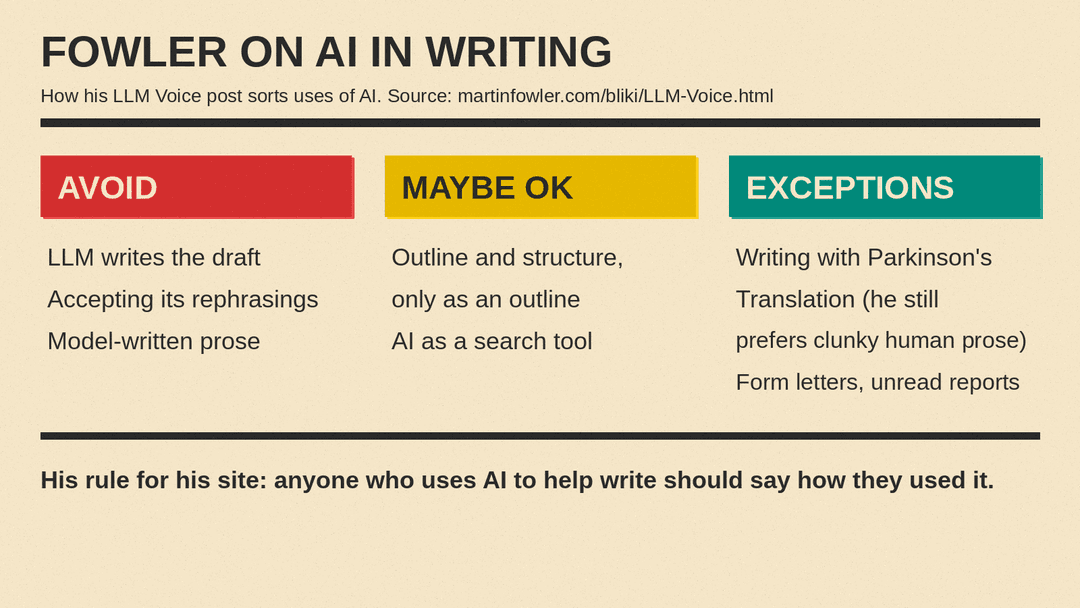
His advice is direct. "I strongly recommend that authors should not fall into the trap of getting the LLM to write a draft," he writes, because human editing rarely removes the voice. "Even accepting suggestions of rephrasing is dangerous." Using a model for an outline "may be ok, but only as far as an outline." His deeper worry is about thinking: "As more people delegate writing to LLMs they will also delegate thinking and comprehension to LLMs."
He lists exceptions. His colleague Jim Highsmith uses an LLM to keep writing while living with Parkinson's disease, and Fowler says he will gladly read LLM Voice to keep reading him. Translation is harder: Fowler would "prefer rather a genuine human's clunky prose to the smooth but soulless LLM." Form letters and reports nobody reads are fair game. The post ends with a disclosure: "I did not use AI or LLMs in any way while writing this post." His site's policy is that contributors who use AI must say how.
The entry builds on his October 21 Fragments, where he agreed with Gergely Orosz about entrants who used AI in a "No AI" essay contest, and wrote: "Once I hear LLM Voice, I flip the bozo bit and check out of the post."
Hacker News: readers are tired
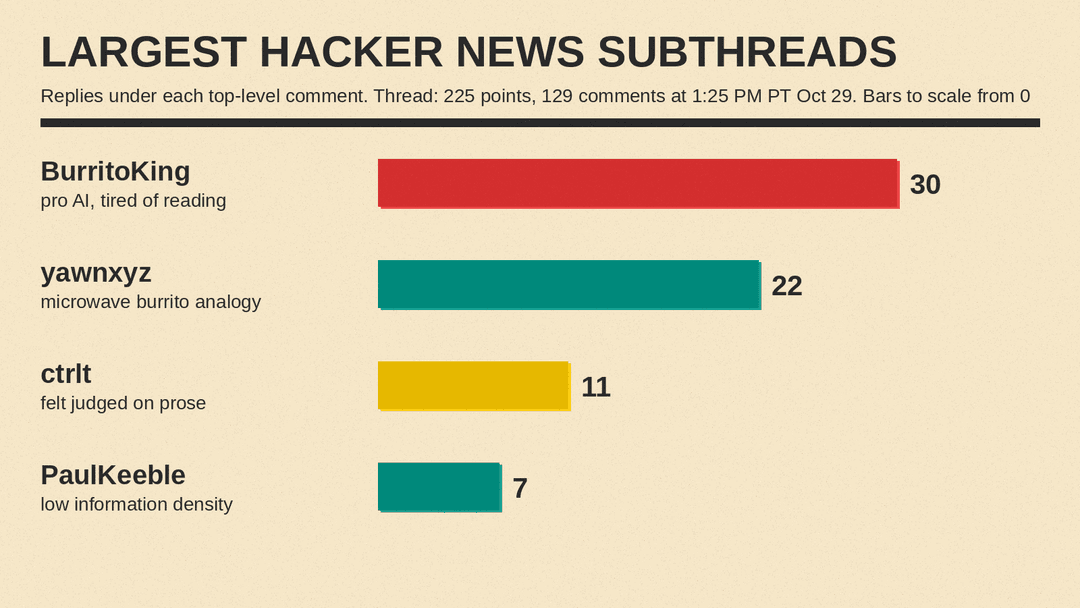
The largest subthread, with 30 replies at 1:25 PM PT, started with a commenter on the other side of the AI debate. BurritoKing wrote: "As someone who is aggressively pro AI, I've also noticed how awful everything is to read lately." The problem, in that comment, is "a mixture of everything sounding identical and everything being a rambling unconcise mess." Three direct replies questioned how anyone could be "aggressively pro AI" and still say that.
Others tried to name the tells. psadauskas objected to "the attempts to punch everything up," adding: "You didn't find the smoking gun in a murder mystery, just a misplaced CSS rule." triMichael compared it to 4chan greentext memes: "Everything is a short punchy sentence." dkn asked writers to share the bullet points instead: "Don’t inflate 3 bullet points to a 10 minute read." pton_xd went furthest: "LLMs have made the internet unreadable."
paultag said spotting it has "slowly moved from a mental exercise (look for specific markers)" into a gut feel about how the pieces fit together. js2 pointed out that Fowler's own post has a missing word and a missing period, and that it "just goes to show: we can all use editors and proof readers."
Hacker News: the microwave burrito debate
The second-largest subthread, with 22 replies, came from yawnxyz, who compared LLM writing to frozen dinners. Some people cook from scratch, some treat food as fuel, and the comment argued that the same split applies to writing and thinking. Some replies turned the analogy around. latexr wrote: "It’s one thing to do it for yourself, quite another to share it with other folks without warning." nisegami quoted a rule of thumb they like: "you can't expect someone to put the time and effort in to read/etc what you didn't put the time or effort in to write/etc."
Hacker News: the case for AI-assisted writing
Not everyone agreed with Fowler. ctrlt said they had a post removed from the Hacker News front page and felt that "what was judged was prose rather than the technical insight." 10111001 replied that LLM voice tells readers that digging for the insight is "a likely waste of effort", "because more often than not, there isn't". djeastm told non-native writers to use broken English or a direct translation instead, calling AI polish "the modern equivalent of going to a thesaurus and replacing all your natural words with five-dollar ones."
hectdev took the other side, calling AI "a boon for people with limiting abilities such as learning disabilities, low language fluency, or generally poor writing skills," and saying that "blanket dismissal reeks of privilege."
A middle position came from people who use models as critics, not writers. tptacek wrote that "LLMs are exceptionally useful writing critics if you know how to hold them correctly, but you can't use a single word they suggest to you." martythemaniak wrote: "If you care about your voice, don't let LLMs write your words." The same comment describes letting AI ask questions and produce rough drafts, then writing the final text from scratch.
Why models write like this
Some commenters turned to how models are trained. capnrefsmmat argued against the idea that the style comes from averaging the training data: "Pretrained models do not have these weird writing styles and sound much more human." In that comment, the style appears after instruction tuning. notfromhere blamed reinforcement learning with LLM judges and said "The last good writing model was GPT 4.5." CuriouslyC expects slow progress: "Long form prose quality is expensive to RL so I expect this to languish for a while."
Opinions split on whether models are improving. jordanpg expects the tells to vanish within "a couple of years if not months." redhed wrote: "I swear AI writing is worse than it was." jacmilts said "Gemini models are so, so much better in this regard," and cpeterso wrote that "Default GPT output is acceptable, but Claude is unbearable," sharing a style prompt that bans words such as "load-bearing" and "unlock."
Humans start to sound like models
A smaller theme was the effect on human writing. fnoef said reading so much model output has led them to adopt the style without using a model. visarga wrote further down that subthread: "Human language is being shaped back by AI language." t_mahmood wrote, "I have started to avoid some words in my writing." abootstrapper deleted Grammarly and said they "dropped my use of the em-dash after being accused of being AI myself."
X: short and mostly in agreement
Reaction on X was smaller and mostly agreed with Fowler. Replying to his post, @80jillion wrote: "I honestly think we need to go back to 140 characters just to combat the Ai vomit tsunami." @MrJames_29 summed up the argument: "The model can finish your article in seconds. Convincing anyone to read it is still your problem." @jurlycat highlighted the first-draft advice. @teddtheodore took a prompting angle: "Name that voice in your prompt and steer it." Fowler's post does not discuss prompting; his advice is to keep the model out of the draft.
Why it matters
Fowler's post is not a study and makes no claims about detection rates. It matters because it puts a widely shared reader reaction into a clear rule from a well-known technical writer: do not let a model write the draft, and say how you used AI. The Hacker News thread shows the cost of ignoring that rule is attention. Fowler and some commenters say they stop reading once they sense it, without checking who or what wrote the text. For anyone who publishes with AI help, including newsletters, docs and company blogs, that is the practical takeaway.
