
A University of Kentucky research administrator asked not to use AI at work because of his beliefs as a humanist, and the university said yes. Religion News Service reported the case on October 26, 2026, and the American Humanist Association announced it the same day. Two days later the story reached the Hacker News front page, where the thread grew past 480 comments. This post collects what people on X and Hacker News said about it.
All view, like, point and comment counts below were checked at about 7:25 PM PT on October 28, 2026.
What actually happened
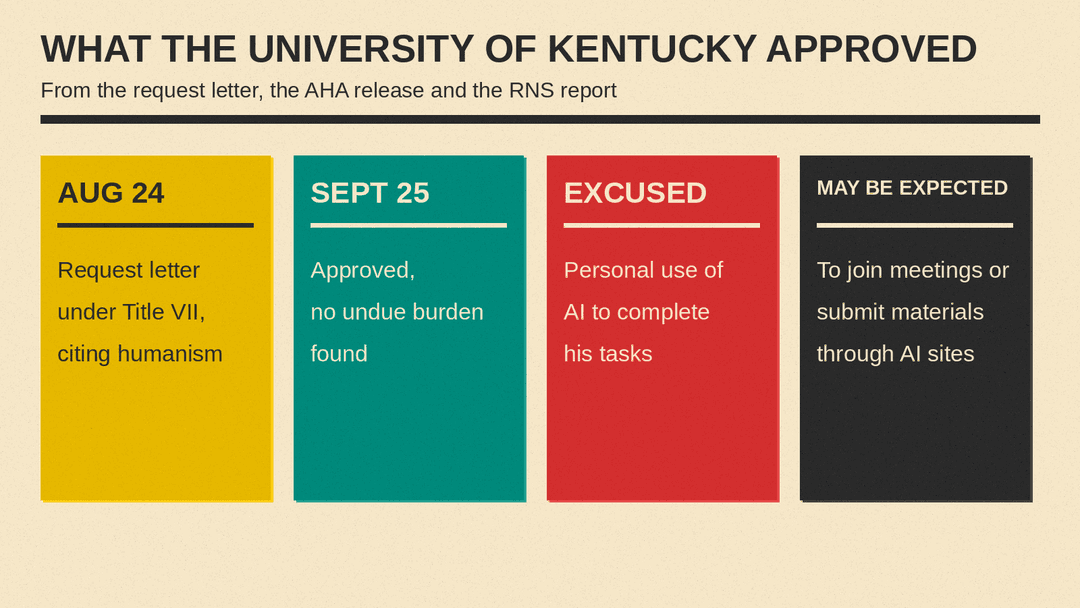
David Durman is a fully remote research administrator in the university's Office of Sponsored Project Administration. His accommodation request letter, dated August 24, 2026, says the office began promoting Microsoft Teams Copilot for meeting notes at a July 31 department meeting, suggested commercial chatbots such as ChatGPT, Claude and Gemini, and was building internal LLM tools. He asked to be excused from "personally using AI or LLM tools, including automated transcription, note-taking, or decision-making systems," and offered to take and share his own meeting notes.
The request was filed under Title VII, which RNS describes as a federal law that lets employees ask for a change in their work requirements to comply with religious belief. The letter cites federal rules and the 1961 Supreme Court case Torcaso v. Watkins for the point that non-theistic beliefs such as humanism are protected.
According to the AHA, the university's Office of Equal Opportunity approved the request on September 25 after finding "no undue burden" on his department. RNS quotes the approval letter: "David may still be expected to participate in such meetings or be required to submit materials through such sites. David is excused from personal use of AI to complete his tasks." So the exemption covers his own use of AI tools. It does not stop colleagues from using AI around him.
Durman told RNS that offloading his thinking "is undercutting my ability to be a moral actor." AHA staff attorney Alexandria Huiskens told RNS it is "the first of its kind at the AHA and for humanism generally." That "first" claim comes from the AHA; we found no independent count.
The posts that spread it on X
Bob Smietana, who wrote the RNS story, posted "A humanist from Kentucky is now exempt from using AI at work on religious grounds" (about 1,100 views). The RNS account shared the story with its summary line.
The most liked post we found came from Hemant Mehta, who wrote that "David Durman says generative AI conflicts with his Humanist beliefs" and added "Kudos to @americnhumanist for making it happen" (53 likes, about 3,900 views). The AHA's own post went further than the news itself: it invited other humanists who feel AI use conflicts with their values to contact its legal team.
The skeptics: is this even religion?
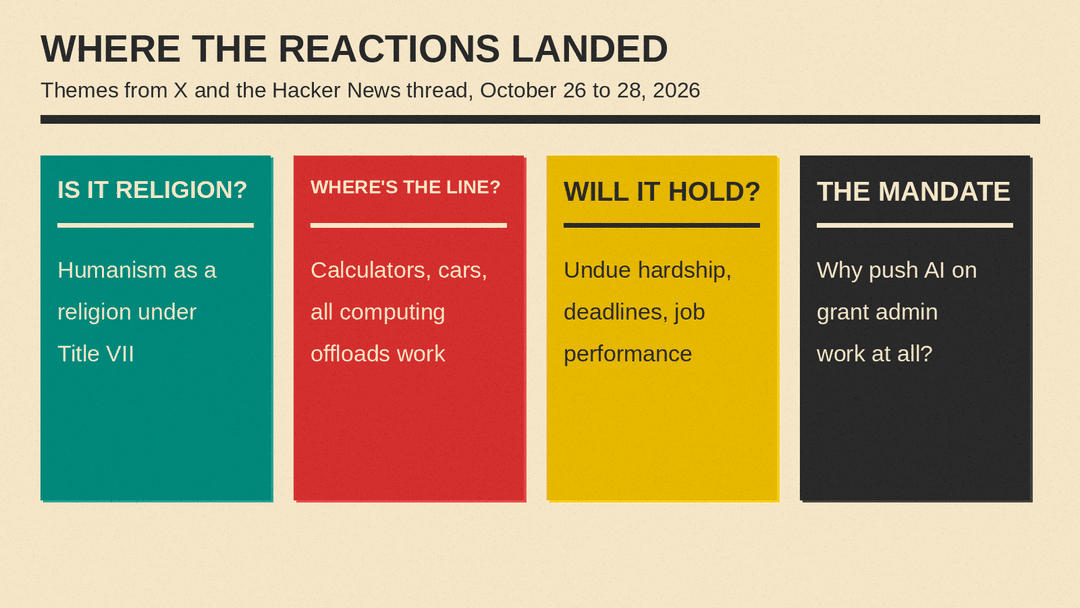
Some of the X pushback was about the label, not the outcome. Jeff Patterson wrote "Humanism isn't a religion, but this is nonetheless neat." Replying to Mehta, @AlGi59550697 asked "This makes me wonder if humanists have to be necessarily atheists?" and said that as an atheist they did not care about AI use.
Others went for the joke. Max Kaplan posted "As an MCPist, it goes against my religious beliefs to use CLIs." @captain__crunch framed it as "The first anti-AI religion might be here."
Hacker News: where is the line?
The Hacker News thread had 436 points and 482 comments. Several separate top-level comments made the same objection in different forms. joshstrange asked "Where is the line?" and argued that "all of computing has involved 'offloading' effort/thought to computers." injidup wrote, sarcastically, "I'm sure he drives stick as well." AndrewKemendo wondered whether the reverse would work, a transhumanist claiming a duty to share everything with machines.
Others defended the case. giantg2 called much of this "strawmanning" and pointed out that the article focuses on his ethical duties and dealings with people as an administrator. ranger_danger quoted Durman and wrote "Very true, 100% agree," adding "I'm not saying we should get rid of AI, but we need to be aware of the dangers of relying on it too much."
The legal limits commenters pointed to
When f6v wrote that "you can get any kind of exemption based on religious beliefs," two replies disagreed. giantg2 said an accommodation "is only possible if it doesn't present undue hardship, safety concerns, etc." Aurornis said courts have rejected beliefs that "couldn't meet the threshold for being a real religious belief," and that a programmer could be exempted from AI tools "but you would still have to do the work at a reasonable standard."
Outside the thread, Douglas Laycock, an emeritus law professor at the University of Virginia and the University of Texas, told RNS that Title VII accommodation requests turn on whether a belief is sincere. "It has to be a deeply held ethical commitment that's analogous to a religious commitment," he said. "That's a fact question that presumably the employer will investigate."
That leads to the main worry in the thread: what happens when the work speeds up. mattw2121 said the exemption works "until the goals given him are unachievable, in the given timelines, by human thinking and reasoning alone." Replying, teeray asked whether that "would not be tantamount to constructive dismissal," comparing it to prayer times that "will be counted against you in performance evaluations." pj_mukh said this case "isn't that interesting" legally because it is about work where ethics is central, and that if someone in a job like housing approvals refused AI on religious grounds, "I would hope any court would strike it down."
Mandates, not the man
A different thread of comments questioned the employer more than the employee. sashank_1509 called it "very weird" for a university to ask research administrators to bring AI into their workflow, and asked what extra output that would really buy. layer8 drew a line "between refusing any AI use, and refusing AI use requirements imposed by an employer."
Some readers shrugged. kayodelycaon called it "a non-story," saying "The ask was small and reasonable." vuurmot replied that because it is a first, "other people could start to ask for similar accommodations."
Why it matters
RNS ties the case to wider doubts about AI, citing a Washington Post-ABC News poll in which 57% of Americans said AI is bad for society. For how AI leaders are arguing about that mood, see Dario Amodei's response to the AI backlash. RNS also reports that Durman's request was inspired in part by Erin Maus, a Unitarian Universalist software engineer who got an exemption from her employer over religious concerns about AI. This case shows one route: a short letter, one meeting, and an approval. RNS contrasts that with accommodation requests that ended up in court, such as a 2023 Supreme Court decision for a Christian postal worker. It is a single employer's decision, it covers only personal use, and, according to the AHA, it rests on the finding of no undue burden on his department. The AHA is now openly inviting similar requests on X, so other employers may face the same question. Most of the argument online was less about Durman than about where reasonable limits sit, and whether they will hold if AI use becomes the default expectation at work.
Sources
- Religion News Service: A Kentucky man becomes the first humanist granted religious exemption from AI
- American Humanist Association press release, October 26, 2026
- David Durman's accommodation request letter, August 24, 2026 (PDF)
- Hacker News discussion
- Hemant Mehta on X
- Bob Smietana on X
- American Humanist Association on X
