
A leaked draft of the European Union's Digital Fairness Act would let users switch off chatbot features that simulate relationships to keep people engaged. It would also set the first EU consumer-law rules for AI shopping agents, according to Euronews, which saw the draft. This is a leak, not law: the text may change. For what the official proposal says, see the Update, Nov 11, 2026.
Update, Nov 11, 2026
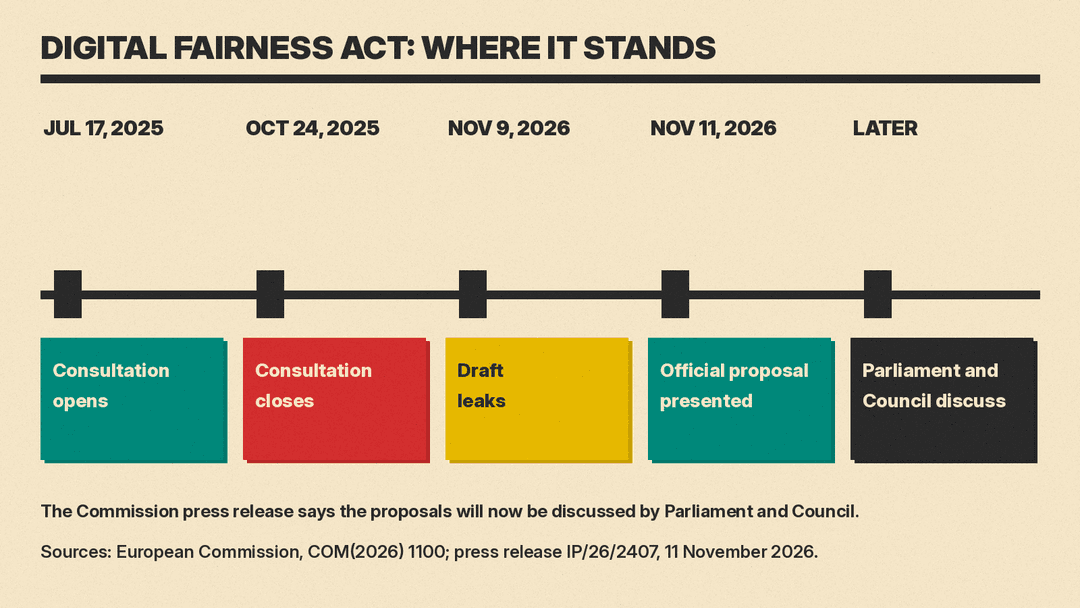
On Wednesday, November 11, 2026, the European Commission presented its proposal for a Digital Fairness Act, COM(2026) 1100. The Commission's press release says: "The proposals will now be discussed by the European Parliament and Council."
On relationship-style chatbot features, the official proposal does not include a ban on AI companions. Recital 66 of the official proposal says "AI companions and general conversational chatbots, in turn, may simulate interpersonal relations to incentivise prolonged use." Article 17 would require traders that design, organise or operate their digital products in a manner that is "intended, or can reasonably be foreseen to encourage compulsive or excessive use" to make available, "in an easily accessible manner, effective tools enabling them to disable, individually or all at once," listed features. One listed feature is "features and system behaviours that encourage continued use by simulating interpersonal relations, such as persistent prompts to continue engaging with an automated system." Article 17 would not apply to traders subject to Articles 9, 14 and 15 of the proposed EU KIDS Act for practices concerning minors, or to traders providing services in the categories specified in Article 2(4), points (c) and (e), of that proposal.
The leaked draft reported by Euronews said all users would gain the right to switch off autoplay, notifications unrelated to their own activity, streak-style rewards and chatbot features that simulate relationships to keep people engaged. The official list in Article 17(1) would cover automatic play of content, notifications not triggered by or not directly related to the consumer's activity, features that incentivise engagement at regular times or with greater frequency, and the relationship-simulating features quoted above.
On software that buys for the user, the official proposal does not use the phrase "AI shopping agents." Article 26 is titled "Automated systems for contracting on behalf of a consumer with a trader." Recital 77 refers to automated systems in contracting "including through the deployment of artificial intelligence (AI) systems". Article 3, point (21) defines an "automated system" as "software that is capable of carrying out actions and taking decisions producing legal effects for its user, including concluding contracts, without the need for human intervention". The Commission's press release says: "Consumers will have the right to communicate with a human in customer service and will have clear rights when using an AI agent to buy products on their behalf." Under Article 26, traders that make such systems available would have to give consumers easily accessible tools to set and change parameters. On first use, the consumer would have to choose whether to confirm all contracts before being bound, confirm only a certain type of contracts based on criteria the consumer sets, including a maximum price and a time limit, or not confirm contracts before being bound. The automated system would have to disclose any payment received for proposing a contract and any conflict of interest, and in those cases require the consumer to confirm the contract. Traders would not be allowed to require consumers to use automated systems to access or conclude transactions on their online interfaces. Article 26 would not apply to the provision of financial services.
The leaked draft reported by Euronews said: "In a first for EU consumer law, the draft sets rules for AI shopping agents." Per Euronews, users would choose which purchases they must approve, and agents would have to disclose sponsored suggestions.
The sections below describe the leaked draft, as reported on November 9, 2026. They are not a description of the official proposal.
What happened with the leaked Digital Fairness Act draft
According to Techmeme's summary of a Monday, November 9, 2026 Bloomberg story, and to Investing.com's report citing Bloomberg News, the draft would require companies to let adults disable addictive features and would target AI systems that simulate relationships. As shown on Techmeme, the Bloomberg story opens: "Social media platforms face a fresh wave of European Union curbs, this time targeting addictive features and artificial intelligence chatbots." We have not independently verified the paywalled Bloomberg article.
Simon Ormiston at Euronews saw a draft. A Commission spokesperson told Euronews Next the body "does not comment on leaks." Marie Colin at Contexte published it. The Digital Fairness Act newsletter describes it as a 71-page document and says the draft includes "potential Commission fines of up to 6% of worldwide annual turnover in cases it investigates", plus restrictions on personalised pricing that exploits consumer vulnerabilities and stricter influencer advertising disclosure with greater responsibility for brands using influencers.
Sara Brandstätter at MLex saw draft annexes and says the proposal is "still subject to change before Wednesday's scheduled presentation".
The Commission ran a public consultation on the act from 17 July 2025 to 24 October 2025. The Commission says the act will address harmful practices online "such as deceptive or manipulative interface design, misleading marketing by social media influencers, addictive design of digital products and unfair personalisation practices". Michael McGrath is Commissioner for Democracy, Justice, the Rule of Law and Consumer Protection.
The Commission's tentative agenda for its next meetings, dated 20 October 2026, listed the Digital Fairness Act for its 11 November 2026 meeting, as part of a consumer package. The official proposal was presented on that date. See the Update, Nov 11, 2026.
The act is separate consumer law, not part of the EU AI Act. For that law's deadlines, see our EU AI Act explainer.
What the Digital Fairness Act draft says about AI chatbots and companions
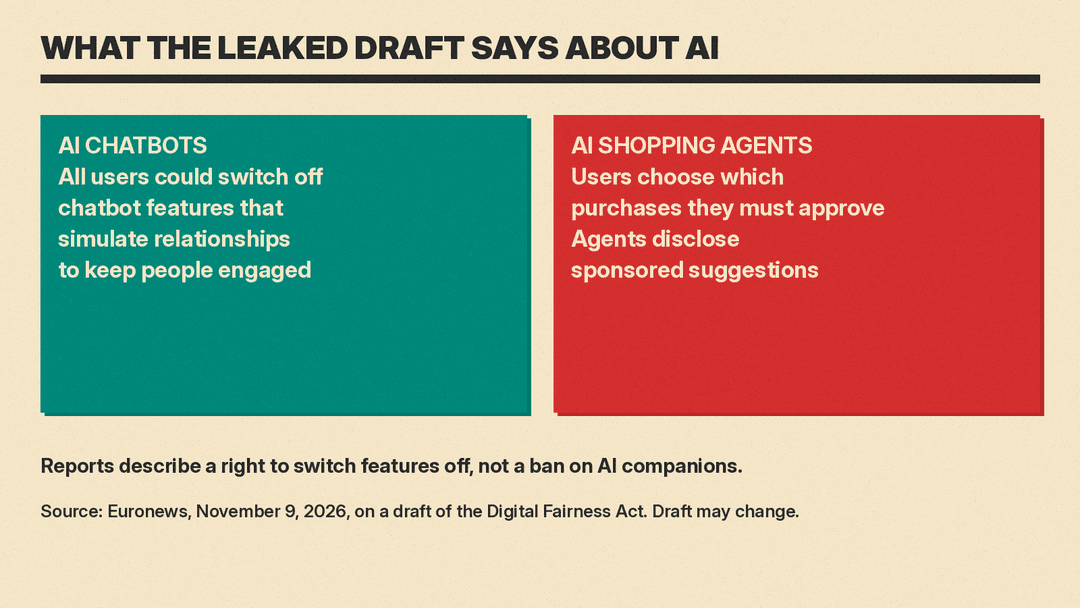
Per Euronews, all users would gain the right to switch off autoplay, notifications unrelated to their own activity, streak-style rewards and chatbot features that simulate relationships to keep people engaged.
Companion apps already face other limits. Apple now rates AI romance companion apps 18+, as we covered in this post. New York has an AI companion law for kids, which we explained here.
What the draft would mean for AI shopping agents
Per Euronews, "In a first for EU consumer law, the draft sets rules for AI shopping agents." Users would choose which purchases they must approve, and agents would have to disclose sponsored suggestions.
The ten dark patterns the EU draft would ban
Per Euronews, the draft would replace the EU's 2005 Unfair Commercial Practices Directive with a regulation applying directly in all 27 member states, and would create a new list of "dark patterns" deemed unfair in all circumstances. Authorities would no longer have to prove harm case by case. The list has ten items:
- making it disproportionately harder to cancel than to sign up
- burying prices or auto-renewal terms
- falsely suggesting there is no alternative
- false or unqualified claims about a product's availability or popularity
- scarcity warnings repeated throughout checkout
- pre-selected options that add extra products or quantities
- framing a refusal as the wrong choice
- repeatedly pressing consumers to change a choice already made
- confusing double negatives
- fake notifications implying someone has contacted the user
The Commission could add new tricks to the list without returning to lawmakers, per Euronews.
What the draft says about subscriptions, prices and children
Per Euronews, free trials could no longer roll into paid subscriptions unless the consumer actively agrees. Customers would get reminders before automatic renewals and the right to speak to a human in customer service. Online subscriptions would require a "terminate the contract here" button.
The draft would also outlaw drip pricing, where unavoidable fees appear only at checkout, ban "was/now" discounts calculated against a manufacturer's recommended price rather than a competitor's real one, and blacklist misleading claims by dropshippers, per Euronews.
For children, per Euronews, paid loot boxes and pay-to-win mechanics would be banned for minors in video games. In-game currencies would have to show their real-money value and be switched off by default for children unless a parent approves. Advertising based on profiling minors would be prohibited for all traders, not only the large platforms already covered by the Digital Services Act.
Digital Fairness Act fines and timeline
The Commission could fine companies up to 6% of their global turnover, per Euronews.
The Commission's impact assessment estimates the rules would spare consumers €88.4 billion in financial losses between 2025 and 2035, per Euronews. Including time lost to unfair practices, it puts the annual benefit at €13.7 billion, against recurring costs to business of €678 million a year once overlaps between measures are accounted for.
Per Euronews, the regulation would apply 12 months after entering into force, and must first be agreed by the European Parliament and member states.
Per Euronews, in a non-paper dated 14 October, reported by Agence Europe, the German government argued that existing consumer directives should be amended rather than a new horizontal law created, and said the case for converting the directive into a regulation "has not yet been sufficiently demonstrated".
McGrath is steering the file, according to Euronews. At a retail summit in Brussels last year, he described the law as "both a pro-consumer and pro-business initiative" that would ease administrative burdens, as reported by Euronews.
What we do not know yet
Reporting on the leaked draft describes a user right to switch off relationship-simulating chatbot features. None of those reports describe a ban on AI companions. The official proposal is now public. See the Update, Nov 11, 2026, at the top of this post. The Commission press release says the proposals will now be discussed by the European Parliament and Council.
Sources
- European Commission: Proposal for a Digital Fairness Act, COM(2026) 1100, 11 November 2026
- European Commission press release: Commission strengthens consumer protection laws, making them fit for the digital age, 11 November 2026 (IP/26/2407)
- Techmeme: summary of Bloomberg's Digital Fairness Act story (intermediary)
- Investing.com: EU drafts curbs on addictive features and AI chatbots, citing Bloomberg (intermediary)
- Euronews: EU to blacklist ten manipulative online design traps, leaked draft shows
- Contexte: La Commission ne renonce à aucune ambition dans le Digital Fairness Act
- The Digital Fairness Act newsletter: Contexte publishes leaked draft
- MLex: Digital firms face broader bans on manipulative practices under draft EU law
- European Commission: open consultation for the forthcoming Digital Fairness Act
- European Commission: tentative agenda for forthcoming Commission meetings, SEC(2026) 2581, 20 October 2026
