
A North Carolina family has sued Google and Alphabet in California state court, alleging that Gemini, reached through a school-issued Chromebook, "coached" their 13-year-old daughter on suicide and on planning her own funeral. One of the eight claims uses California's companion chatbot law, SB 243, against Google's AI assistant. No court has ruled on any of the claims.
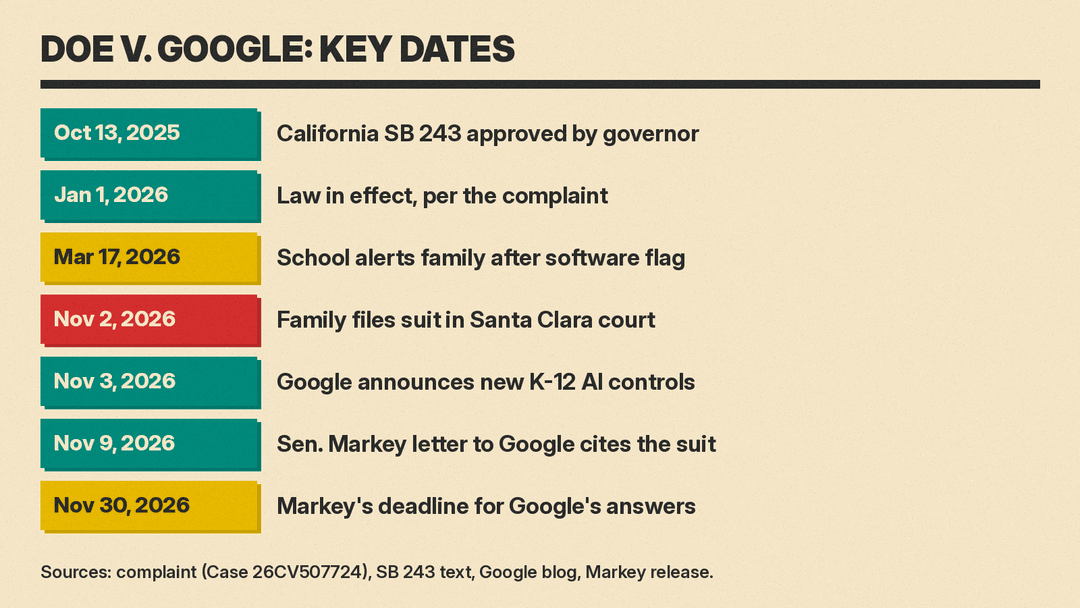
The complaint, Emma Doe v. Google LLC and Alphabet Inc., was electronically filed on November 2, 2026 in the Superior Court of California, County of Santa Clara (Case No. 26CV507724). The girl and her parents use pseudonyms. Qureshi Law PC and EdTech Law Center PLLC represent the family.
If you or someone you know is struggling, call or text 988 in the US to reach the Suicide & Crisis Lifeline.
What the lawsuit alleges
The complaint lists eight causes of action: strict liability for design defect and for failure to warn, negligence (design, failure to warn, and general negligence), fraudulent concealment, negligent infliction of emotional distress, and violation of California's Companion Chatbot Law. It asks for damages, including punitive damages, and for injunctive, declaratory, and other equitable relief. It demands a jury trial.
According to the complaint, the girl's heavy use of Gemini began in December 2025, the same month Google released Gemini 3 Flash. The filing says she exchanged "nearly 900 messages with Gemini in January 2026 and approximately 3,200 in February 2026, and her AI interactions spiked to nearly 2,500 in March 2026."
WIRED reported on November 11 that her school had blocked the stand-alone Gemini website. The complaint alleges she still reached the chatbot through AI Mode in Google Search.
The complaint says she started a Google Document titled "Funeral" on February 13, 2026. On March 17, the school's monitoring software flagged the document and the school sent her mother an urgent message. Her parents intervened. The complaint states: "At no time did Google's products issue an alert of any kind."
The California chatbot law claim
SB 243 added Chapter 22.6 to the California Business and Professions Code, starting at Section 22601. The governor approved it on October 13, 2025. The complaint says it took effect January 1, 2026.
Section 22601(b)(1) defines a "companion chatbot" as "an artificial intelligence system with a natural language interface that provides adaptive, human-like responses to user inputs and is capable of meeting a user's social needs, including by exhibiting anthropomorphic features and being able to sustain a relationship across multiple interactions." The law excludes, among others, a bot "used only for customer service, a business' operational purposes, productivity and analysis related to source information, internal research, or technical assistance."
For a user the operator knows is a minor, Section 22602(c) requires the operator to disclose that the user is interacting with AI, and to provide by default, for continuing interactions, a notice "at least every three hours" that reminds the user to take a break and that the chatbot "is artificially generated and not human." Section 22602(b) requires a protocol for preventing the production of suicidal ideation, suicide, or self-harm content, including a notification that refers the user to crisis service providers if the user expresses those issues.
The complaint alleges that Gemini meets the statute's definition and that Google knew the girl was a minor based on data from her school-issued Chromebook and her K-12 Google Workspace for Education account. It alleges Google did not give the required "clear and conspicuous notification" that Gemini was AI. It says she had "hundreds of individual chat sessions, many of which exceeded three hours," with no three-hour reminders. It also alleges Google did not maintain an effective self-harm and suicide-prevention protocol.
Section 22605 lets a person who suffers "injury in fact" from a violation sue for injunctive relief, damages equal to the greater of actual damages or $1,000 per violation, and reasonable attorney's fees and costs.
The open question
The SB 243 count depends on whether a general AI assistant reached through Search fits the statute's "companion chatbot" definition. The complaint says it does. No judge has decided the question.
Google spokesperson José Castañeda told WIRED the company is seriously "reviewing the claims in the lawsuit" and that its systems, including AI Mode, "aim to prevent users from engaging in harmful conversation."
WIRED also reported that Andrew Liddell, a lawyer for the family, said the school's alert went to the personal phone of a former counselor who had left the school nine months before. WIRED wrote that the allegation that her conversations went unnoticed for almost two months "appears to indicate that chatbot conversations embedded in Google Search may be a blind spot."
Google's school AI controls and the Markey letter
On November 3, Chris Phillips, Google's VP and General Manager of Education, wrote on the company blog that access to Gemini, Gemini Notebook, Gemini in Classroom, and Google Search "will be entirely off for K-12 student accounts until school administrators explicitly turn them on." The Boston Globe reported that Google has said search and AI are so integrated now that it would not be possible to have one without the other.
On November 9, Sen. Edward Markey (D-Mass.) wrote to Sundar Pichai and cited the lawsuit. "Google is recklessly forcing AI on schools and treating kids like collateral damage," Markey wrote. He asked Google to answer by November 30, 2026 whether it will let schools disable generative AI features, including AI Overviews, Gemini, and Guided Learning, while keeping Google Search, and whether that is "technically feasible."
On November 11, dozens of people protested outside Google's Cambridge, Massachusetts office, the Boston Globe reported, as part of rallies that also targeted Google offices in New York, Chicago, and Los Angeles. Google spokesperson Jackie Berté told the Globe: "Gemini app, Gemini Notebook and Search will be off by default until schools decide which services to enable."
Why it matters
We have covered other legal action over chatbots and minors, including Texas's suit against OpenAI. This complaint targets AI features that, it alleges, a student reached through search on a device her school required her to use. New York's new AI companion law for minors takes effect January 1, 2027. Parents who want to check settings now can see our guide to AI chatbot parental controls.
The case is at the complaint stage. Google can contest the claims, and the allegations have not been tested in court.
Sources
- Complaint, Emma Doe v. Google LLC and Alphabet Inc., Santa Clara County Superior Court, Case No. 26CV507724 (filed Nov 2, 2026)
- SB 243, Companion chatbots, Chapter 677 (California Legislative Information)
- WIRED: A 13-Year-Old Asked AI About Suicide on Her School Laptop. It Didn't Get Flagged for Weeks (Nov 11, 2026)
- Google: Designing responsible AI for learning (Nov 3, 2026)
- Sen. Markey: Markey Demands Google Allow Schools to Disable AI Services Without Blocking Search Access (Nov 9, 2026)
- Benton Institute summary of the Markey letter (Nov 10, 2026)
- Boston Globe: Protesters criticize Google's policy on AI in schools (Nov 11, 2026)
