
Sprinklr, the customer experience software company used by large brands for social media, marketing and contact centers, opened a beta on October 27 for Sprinklr Marketing AI Agents. It is a set of six connected agents that cover a campaign from the first idea to the budget split. The company says people stay in control of strategy, creative work, approvals and brand decisions.
This is a beta, not a general release. A Sprinklr spokesperson told CMSWire that the announcement covers the beta only, and CMSWire reports that no general availability date is set. Sprinklr's product page labels it a Limited Availability feature. Neither the release nor CMSWire gives a price.
The problem Sprinklr says it is solving
Sprinklr's pitch is about timing. In its release, the company says a relevant conversation or trend "may emerge and fade within days," while a traditional concept-to-launch process "can take several weeks" as work moves through planning, creative, localization, channel activation, governance and approvals. Karthik Suri, Sprinklr's chief product and corporate strategy officer, told CMSWire that a traditional campaign cycle can run four to six weeks, while a viral moment lasts roughly six days.
The second pressure is workload. The release says marketers and agencies are asked to support more markets, products, channels, languages and content "without proportional growth in resources." Anish Chadda, who leads Sprinklr's marketing product strategy, told CMSWire: "A lot of our customers right now, they're drowning."
The six agents
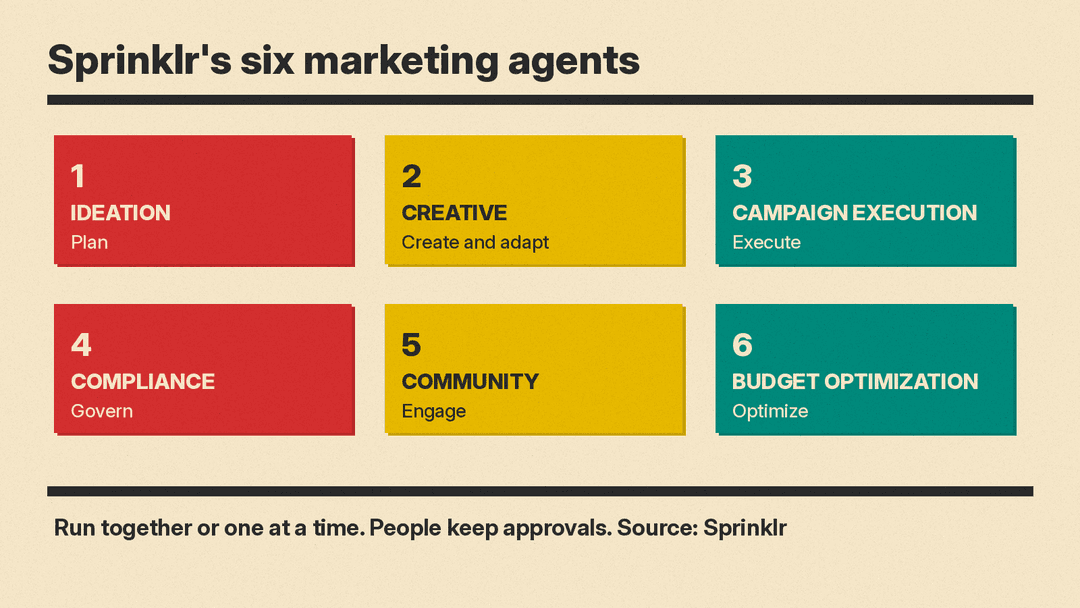
Sprinklr says the agents can work together across a campaign or be deployed one at a time for specific needs. Here is what each one does, based on the company's release:
- Ideation Agent (plan). Connects performance, listening, audience, competitive, web and other signals to surface campaign ideas. It can also recommend changes to content that is already planned or scheduled when market conditions change.
- Creative Agent (create and adapt). Helps teams scale approved creative through editing, variations, localization and A/B testing, using brand and campaign context. Sprinklr says the focus is extending approved ideas and assets, not replacing human creative work.
- Campaign Execution Agent (execute). Reads media briefs and plans and turns them into campaigns, audiences and creative across channels. It can catch inconsistencies, such as a target market that does not match the creative's language, and connect with compliance checks before launch.
- Compliance Agent (govern). Checks content against brand standards, internal policies, regulatory and channel requirements, and market context. It automates repeatable checks and flags exceptions for a human to review before activation.
- Community Agent (engage). Helps brands find the conversations that matter and respond at scale, with guidance tailored to each channel.
- Budget Optimization Agent (optimize). Uses campaign objectives and performance to recommend how to split budget across channels before launch, and how to adjust it while the campaign runs.
What early customers use it for
More detail comes from CMSWire's interview with Sprinklr executives. Chadda said productivity tasks, such as making content variations and setting up campaigns ("campaign trafficking"), took off first. He expects the recommendation and budget features to catch on "maybe in the early part of next year."
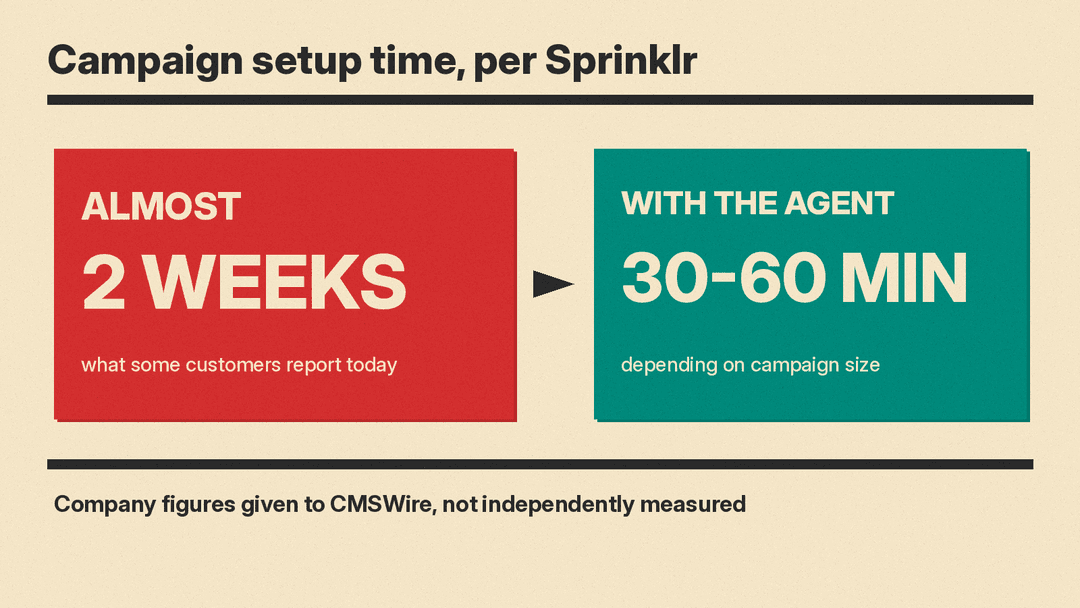
The Campaign Execution Agent has seen the heaviest adoption so far, according to Chadda, including from agencies. He said some customers report that building a campaign across all their channels takes "almost two weeks," and that the agent brings that down to 30 to 60 minutes, depending on campaign size. Both figures come from Sprinklr: the two weeks is what Chadda says some customers report, and the 30 to 60 minutes is his figure for the agent. Neither is an independent measurement.
On creative, Chadda said enterprise customers are cautious about fully AI-generated content and mostly use the agent to iterate. "A lot of our enterprise customers, I don't think are completely ready for AI-based content to be rolled out," he said.
He also shared unnamed customer examples with CMSWire:
- A media streaming client planned the same messaging for a TV show launch in every market. The Ideation Agent flagged that some of the show's material could draw negative reactions in specific markets, and the client changed its messaging there.
- A Big Four consulting firm told Sprinklr it had published 90,000 pieces of content on LinkedIn in the first nine months of the year and found about 15 versions of its logo in use. The Compliance Agent now checks brand consistency and flags contradictory messaging across markets.
- A retail apparel client had sports-themed content scheduled weeks earlier. The agent flagged it after a surge of social conversation around topics in the post, so the client could revise it before publishing.
The AI search angle
Sprinklr also pitches the agents as a way to act on how brands appear in AI answers from tools like ChatGPT and Gemini. Chadda described a large financial institution that checked how its premium travel card showed up in those chatbots. It found the prompts centered on points redemption and that many of the citations came from a handful of subreddits. The bank made Reddit a priority: the Ideation Agent picked which conversations to watch and join, and the Creative Agent helped shape community-style replies, since overtly sponsored posts tend to get removed by Reddit moderators, Chadda said.
CMSWire notes that tying this kind of AI visibility to business results is still an open problem. Chadda said attribution is the next step.
How much autonomy
Suri described the design as "human in the middle." He told CMSWire he wants the orchestration to be "as autonomous and as intelligent and contextual as it gets," with the level of autonomy set by the risk of each use case. In practice, the release lists human oversight at key decision points, and the Compliance Agent flags exceptions for human review before activation.
Why it matters for marketing teams
Chadda told CMSWire that a large part of the delay in time to market comes from how teams work today: social, insights, paid media and influencer groups that, in his words, are "still working in silos and taking information offline and feeding it back in." The agents sit on a shared data layer that pulls in paid, owned and earned data along with documents such as campaign briefs and wrap-up reports, according to CMSWire.
If you are a Sprinklr customer, three practical points stand out:
- Start with setup work. Sprinklr's own account is that campaign building and content variations deliver value first.
- Keep approvals where they are. The Compliance Agent flags exceptions for review. Decide in advance who reviews them.
- Treat the time savings as a claim to test. The 30-to-60-minute figure comes from Sprinklr. Time a few real campaigns before and after.
Sprinklr says the beta is open now and that customers should contact their account team to join. The agents are being shown this week at its CXUnifiers 2026 event, alongside the company's latest product release, which adds Agent Architects for designing and governing AI agents, Voice AI Agents, and support for AI-native marketing channels including ChatGPT Advertising.
