
A lesson one coding agent learns usually stays inside that agent's tool. Beacon, an MIT-licensed project from New York startup Asymptote Labs, tries to fix that by recording sessions from many agent tools in one place and turning the useful parts into reviewed, reusable skills.
On October 20, Asymptote announced a $5.5 million seed round led by Tower Research Ventures, with Lytical Ventures, 1984 Ventures and South Park Commons taking part. Here is what Beacon does, what it costs, and what to check before you install it.
What Beacon is
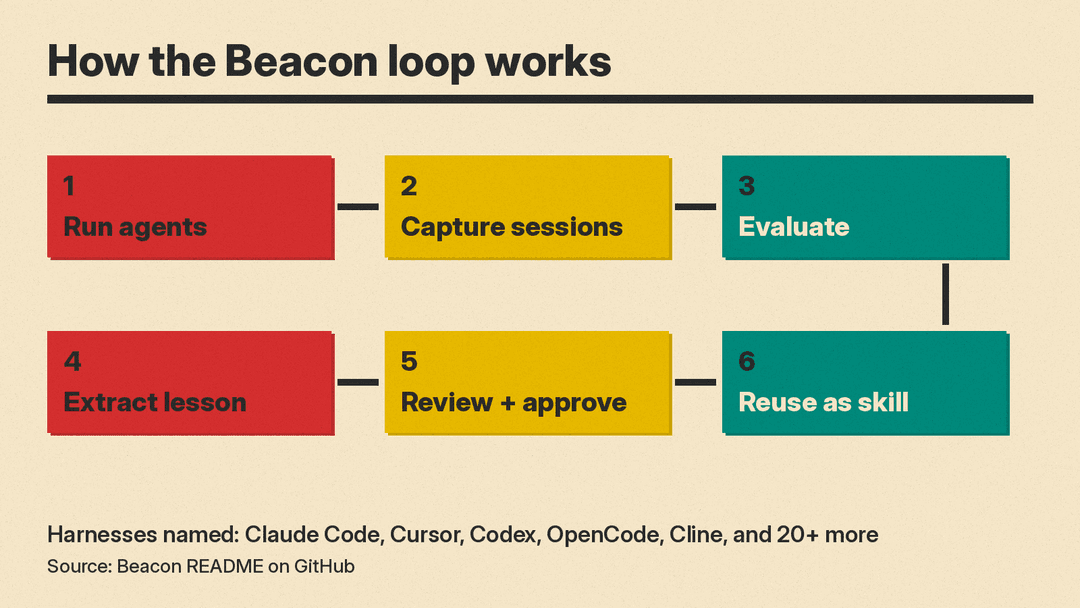
The Beacon README describes it as "an open-source memory layer for AI coding agents that learns from your work across Claude Code, Cursor, Codex, OpenCode, and 20+ other harnesses." A harness is the agent app you work in, such as Claude Code, Cursor, Codex CLI, GitHub Copilot CLI or Gemini CLI.
Beacon has two jobs:
- Telemetry. It captures sessions, prompts and responses, tool calls, commands, file activity, approvals, MCP interactions and token usage, and normalizes them into what the README calls "a common OpenTelemetry-based event model." By default this goes to local JSONL files on your machine.
- Memory. It reviews that history for workflows, corrections, debugging patterns and repo conventions worth keeping, and lets future agents retrieve the reviewed knowledge "through MCP or Agent Skills."
The Beacon home page gives an example: an agent fixes a webhook retry bug after it finds a repository-specific signing rule. Beacon's "dreaming process" reviews the session and drafts a "Debug failed webhook deliveries" skill. You review it once, and later agents can pull it when the same problem comes back.
Why cross-harness matters
"Most agent memory belongs to a single harness," the README says. It puts Beacon's pitch plainly: "Your Cursor sessions can improve Codex. Your Codex sessions can improve OpenCode."
That matters to anyone who moves between tools. Our Cursor vs Claude Code vs Codex comparison shows how close the main options are. If your project knowledge sits in a format no single vendor owns, switching costs drop.
The output format is also familiar. The plans page says Beacon can turn an approved memory into a SKILL.md your agents load. That is the Agent Skills format, which Claude Code plugins also use; Epic's Unreal Engine plugin for Claude Code is one example.
What it supports
The README's coverage tables list 29 local runtimes, including Claude Code, Claude Cowork, Codex CLI and Desktop, Cursor, Devin CLI, Gemini CLI, GitHub Copilot CLI, Kiro, OpenCode, OpenHands, Qwen Code and VS Code. Coverage is not equal: for example, the table shows no file activity capture for Codex CLI and no token counts for Cursor.
It also lists browser extensions for Claude.ai and ChatGPT, cloud agents (Claude Code, Cursor and Devin cloud agents), CI jobs through beacon ci exec, and SDK hooks for the Anthropic, OpenAI, Claude Agent SDK and Vercel AI SDK surfaces.
How the memory loop stays under your control
The Beacon Skills docs say the skills "keep the person reviewing in control of every write to memory." Five skills do the work:
beacon-memory-recallfetches approved project memory before a task.beacon-memory-distillturns selected traces into a lesson: a dry run, a consented evaluation, a draft, then your approval. It needs an evaluator API key.beacon-memory-promoteinstalls an approved memory as a project Agent Skill.beacon-lens-createbuilds a custom view for the local dashboard.beacon-trace-shareuploads the current session to beacon.sh, only when you ask.
Recall and promote need no key and, in local mode, no network.
What it costs
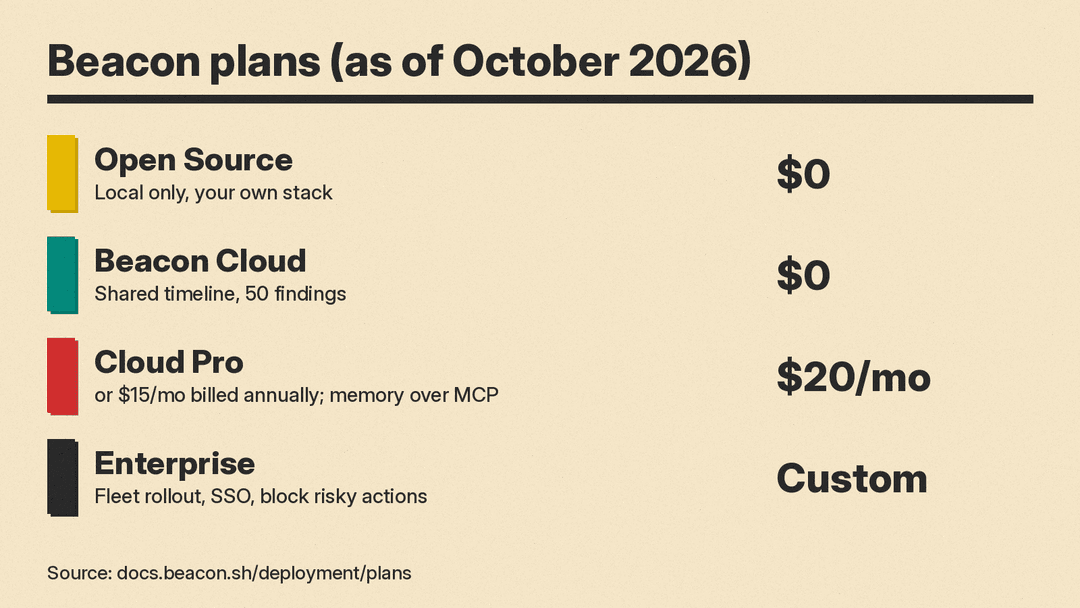
According to the Beacon plans page, as of October 2026:
- Open Source: $0. Local only. Sessions stay on your machine, with a local dashboard and export to your own Elastic, S3, GCS or OpenTelemetry stack.
- Beacon Cloud: $0. Devices upload to beacon.sh for one shared timeline, session search over MCP, and 50 findings over the account's lifetime.
- Beacon Cloud Pro: $20 a month, or $15 a month billed annually. Unlimited findings, memory over MCP, skills pulled from your sessions and real-time email alerts.
- Enterprise: custom pricing. Adds blocking or approval for risky actions, fleet rollout through Jamf, Intune or Fleet, and SSO, RBAC and audit logs.
Note that the cross-machine memory features (memory over MCP and skills from your sessions) are listed as Pro and Enterprise features, not part of the free cloud tier.
What to check before you install
Beacon records everything your agents do, including prompts and file edits. That is the point, and also the risk.
- Interactive setup preselects the cloud. The README says interactive setup "preselects Beacon Cloud, with an explicit Local opt-out." It says signing in forwards nothing, but confirming Beacon Cloud installs Beacon and starts forwarding. Pick Local if you want nothing to leave your machine. You can stop forwarding with
beacon endpoint disconnect. - It writes to your agent folders. Setup installs Beacon Skills into
~/.agents/skillsand~/.claude/skillsunless you turn that off, and with Beacon Cloud it registers an MCP server in your harnesses. - Lenses run code on your traces. The README warns that the lens sandboxing "cannot block every way a browser can send data out, so install only lenses you trust with your traces."
- Know where secrets go. If your sessions include keys or customer data, decide whether that history should sit on beacon.sh. The README lists a "Metadata-only" privacy mode for Beacon Cloud.
The business behind it
Asymptote's seed announcement shows the company sees memory as one use of a bigger product. It calls Beacon a "telemetry layer for AI agents" and says Asymptote "is initially focused on securing AI agents at runtime through real-time detection and response." The founders, Justin D'Souza and Shukan Shah, were early engineers at Doppel, per the release.
The release says Beacon's GitHub stars "grew more than 460% in September" and that it reached No. 3 on GitHub's global trending repositories. As of October 21, the repo shows more than 2,400 stars. Tower Research Ventures says in its own post that the round included "security and engineering leaders from the likes of Cursor, Vercel, Doppel, Microsoft, and more."
Why it matters
Beacon treats memory as a layer separate from the agents. Research also suggests the way context reaches a coding agent changes results: a recent paper found agents resolve more issues when shown whole files instead of compressed context. Beacon bets on a different input, the lessons from your own past sessions, kept in a format you own.
Whether those skills actually make agents better is not yet shown by independent tests. The seed announcement gives adoption numbers, not accuracy numbers. Teams that try it should start in Local mode, review every drafted skill, and measure whether repeat mistakes drop.
