
The European Parliament split last week over a question the AI Act does not answer: when an AI system harms someone, who pays, and how does the victim prove it? Socialist and Green MEPs asked the European Commission to bring back an AI liability law it withdrew in 2025. The centre-right said the AI Act is already enough, The Next Web reported, citing Politico's account of the plenary debate.
The debate matters because a separate EU liability law that does cover AI starts to apply on December 9, 2026. This explainer covers what was dropped, what remains, and where the gap is.
What happened in the debate
The split ran through the centrist parties that back Commission President Ursula von der Leyen, according to TNW. The debate centred on a global framework for AI, and much of it turned on the rules the Commission had already dropped.
- For new rules. Alex Agius Saliba, a Maltese vice-president of the Socialists and Democrats, said: "To withdraw the AI liability directive was a big mistake. We strongly urge the Commission to bring forward this important piece of legislation." Dutch Green MEP Kim van Sparrentak compared AI to faulty electronics: "If a phone charger explodes in your house, we never call it innovative. We call it cheap, dangerous junk, and we hold the manufacturer liable for damages." She wants a liability act that covers the testing and development of AI.
- Against. Arba Kokalari, a Swedish centre-right MEP who led Parliament's work on the AI omnibus package, said the EU already has a full rulebook in the AI Act, even though parts of it are not yet in force. She called for "less bureaucracy, more private investments, better access to data and computing infrastructure."
- The reply. Brando Benifei, who led Parliament's work on the AI Act in the last term, said Europe should lead with new liability rules, "or we will need to wait for the next blogpost of a CEO to know what is happening."
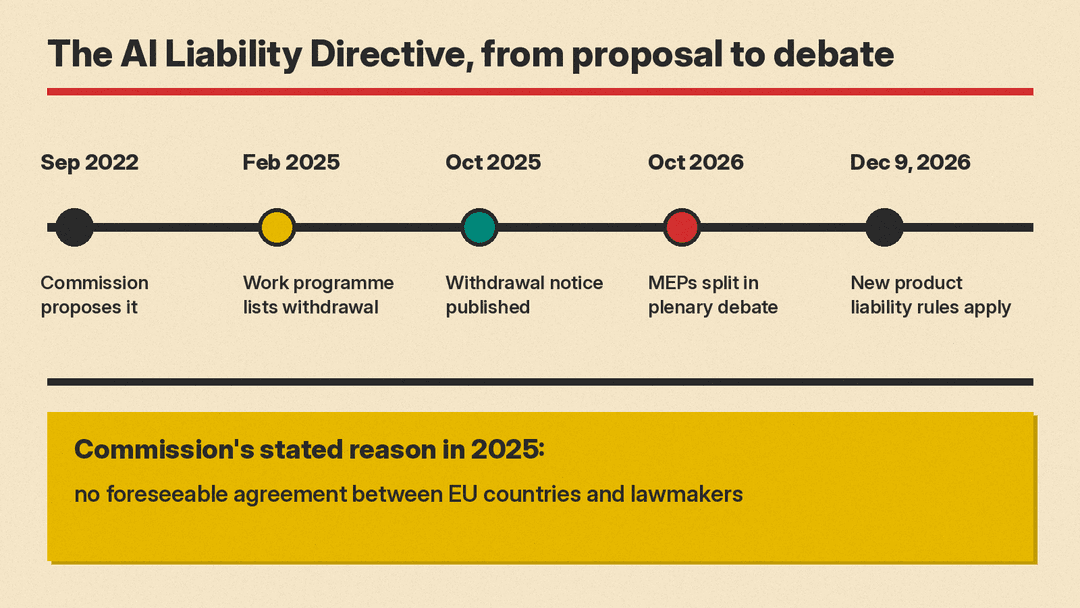
At the end of the debate, Commissioner Jozef Síkela said the Commission withdrew the rules because EU countries and MEPs could not agree on them, TNW reported.
What the AI Liability Directive would have done
The Commission proposed the AI Liability Directive on 28 September 2022. It aimed to make it easier for victims to win compensation when someone's fault led to harm involving an AI system, by setting uniform rules on access to information and on easing the burden of proof.
According to the Commission's 2022 announcement, the proposal had two main tools:
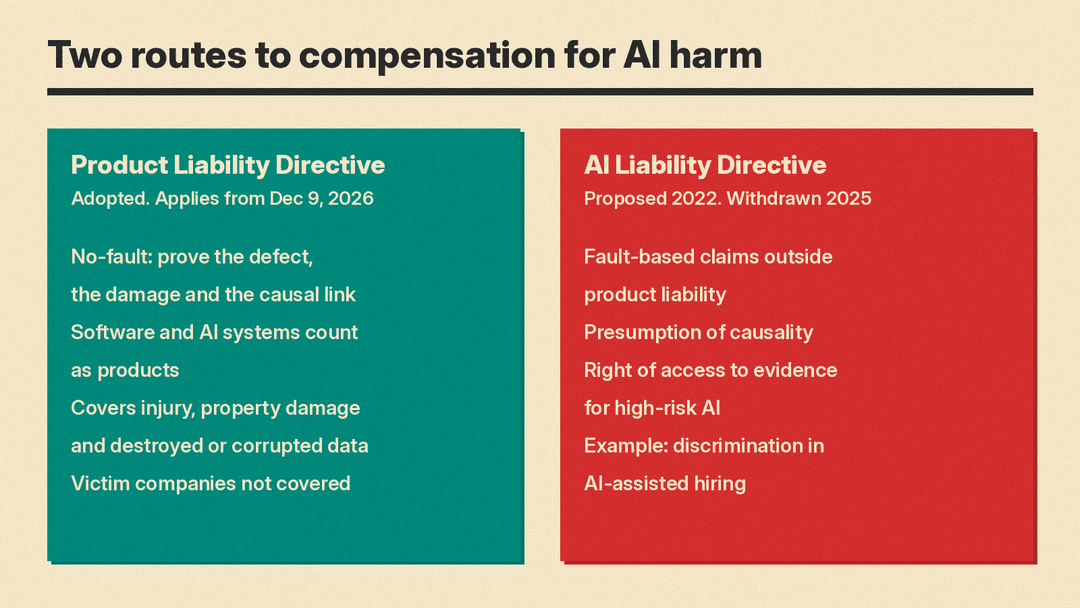
- A presumption of causality. If a victim showed a relevant fault, and a causal link to the AI's output seemed reasonably likely, the court would presume the link. The victim would not have to explain in detail how a complex AI system caused the harm. The company could still fight the presumption.
- A right of access to evidence. Victims could ask companies and suppliers for evidence in cases involving high-risk AI.
It targeted claims outside the product liability rules, where harm comes from wrongful behaviour. The Commission's examples were breaches of privacy, safety issues, and discrimination in a recruitment process that used AI.
How it was dropped
The Commission listed the directive for withdrawal in its 2025 work programme in February 2025. It said it saw no foreseeable agreement and would assess whether to table another proposal, Reuters reported. The formal withdrawal notice appeared in the EU's Official Journal on 6 October 2025, according to the European Association of Private International Law blog.
Support in Parliament was already mixed. Parliament's Legislative Train tracker records that the Internal Market committee called the directive "premature and unnecessary" in May 2025. A 2024 Parliament research study went the other way. It proposed a wider scope that would include general-purpose AI, and a move to a broader software liability regulation.
What still covers AI harm: the new Product Liability Directive
The other half of the 2022 package did pass. The new Product Liability Directive entered into force on 8 December 2024. EU countries must put it into national law by 9 December 2026, and it applies to products placed on the market from that date.
The Commission says it covers all types of software, including applications, operating systems and AI systems. Key points from the Commission's page:
- No-fault liability. The manufacturer must pay for damage caused by a defective product. The victim does not have to prove fault, but must prove the defect, the damage and the causal link.
- Updates and learning count. Manufacturers can be liable for defects that existed when the software or AI system was released, including defects that show up later through updates, upgrades or a machine-learning feature.
- Types of damage. Death or personal injury (including psychological harm), damage to property, and destruction or corruption of data.
- Evidence tools. Both sides can request access to evidence, and the burden of proof can be eased where needed.
- Limits. The directive does not cover cases where the victim is a company, and a victim has 3 years to bring a claim.
Why it matters
The AI Act sets rules that AI providers must follow. The liability question is different: who pays after harm happens. Our EU AI Act explainer covers those duties and deadlines, and our explainer on EN 18286 covers the AI Act's first harmonized standard. For products placed on the market from December 9, the Product Liability Directive will let people sue over defective AI products without proving fault. It covers physical harm, property and data.
The gap the left wants to close is the other kind of case: harm caused by someone's fault that is not a product defect, such as the Commission's own example of biased AI hiring. The withdrawn directive was the Commission's "targeted harmonisation of national liability rules for AI" for those claims. Without it, they stay under each EU country's own liability rules.
The US faces the same question. TNW points to Bloomberg reporting that a Trump liability push has not settled who is to blame when an AI agent goes rogue. Politico also reported that OpenAI chief executive Sam Altman has floated a liability framework for companies whose models can carry out cyberattacks on their own, according to TNW. Politico says he raised it after this summer's hack by autonomous OpenAI agents into Hugging Face, which OpenAI described in a technical report.
What to watch: whether the Commission takes up Parliament's call for a revised proposal, which it said in 2025 it would assess. Also watch how national courts apply the new product liability rules to AI once they take effect on December 9.
Sources
- The Next Web: EU lawmakers split over bringing back AI liability rules
- Politico Europe: Von der Leyen coalition fractures over need for AI liability rules
- European Commission: Liability rules for artificial intelligence
- European Commission press release IP/22/5807 (2022)
- European Commission: Liability for defective products
- European Parliament Legislative Train: AI liability directive
- Reuters: EU ditches plans to regulate tech patents, AI liability, online privacy
- EAPIL: European Commission withdraws proposals on assignments of claims and AI liability
