
New York City wants companies to stop trapping customers in chatbot loops. On October 20, 2026, the city's Department of Consumer and Worker Protection (DCWP) proposed rules on automated customer service systems. Businesses would have to say when a customer is talking to a machine and give a clear way to reach a person. The rules are not final. Comments are open until November 19, 2026.
DCWP says New York would be the first municipality in the nation able to enforce this type of consumer protection once the rules are adopted. Here is what the proposed rule text says.
Who it covers
An "automated customer service system" is any technology used for customer service "where all or substantially all the communication to the consumer is made by such technology rather than by a natural person." DCWP says that covers AI chatbots and can also include phone voice response systems. Customer service means help with a question about a product, account, refund, bill, complaint, cancellation, fraud claim or dispute.
Commissioner Samuel Levine told reporters the rule would apply to any company doing business in New York City, not just those based there, Gothamist reported.
The four main duties
1. Say it is a machine. The business must "clearly and conspicuously" disclose that the customer is talking to an automated system, at the start of the interaction and in the language being used. DCWP says California, Maine, New Jersey and Utah have similar disclosure rules.
2. Do not fake customer service. It would be a deceptive and unconscionable trade practice to say customer service is available and then fail to provide it "in a reasonable and timely manner." That means, "repeatedly and unreasonably," sending customers to menus that do not address the question, or answering with "unresponsive, irrelevant, or erroneous information."
3. Offer a way to a human. If a business uses an automated system and gives no option to reach a person, the rule presumes it broke duty 2. The business can try to rebut that presumption. DCWP says this protects consumers "while still allowing the use of new technologies."
4. No technology defense. It is not a defense that a business used a technology that made a claim, left out information, carried out the violation or helped with it. For how Europe is weighing liability for harm caused by AI, see our explainer on EU AI liability rules.
What a human option looks like
The rule gives two ways to pass the human-access test.
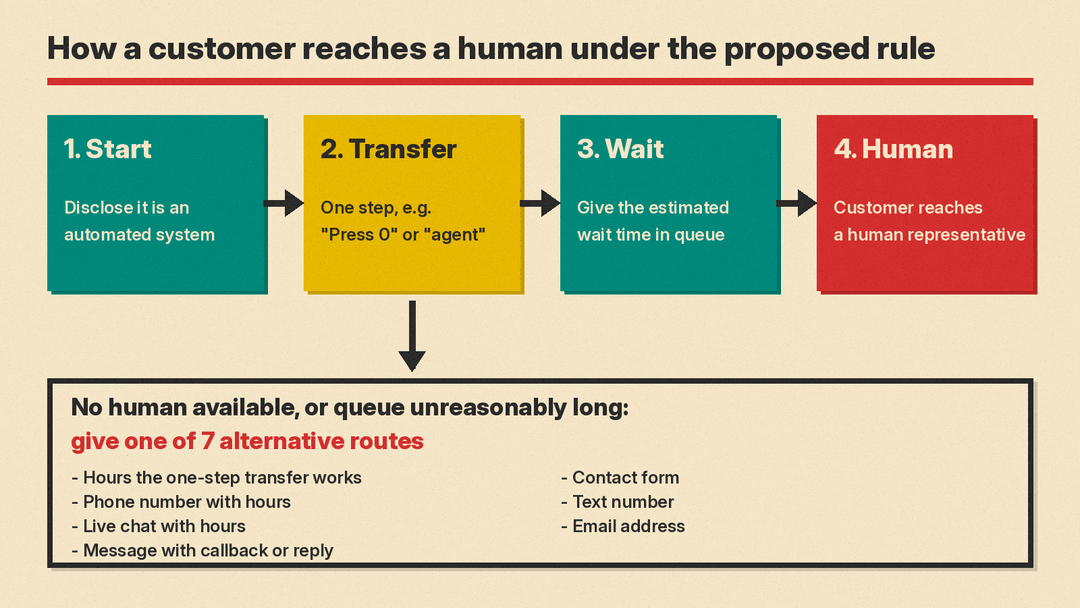
- A single-step transfer. One button, voice command or menu choice, usable at any point, that moves the customer to a human or a queue. The system must say what to do, for example "Say or type 'agent'" or "Press 0", and give an estimated wait time if there is a queue. It cannot make the customer answer more questions or justify the request first, except a menu that only routes to the right person.
- An alternative route. If no human is available, or the queue is unreasonably long, the system must tell the customer how to reach a person another way. The rule lists seven options: the hours when the one-step transfer works, a phone number with hours, a live chat with hours, a message with a callback or written reply, a contact form, a text number, or an email address. The last four must state a response timeframe.
A contact page that says "customer service" or "contact us" next to a channel also counts as a promise of service through that channel.
Records and fines
Businesses would keep records for at least three years, in a machine-readable format. These include contracts for the system, a log of each interaction (length, whether a transfer was offered and used, and the outcome), and yearly totals, such as how many interactions involved a customer who had used the system in the previous 72 hours.
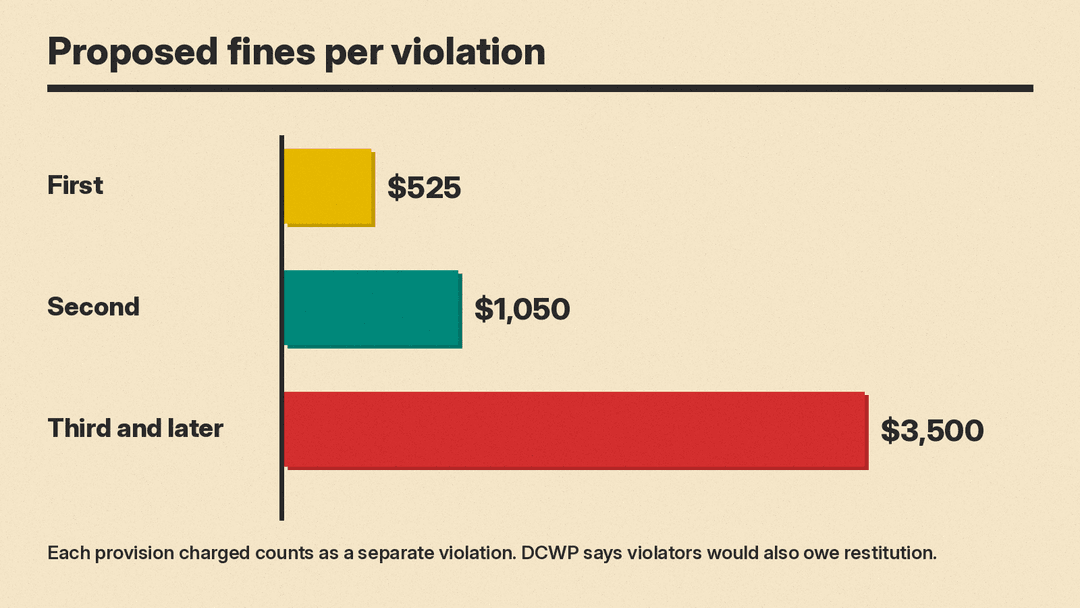
The proposed fines:
- First violation: $525
- Second violation: $1,050
- Third and later violations: $3,500
Each provision charged counts as a separate violation, and DCWP says violators would also owe restitution. The Mayor's Office of Operations certification says the rule gives no cure period.
Why the city says it acted
DCWP cites a Gartner report that chatbots resolve customer issues at rates from 17% for billing disputes to 58% for returns or cancellations. "We are not waiting for Washington to come to the rescue of working people," Levine said in the city's announcement.
Legislators in 37 states have introduced more than 120 chatbot bills, Gothamist reported, citing the Future of Privacy Forum. It said state laws passed so far largely require disclosure and address safety concerns, particularly for children, and few if any target customer service chatbots. For another recent disclosure law, see our explainer on Pennsylvania's AI ad label law.
What happens next
- Comments: through rules.cityofnewyork.us or by email to DCWP, until November 19, 2026.
- Hearing: by phone and video at 11:00 AM on November 19, 2026. Speakers get up to three minutes.
- Adoption: DCWP will review comments first. Levine said the start date depends on how many comments come in, and companies will get a transition period, Gothamist reported.
For businesses that serve New York City customers through chatbots or phone menus, the draft sets out the likely test: say it is a machine, offer a human in one step, and keep the logs to prove it.
Sources
- NYC DCWP: Mamdani Administration Proposes Ban on AI Customer Service Doom Loops (Oct 20, 2026)
- NYC DCWP: Notice of Public Hearing and Proposed Rules Regarding Automated Customer Service Systems (PDF)
- The City Record Online: DCWP notice on automated customer service systems
- Gothamist: NYC proposes crackdown down on AI customer service chatbots
