
Pennsylvania now has a law that tells advertisers when they must label AI in an ad. Governor Josh Shapiro approved Senate Bill 806 on October 22, 2026, and it became Act No. 99 of 2026, the Artificial Intelligence Deceptive Advertising Act. The act says it takes effect in 60 days, which The Next Web puts at December 21.
The law does not ban AI in ads, and it does not require a label on every AI image. It targets one thing: AI content that gives people a false idea about what is being sold. Here is what the final text says, who it reaches, and what it leaves open.
What the law covers
The act defines "synthetic content" as information, "including an image, video, audio clip or text, that has been significantly modified or generated by artificial intelligence," according to the final bill text (PN 1808).
The core rule is in Section 4. An advertiser may not "knowingly, recklessly or willfully" create and spread an ad that uses synthetic content "in a manner that creates a false consumer perception about the nature, origin or authenticity of the goods or services being advertised," without a clear and conspicuous disclosure.
So the duty has three parts. The ad must use synthetic content. That content must create a false impression about the product or service itself. And the advertiser must act knowingly, recklessly or willfully. An AI-generated background in an honest ad for a real product is a different case from an AI image that shows a product doing something it cannot do.
What the label must say and where it goes
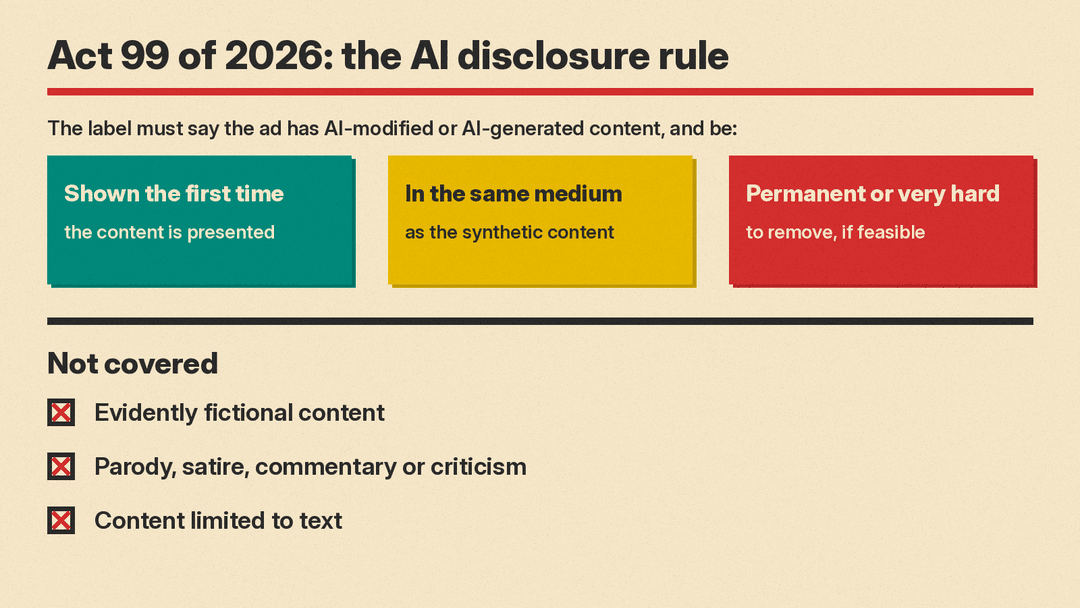
The disclosure must state that the ad "contains content that was modified or generated using artificial intelligence." The text sets three conditions. The label must be:
- displayed the first time the synthetic content is presented to the consumer
- presented in the same medium as the synthetic content
- permanent or "extraordinarily difficult to remove," to the extent technically feasible
The act also defines "clear and conspicuous" in detail. The disclosure must be readily noticeable and understandable, and it must be in the language the consumer uses to interact with the content. It must not contradict the rest of the ad. Audio disclosures need a volume and cadence a consumer can follow. On-screen disclosures must stay up long enough to read. Print ads, including point-of-sale displays and brochures, need a type size and contrast a consumer can read.
What is exempt
Section 4(b) lists three exceptions. The rule does not apply to content that is:
- evidently fictional, based on its content or context
- parody, satire, commentary or criticism
- limited to text
The text exemption matters. The definition of synthetic content includes text, but an ad that is only text falls outside the labeling rule. In practice, the duty lands on AI images, video and audio.
Who enforces it and the penalty
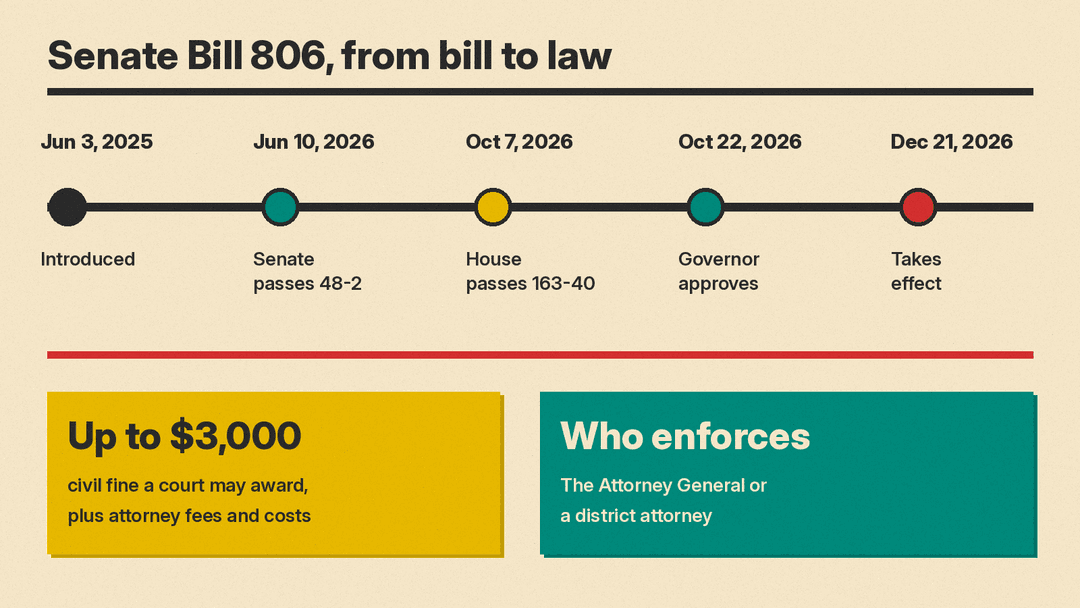
Section 5 gives enforcement to the Pennsylvania Attorney General or the appropriate district attorney. They can seek a temporary or permanent injunction and bring a civil action. A court may award a civil fine that "does not exceed $3,000," plus actual attorney fees and court costs. The text does not say whether the cap applies per ad or per violation.
The act also says a disclosure "shall not be construed to limit any recourse under law." A label is not a shield. An ad that is misleading in other ways can still face other claims.
The House Appropriations Committee fiscal note gives a sense of how the state plans to enforce it. The Office of Attorney General expects to hire a Deputy Attorney General, a technologist and an administrative assistant, at a cost of about $437,000 in fiscal year 2026/27 and $498,000 in later years.
How it passed
State Senator Nick Pisciottano was the prime sponsor, with Republican and Democratic co-sponsors listed on the bill page. The record shows:
- June 3, 2025: introduced and referred to the Senate Communications and Technology Committee
- June 10, 2026: amended on third consideration and passed by the Senate, 48 to 2
- October 7, 2026: passed by the House, 163 to 40
- October 22, 2026: approved by the governor as Act No. 99 of 2026
"Consumers deserve to know if AI is being used to create a false impression about a product or service," Pisciottano said in a Senate Democrats statement after the final vote, as quoted by The Next Web.
What is still unclear
The final text leaves some questions for regulators or courts:
- Who is an advertiser. The definitions section does not define "advertiser." The text does not name ad platforms, agencies or AI tool makers.
- What "significantly modified" means. The act does not say how much AI editing turns an image into synthetic content. Routine retouching and a fully generated product shot sit at opposite ends.
- What "technically feasible" means for a permanent label. The text does not name a method, such as a watermark or metadata.
- How the $3,000 cap counts. The text does not say if it is per ad, per day or per case.
What advertisers and creators can do now
This is not legal advice, but the text points to a few simple steps before December 21:
- List the ads you run in Pennsylvania that use AI-generated or AI-edited images, video or audio.
- For each one, ask whether the AI content could change what a buyer believes about the product, where it comes from, or whether it is real.
- If yes, plan a label that says the ad contains content modified or generated using AI, shown at first view, in the same format as the content.
- Keep clearly fictional, parody and text-only ads in a separate group, since the act exempts them.
Pennsylvania is not the only place with AI label rules. Europe's AI Act has its own transparency duties for AI-generated content; our EU AI Act explainer covers its deadlines.
