
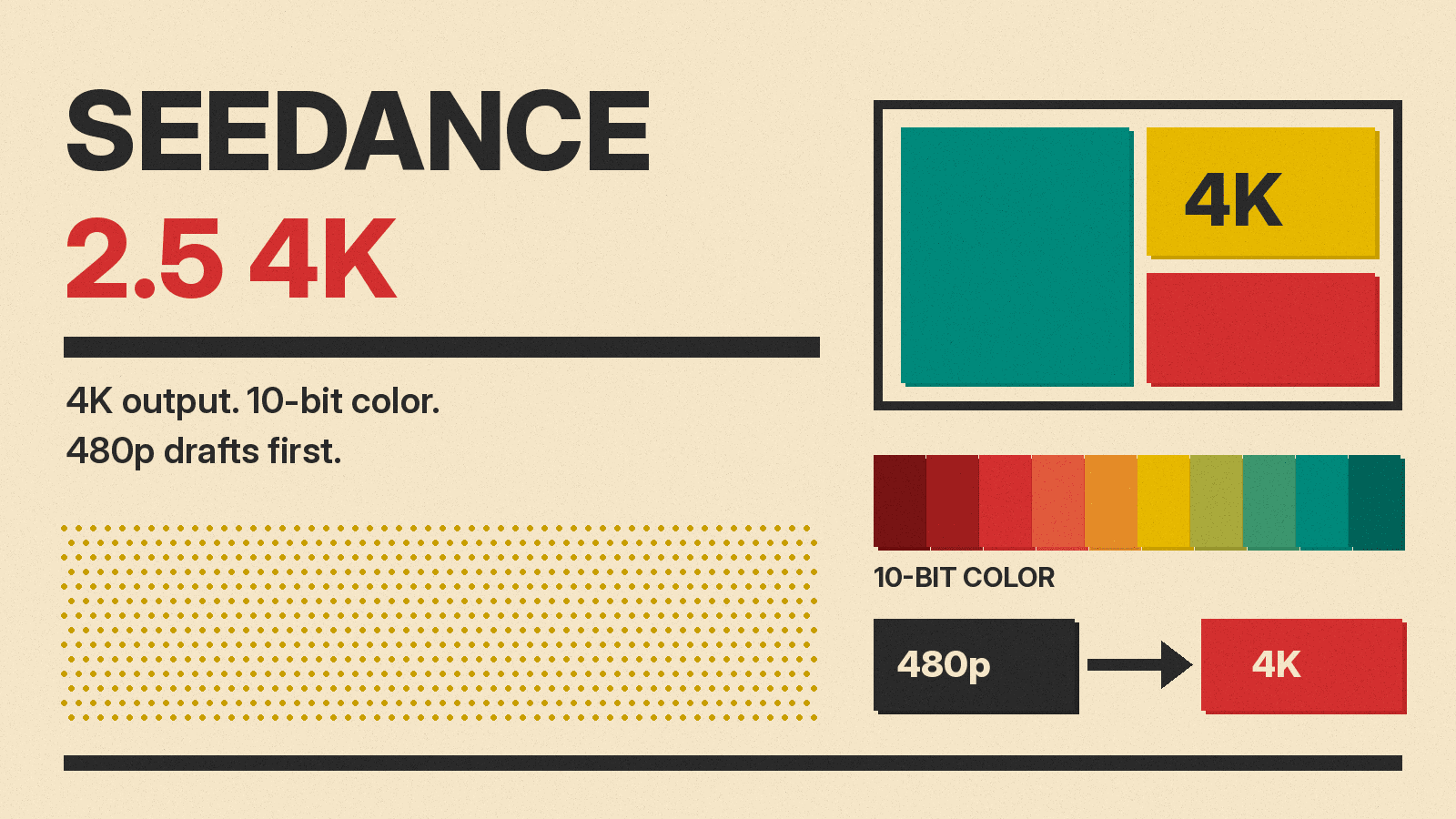
ByteDance has a new top tier for its Seedance video models, and it is aimed at film and television production. Seedance 2.5 4K, which BytePlus calls "the most capable model in the Seedance 2.5 generation," adds 4K output, 10-bit color and a lower-cost 480p Draft mode for testing shots. For now it is available for trials by selected enterprise customers.
What was announced
ByteDance's cloud platform Volcano Engine released Seedance 2.5 4K in China on October 23, 2026, targeting film and television production, TechNode reported, citing IT Home. BytePlus, which sells Seedance models through its ModelArk platform, followed with an English launch post dated October 27 under the line "Higher Ceiling, Built for the Big Screen."
BytePlus says that "through specialised training," the 4K model captures facial expressions, subtle movements and visual detail "more fully." The post highlights these changes:
- 4K output for final renders.
- 10-bit color depth, which BytePlus says gives "richer colour gradations and smoother transitions."
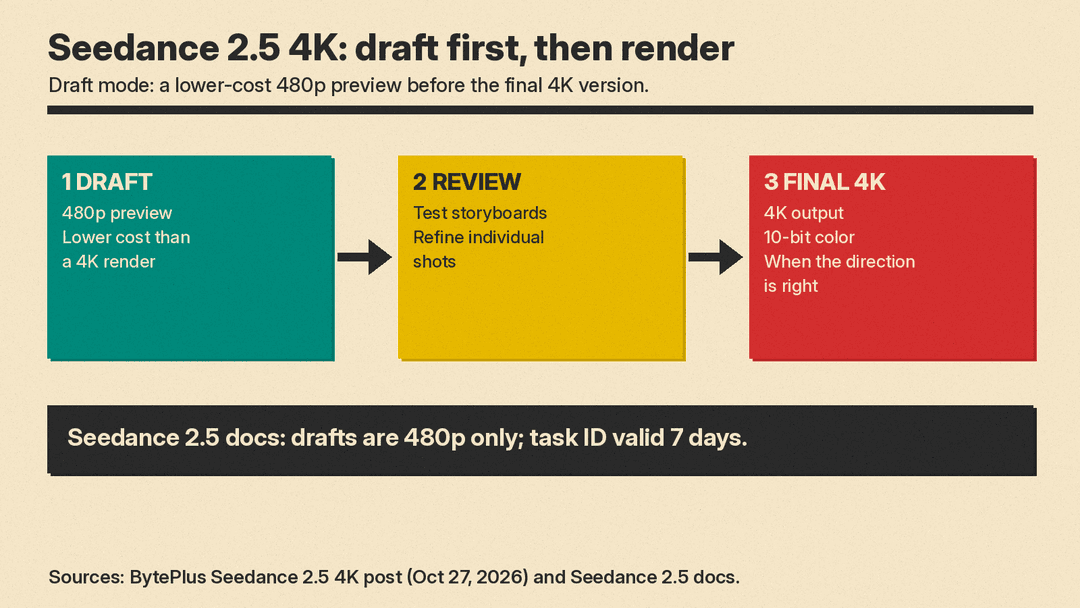
- A 480p Draft mode for low-cost previews before the final 4K render.
- Better preservation of uploaded source material in reference-based generation and video editing, including clearer fine text on things like posters and product packaging.
BytePlus showcases the model with a short film, "Otter is Nobody 2," which it says was created with Seedance 2.5 4K.
Who can use it
Not most people, yet. TechNode says the model "is currently available for trials by selected enterprise customers," and that some film production and post-production companies in China and overseas have begun testing it. The BytePlus post describes the same group: "selected film production and post-production companies" using it "in pipelines for real production tasks," spanning storyboard development, film previs, background editing and animation.
Neither source gives a public release date, a 4K price or a model ID for the API. If you use Seedance through BytePlus today, you get the standard Seedance 2.5 model, covered below.
What early testers say
BytePlus names three trial customers. Only the Resin line is a direct customer quote; the other two are BytePlus's summaries. Treat all three as vendor-selected testimonials, not independent reviews:
- BytePlus says Innovative Dreams "explored the model through an early demo created with Seedance 2.5 4K."
- Resin: "Seedance 2.5 4K has revived projects we'd shelved because the VFX budgets weren't commercially viable."
- BytePlus says Tomorrow Film Agency "highlighted lifelike faces in 4K close-ups, with facial details staying consistent across shots," and noted "delicate finger movements when turning pages and subtle changes in the light in a character's eyes."
BytePlus also says that in "dialogue-driven scene tests conducted by film and television clients," the 4K version "captured subtle character reactions more fully." It does not publish scores, test sizes or comparisons with other models.
How Draft mode works
Draft mode changes how you spend on a shot. The idea: render a lower-cost, low-resolution version first, check that the scene works, then generate the high-quality final version.
The BytePlus Seedance 2.5 documentation already describes this for the standard Seedance 2.5 model, and the 4K post says the 4K model supports it too. Per the docs:
- It is a two-step method. You set
draft=trueto get a low-resolution preview that lets you check "the scene structure, shot scheduling, subject motion, and prompt intent." - Only 480p drafts are allowed. Asking for another resolution causes an error.
- A 480p draft costs the same tokens as a normal 480p video.
- You then use the draft's task ID to make the final video. The final render reuses the draft's model, prompt, input assets, seed, audio settings, aspect ratio and duration, so the result stays consistent. For standard Seedance 2.5, a final video made from a draft must be 1080p.
- A draft task ID is valid for seven days.
The 4K post frames Draft mode as a step for storyboards, saying teams can "quickly test storyboards and refine individual shots, then generate the final output in 4K once they are happy with the direction."
How it compares with standard Seedance 2.5
The 4K model belongs to the Seedance 2.5 generation, which BytePlus opened to API customers earlier. According to the docs (updated October 20), standard Seedance 2.5:
- Generates up to 30 seconds per request, up from 15 seconds in the 2.0 series, and can extend videos over multiple rounds.
- Accepts up to 50 reference assets per request: 30 images, 10 videos and 10 audio clips.
- Supports timestamp-based video editing, native audio and 11 languages.
- Outputs 480p and 720p at 8-bit color, and 1080p at 10-bit color with H.265/HEVC encoding.
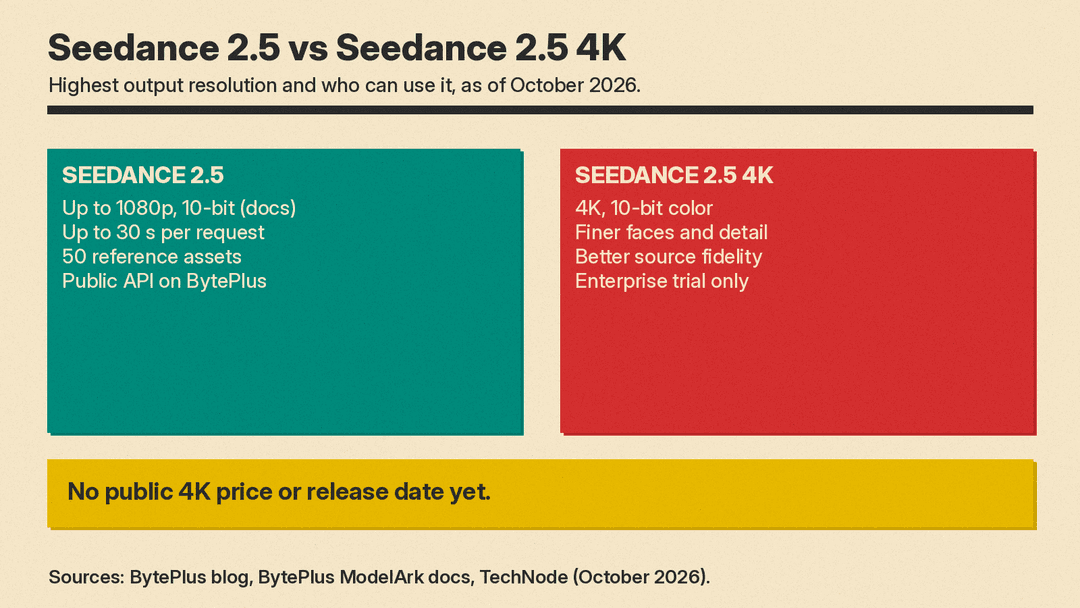
So the 4K model raises the resolution ceiling from 1080p to 4K and puts the focus on faces and source fidelity. BytePlus's own pages are not fully consistent on the public model's limits: the BytePlus offers page FAQ says Seedance 2.5's maximum resolution is 720p, while the docs list 1080p. The docs' capability table also lists 4K (10-bit) output for the older Seedance 2.0, so 4K itself is not new to the family; what is new is 4K on the 2.5 generation.
On price, as of October 27 the offers page lists Seedance 2.5 resource plans starting at $32 for 5 million tokens, which BytePlus says covers roughly 120 to 500 seconds of 480p video, and $64 for 10 million tokens. Neither the offers page nor the 4K post gives a 4K price.
For a wider view of how Seedance stacks up, see our Kling 4.0 vs Seedance 2.5 comparison and our AI video generator pricing guide.
Why it matters
BytePlus pitches Seedance 2.5 4K at the big screen. Its post says the 4K model's textures, 10-bit color and facial detail create "a more detailed, cinematic look that is better suited to the big screen," and TechNode says the release targets film and television production.
Three parts of the launch speak to production work. BytePlus says 10-bit color gives "richer colour gradations and smoother transitions." It says the model better preserves the quality, clarity and colour of uploaded materials, such as posters and product packaging. And Draft mode lets teams test shots at 480p and keep 4K generation for the final result. The Resin quote points to the business case: Resin says the model "has revived projects we'd shelved because the VFX budgets weren't commercially viable."
Every quality claim so far comes from ByteDance and its chosen customers. There are no public benchmarks, no 4K price and no date for wider access. Until independent testers get it, treat Seedance 2.5 4K as an enterprise trial, not a tool you can plan a production around. If you need a video model you can use today, our guide to the best AI video generators covers the options that are open now.
