
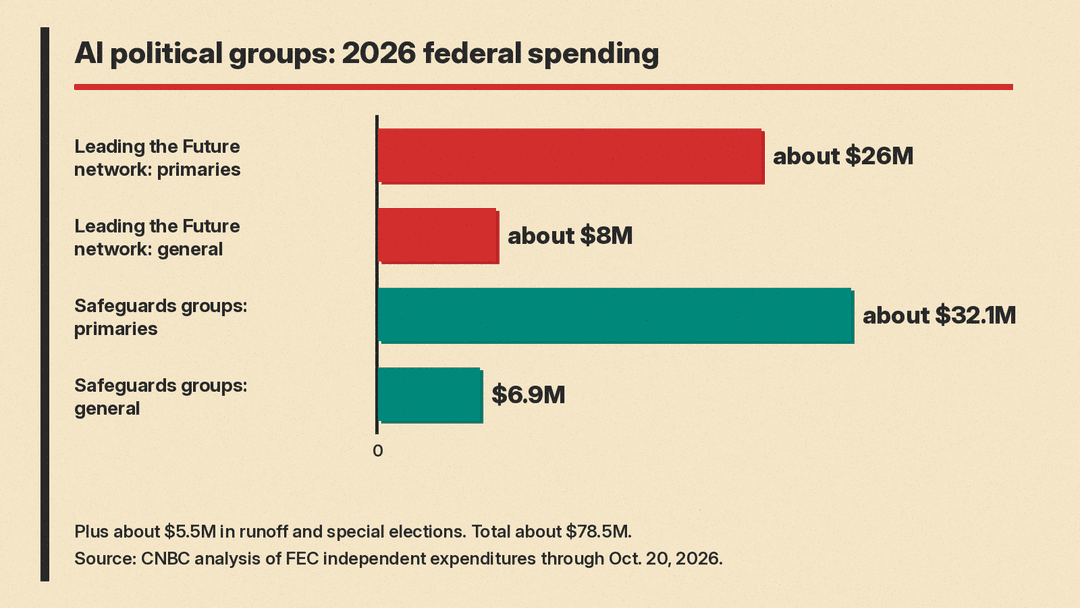
With one week to go before the US midterm election, the AI industry's political money is split into two camps, and in some races the two camps have backed opposite sides. A CNBC analysis of Federal Election Commission filings through October 20 counts roughly $78.5 million spent on federal candidates this cycle by AI-aligned political groups. About 74% of it went to primaries, and the pace has dropped sharply in the general election.
CNBC's opening line sums up its finding: "Silicon Valley's bid to dominate artificial intelligence politics has devolved into a fight with itself."
The two camps
CNBC sorts the groups by what they want from AI policy.
- Faster development, lighter and more uniform rules. The main network is Leading the Future, which CNBC says launched in August 2025 with more than $100 million in commitments from backers including Andreessen Horowitz, OpenAI President Greg Brockman and his wife Anna, and Joe Lonsdale. It runs a Democratic PAC, Think Big, and a Republican PAC, American Mission, which back candidates who favor faster AI development and oppose a patchwork of state rules.
- Stronger safeguards and more room for states to regulate. CNBC reports that Anthropic committed $20 million to Public First Action in February and another $20 million in July. Anthropic says its money is restricted to policy and public education and cannot fund candidate elections. CNBC adds that separately funded super PACs tied to Public First Action have spent millions on similar priorities. Safeguards-side super PACs named in CNBC's analysis include Jobs and Democracy PAC, Defending Our Values and Guardrails Alliance.
CNBC says both sides favor AI innovation and agree on the need for guardrails. They disagree on how fast AI should be deployed, how far regulation should reach and how much power states should keep.
Where the $78.5 million went
These are CNBC's figures for independent expenditures supporting or opposing congressional candidates. CNBC says they exclude state races and nonprofit advocacy spending.
- Leading the Future network: about $26 million in primaries and about $8 million in general-election races.
- Safeguards-focused groups: about $32.1 million in primaries and $6.9 million in general-election contests.
- Both camps: roughly $5.5 million more in runoff and special elections.
Added up, that is about $34 million for the faster-development side and about $39 million for the safeguards side before runoffs and specials. In the general election alone, the faster-development groups lead, about $8 million to $6.9 million.
The race that drew the most money
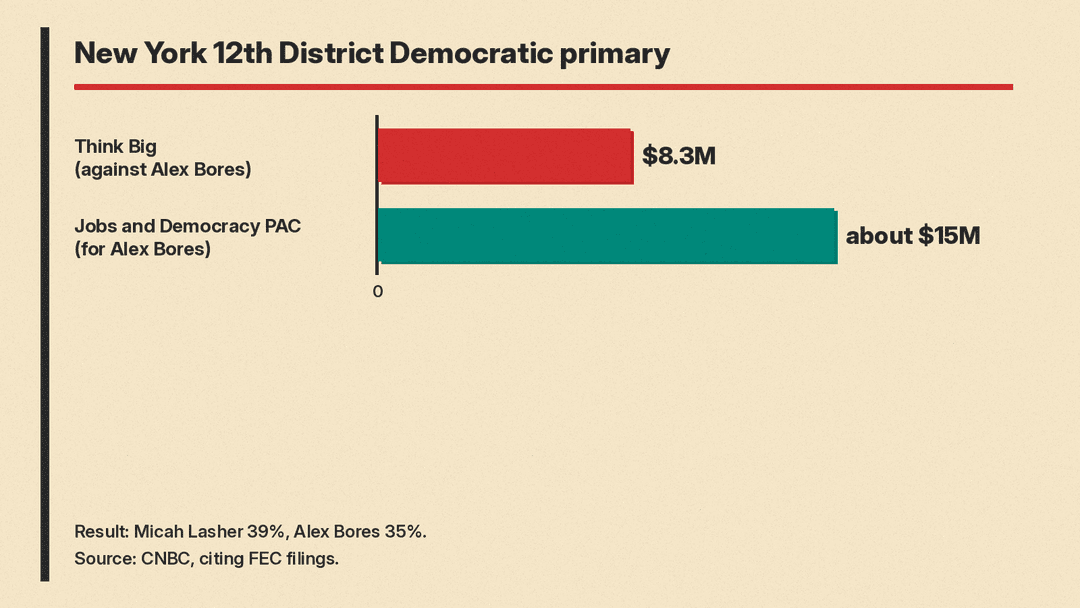
The biggest single fight was the Democratic primary in New York's 12th District. According to CNBC, Think Big spent $8.3 million trying to defeat state Assemblymember Alex Bores, who wrote major state AI safety legislation. Jobs and Democracy PAC, which CNBC describes as Anthropic-backed, spent about $15 million to support him, and allied safety groups spent millions more.
CNBC says those two PACs together spent $23.3 million, about 40% of the two camps' primary spending nationwide. Bores lost to Micah Lasher, 39% to 35%, which CNBC calls a tactical victory for Think Big.
Sacha Haworth, founder and executive director of the Tech Oversight Project, a watchdog that wants stronger rules for Big Tech and AI, told CNBC: "They helped light a flame under the backlash that's now fueling so much of the midterm elections." Haworth added that the race showed spending against safety-first candidates could now set off a counterattack from inside the industry itself.
Head-to-head in Florida
In Florida's 25th District, the split produced a direct face-off. CNBC reports that in the primary, Think Big spent $310,000 supporting Democrat Jared Moskowitz, while Defending Our Values spent almost $857,000 to boost Republican Scott Singer and another $740,000 against one of his primary opponents. Moskowitz and Singer now meet in the general election.
In the fall, CNBC says Guardrails Alliance reported spending $412,500 each against Republican House candidates Jay Feely in Arizona and Aaron Flint in Montana, both of whom benefited from Leading the Future-aligned spending in their primaries. It also reported about $412,000 against Democratic Rep. Jimmy Gomez in California, whom Leading the Future endorsed but did not report spending for.
Why the money slowed down
CNBC says part of the drop reflects the smaller number of competitive November races. CNBC says the slowdown has also coincided with AI becoming a harder political sell. A new CNBC All-America Economic Survey found 52% of registered voters said companies should pause development of advanced AI until Congress passes regulations, against 32% who favored moving ahead. Sixty-three percent said they would oppose an AI data center within 10 miles of their home.
Bruce Freed, president of the nonpartisan Center for Political Accountability, told CNBC: "When evaluating risk versus reward right now, the backlash is just too big." Freed also said: "AI executives and groups spent heavily in the primaries, so they likely achieved what they set out to do in most races. At this point, there's no real downside to scaling back."
CNBC, citing earlier press reports, lists some of the pullback:
- The Brockmans gave $25 million to Leading the Future. Semafor reported that, amid objections from OpenAI employees to the group's tactics, OpenAI's chief strategy officer said internally the company was taking "reputational hits." The New York Times reported the Brockmans later dropped plans for another $25 million.
- Political groups funded by Meta returned $25 million this summer, cutting its planned $65 million state-level push to about $40 million.
- OpenAI CEO Sam Altman told Politico earlier this month: "I don't think spending money on politics is what's going to make people feel better about it."
The crypto model
CNBC says the plan was modeled on crypto. Fairshake and its affiliated pro-crypto super PACs spent more than $130 million in the 2024 cycle, according to FEC filings cited by CNBC. CNBC, citing crypto publication CoinDesk, says the candidates it backed won 53 of 58 races. Leading the Future is co-led by Josh Vlasto, who worked for Fairshake last cycle.
CNBC says electing more allies could give either camp an edge in shaping AI policy in the next Congress, even as the feud risks weakening Silicon Valley's clout. For how the midterms could shape AI oversight in the next Congress, see our explainer on what a Democratic majority could do on AI, and for one company's election-season product change, see how ChatGPT now handles election interference images.
