
Dean W. Ball, an AI policy writer who now works at OpenAI, put a number on one of the most argued-over questions in AI policy this weekend. In a post on X on October 18, he wrote that distillation "has always been part of the explanation for why China is so close behind the U.S. in model benchmark performance," and that after joining OpenAI he thinks it "probably plays a bigger role in the explanation than I realized."
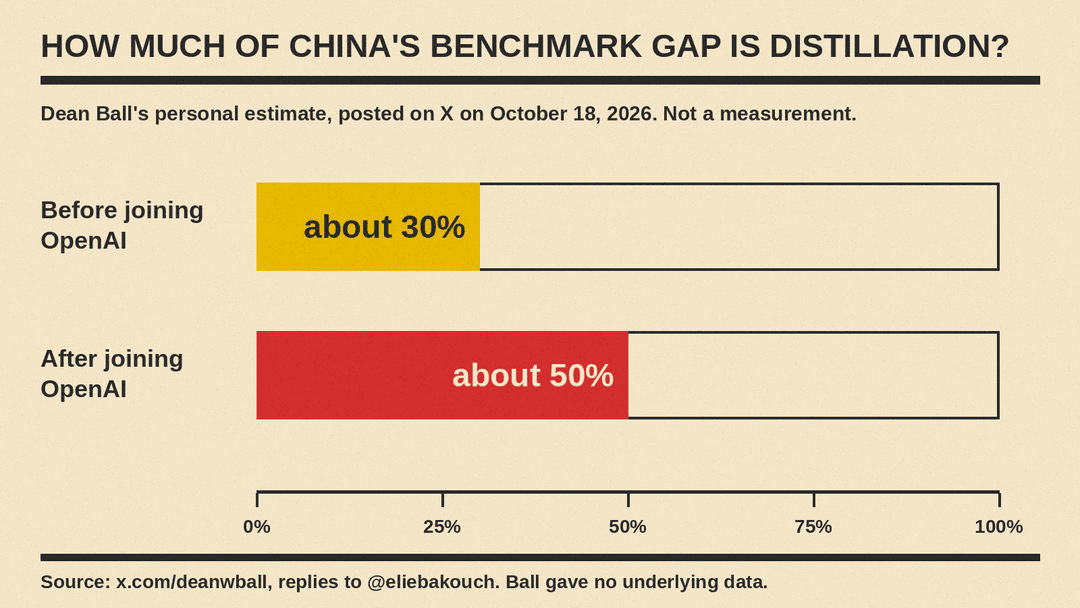
Asked by researcher Elie Bakouch (@eliebakouch) for a percentage, Ball replied: "I would have guessed distillation explained ~30% of Chinese close-behindness before seeing what one can see within openai, and after that, more like 50%."
That is a personal estimate, not a published measurement. Ball said in the same thread that "there are limits to what I can say here." But it comes from someone who says he has seen "what one can see within openai," and it lands about six weeks after US security agencies named six Chinese labs in a formal advisory. Here is what the claim means, what evidence is public, and what China says in response.
What set it off
Ball was quoting a post by the X user @scaling01, who wrote on October 17 that it was "very curious that DeepSeek now has the same terse reasoning style as Astra," OpenAI's GPT-6 Astra, adding "must be a coincidence." That post followed DeepSeek's release of V4.1-Flash-1017 the same day. A similar writing style is not proof of distillation, and neither Ball nor OpenAI has said that this specific DeepSeek model was trained on OpenAI outputs.
Two meanings of "distillation"
Distillation means training one model on the outputs of another. Labs do it to themselves all the time to make smaller, cheaper models, and researchers use it openly. Ball argued that the policy fight is about something narrower. "A big part of distillation in practice involves people stealing cots," he wrote, meaning chains of thought, the step-by-step reasoning a model produces before its answer. "It's not just training on the normal outputs of the model. This is one of the reasons we tend to think of them as 'attacks.'" He added that "researchers and policy people mean quite different things by 'distillation.'"
Bakouch pushed on the tradeoff: how much a copier learns per sample likely depends on how much reasoning a lab shows its users, so hiding reasoning protects the model but can hurt the product. Ball also said detection is hard: "much much harder to train classifiers on this than you'd think. false positive rate is crazy high," he wrote.
The public evidence so far
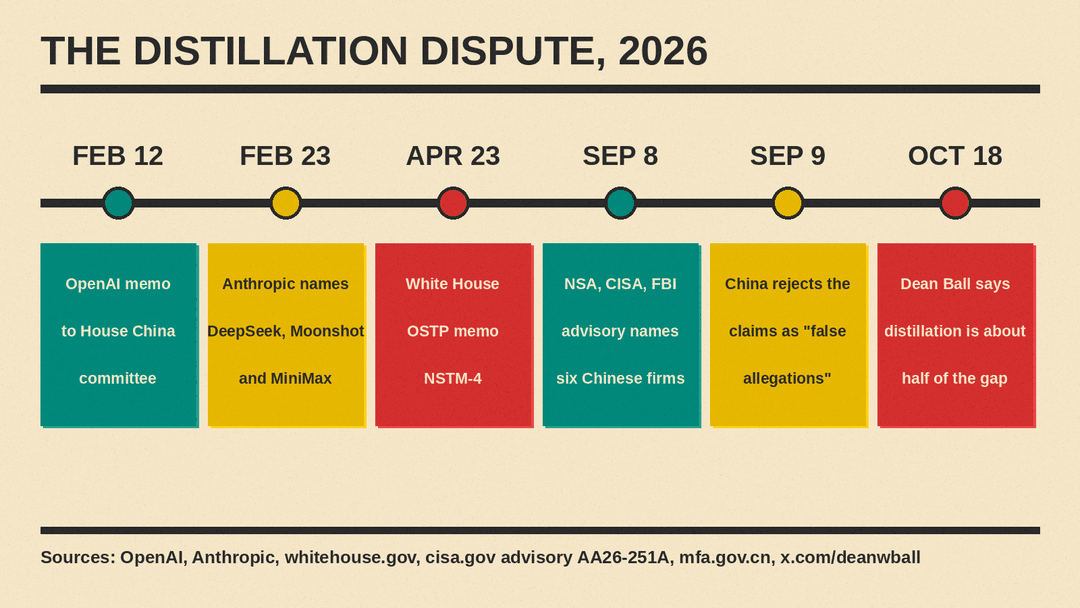
- February 12: OpenAI told the House Select Committee on China, in a memo, that it had seen "accounts associated with DeepSeek employees developing methods to circumvent OpenAI's access restrictions" through "obfuscated third-party routers," and that Chinese actors had "moved beyond Chain-of-Thought (CoT) extraction toward more sophisticated, multi-stage pipelines."
- February 23: Anthropic said DeepSeek, Moonshot and MiniMax generated over 16 million exchanges with Claude through about 24,000 fraudulent accounts. It put DeepSeek's share at over 150,000 exchanges.
- April 23: Michael Kratsios, director of the White House Office of Science and Technology Policy, issued memo NSTM-4, saying the government "has information indicating" that foreign entities, "principally based in China," run "industrial-scale campaigns" using "tens of thousands of proxy accounts." It said such models "do not replicate the full performance of the original" but "appear to perform comparably on select benchmarks at a fraction of the cost." The administration said it would share information with US labs and "explore a range of measures to hold foreign actors accountable."
- September 8: The NSA, CISA and FBI published advisory AA26-251A. It names DeepSeek, Moonshot AI, Alibaba, MiniMax, StepFun and Z.AI and says they "extracted billions of tokens across millions of exchanges/requests" from Claude, GPT, Gemini and Grok models "since at least late 2024," "likely with Chinese government awareness." It says Moonshot "extracted significant Claude Fable 5 data to train its Kimi-K3 model," and calls DeepSeek's publicly quoted $5.6M training cost "misleading" because it leaves out the cost of distilled data. It describes a gray market of API proxies called "transfer stations."
Ball's 50% figure fits the direction of these documents. The advisory goes further, calling distillation "the critical core" of these labs' model development. None of the public documents gives a share of the gap, and none releases the underlying logs.
China's answer
China rejects the claims. At a September 9 press briefing, Foreign Ministry spokesperson Mao Ning said China's AI progress "comes from greater self-reliance and strength in science and technology" and asked the US to "stop leveling false allegations to smear China." The Commerce Ministry called the advisory "groundless and legally unsound," said it "politicizes and weaponizes distillation," and said US companies' own reports "disclose their extensive distillation of Chinese models."
Why it matters
- For reading benchmarks. If Ball is right, part of the narrow gap between Chinese open-weight models and US frontier models is copied capability, not independent progress. The White House memo makes the same argument: benchmark parity can overstate real capability. Buyers choosing a cheap Chinese model on leaderboard scores should test it on their own tasks.
- For model design. Labs that fear copying have a reason to show users less reasoning, which is a cost to developers who debug with it.
- For policy. The April memo promised to "explore a range of measures to hold foreign actors accountable," and the advisory gives agencies named targets. China, for its part, has proposed its own export controls on frontier model weights and AI technology. Both sides are now treating model capability as something to guard at the border.
- For the source. Ball works for OpenAI, a company with a direct commercial interest in this argument, and his figure cannot be checked from outside. Treat it as an informed insider estimate, not evidence.
Sources
- Dean W. Ball on X, October 18, 2026
- Dean W. Ball reply with the 30% and 50% estimate
- @scaling01 on DeepSeek's reasoning style
- OpenAI memo to the House Select Committee on China, February 12, 2026
- Anthropic: Detecting and preventing distillation attacks
- White House OSTP memo NSTM-4, April 23, 2026
- NSA, CISA and FBI advisory AA26-251A, September 8, 2026
- China Foreign Ministry press conference, September 9, 2026
- China Commerce Ministry spokesperson's remarks on the advisory
