
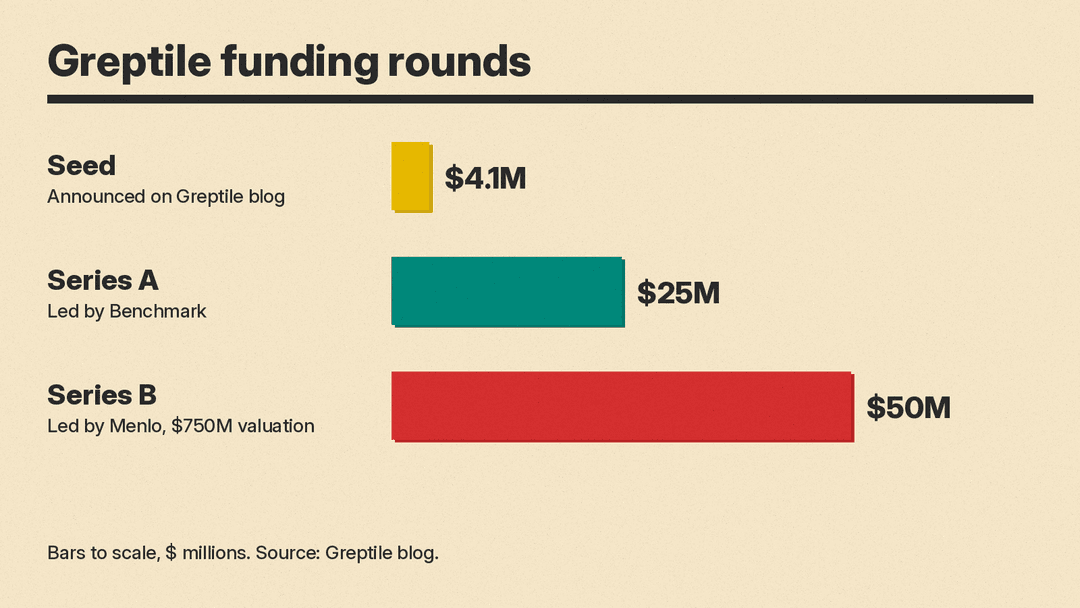
Greptile, the AI code review company, has raised a $50M Series B led by Menlo Ventures. The round values the company at $750M. Jump Trading, Wing, Operator Collective, Benchmark, YC, Browder Capital and Initialized also took part, and Deedy Das is joining the board, according to the announcement by Daksh Gupta.
The money is the headline. The more useful part is the argument behind it: coding agents now write code much faster than teams can check it, and Greptile wants to be the layer that does the checking.
What Greptile says it does today
Greptile reviews pull requests (PRs), the proposed changes engineers submit before code is merged. In the Series B post, the company says it "reviews and tests more than 1% of all PRs opened on GitHub every day" and that it is "the code validator for thousands of engineering teams including Nvidia, Coinbase, Decagon, and Vanta."
Investors added a few numbers of their own. Y Combinator wrote on X that Greptile serves those teams "with fewer than 50 people." Wing's Zach DeWitt posted "1M+ bugs prevented a week" and "10,000+ companies." Those figures come from the investors' posts, not from the Greptile announcement, and llms.blog could not check them.
The pitch: one independent check for every agent
The Series B post makes a specific claim about how the best teams work: they "use multiple coding agents and run all their changes through Greptile, which acts as a single, independent validation layer."
Gupta's case is that faster coding has not turned into faster shipping. "While coding is orders of magnitude faster than before, the impact on a team's ability to ship new features at work has been modest," he writes. Engineers still have to decide whether a change works and whether it will break something for users. The stated mission is "to automate code validation so even teams building mission-critical software can auto-merge complex changes."
This matches what other teams report. Anthropic's Claude Code team described a similar problem and a layered AI review loop in its own write-up, which we explained here. The difference is who does the reviewing. Greptile sells review as a separate product that sits outside whichever coding agent wrote the change.
Three features that show the direction
It runs the code, not only reads it. In June, Greptile launched TREX (Test, Run, Execute). When it reviews a PR, it picks behavior worth running, starts an agent in a sandbox, runs the relevant code and reports issues. It attaches evidence to the comment: "logs, screenshots, API traces, execution scripts, or even a video of a UI change playing out." Greptile says that "in our evals, Greptile review with TREX catches 20% more bugs."
It sends the review to a different model than the one that wrote the code. In a July research post, Greptile ran Claude Code and Codex review on two sets of 500 PRs, one written by each agent. Both models found more high-severity bugs in the other model's code than in their own. Greptile then shipped a feature it calls Model Inversion. It detects which agent wrote a PR from commit trails, branch prefixes and PR titles, then routes the review to the other model: "If Claude wrote it, GPT reviews it, and vice versa." The company calls the feature experimental.
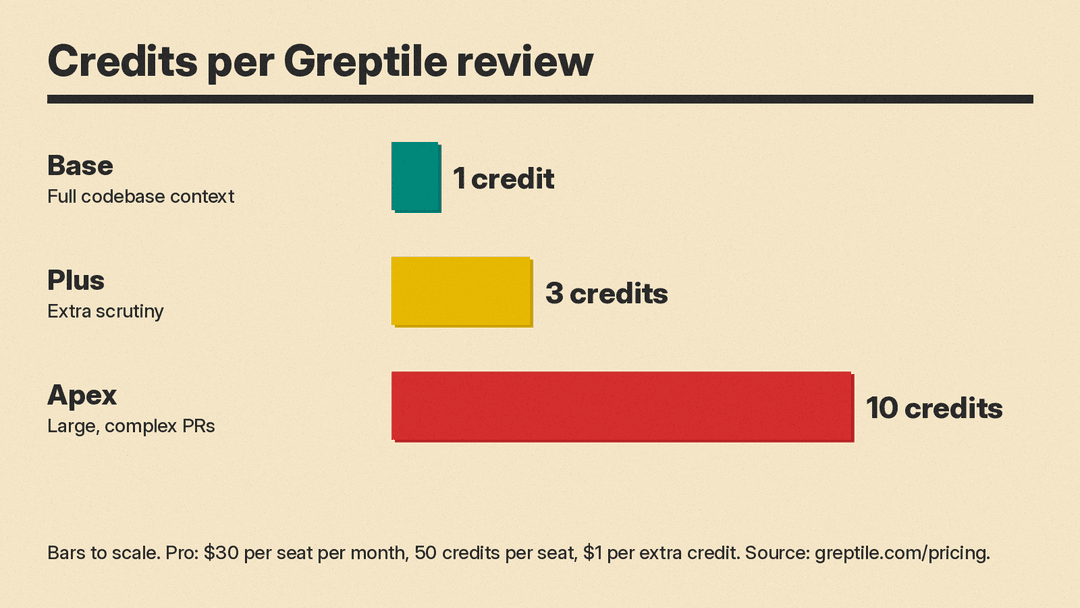
It lets teams pay for deeper reviews on risky changes. In September, Greptile added two higher review tiers, Plus and Apex. They give each review more time to run subagents and tasks in parallel. Teams can set rules to use a higher tier for large PRs or high-risk code. Greptile says Apex "now runs on all large PRs before they get to the prod deploy stages" at Greptile, and that its merges to production are now "smaller and more frequent."
What it costs (as of October 2026)
From Greptile's pricing page:
- Starter: free for 1 active developer, with unlimited repositories and 50 credits per month.
- Pro: $30 per seat per month, with 50 credits included per seat and $1 per additional credit.
- Enterprise: custom pricing, with an option to self-host, SSO/SAML and GitHub Enterprise support.
- Credits per review: Base 1, Plus 3, Apex 10.
- A seat is "any developer who has gotten a review done by Greptile in that billing period."
- Qualified non-commercial open-source projects with an OSI-approved license can use it free. Pre-Series A startups with under $2M revenue in the past 12 months can get 50% off.
The credit math matters. On Pro, the 50 included credits cover 50 Base reviews per seat, but only 5 Apex reviews. A team that sends every large PR to Apex will pay for extra credits.
Why it matters
AI code review is now a crowded category, and Greptile's own blog said as much in a post titled "There is an AI Code Review Bubble." This round is a bet that review will stay a separate product and not get folded into the coding agents themselves. Greptile's answer is independence: one checker for code from Claude Code, Codex, Cursor or a human, with a reviewer that is deliberately not the model that wrote the change.
For teams, the practical question is narrower. If agents already write most of your PRs, the slow step is the human check at the end. A tool that runs the code, attaches proof, and saves the deepest reviews for risky changes targets that step directly. Whether it is reliable enough to let teams "auto-merge complex changes," as Greptile hopes, is still an open question.
Sources
- Greptile: Series B and The War on Bugs
- Greptile: Introducing Greptile Plus and Apex
- Greptile: Introducing TREX
- Greptile: Models are worse at reviewing their own code
- Greptile pricing
- Greptile: Series A and Greptile v3
- Greptile blog index (seed round, AI code review bubble post)
- Y Combinator on X
- Zach DeWitt on X
