
Anthropic has opened a beta of linked billing on the Claude Platform, a way for third-party apps to charge Claude API usage to a customer's own Claude organization instead of asking that customer to paste in an API key. The Claude Platform release notes date the launch to November 17, 2026, and Anthropic's announcement lists platforms that support it today, including Asana, Linear, Ramp, Railway, Warp and Factory.
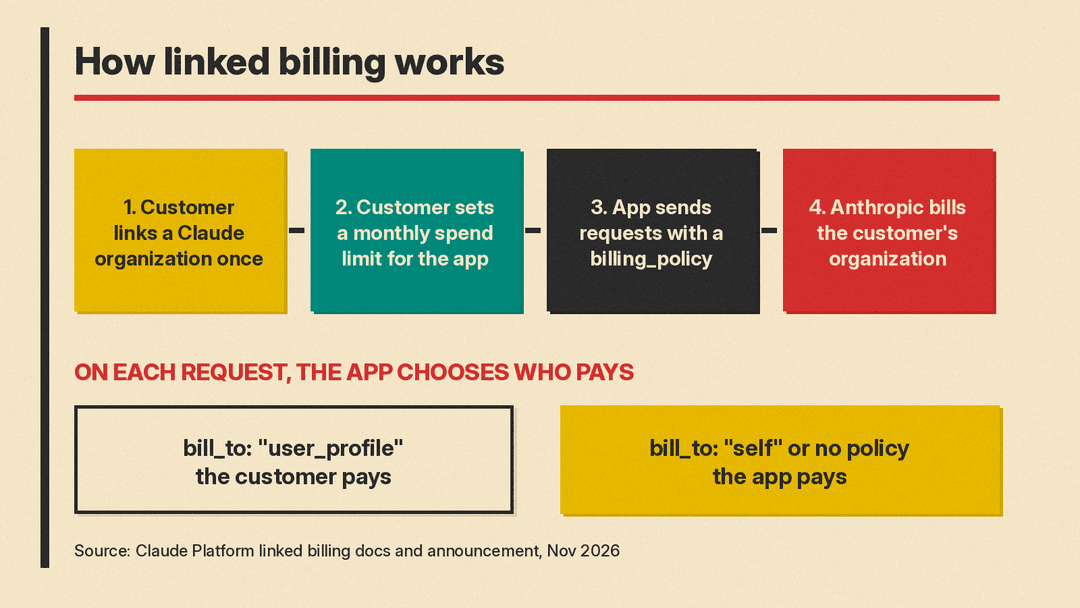
For anyone who has used a coding agent or automation tool with a "bring your own key" field, this changes who holds what. The customer links an organization once, sets a spend limit, and can cut the link from the Claude Console. The platform never stores the key.
What linked billing does
Anthropic's announcement describes the old setup plainly: an API key "works like a password," so anyone holding it can make requests billed to the customer, and the platform has to guard it. With linked billing, the customer links their Claude Platform organization and usage is billed to it directly. "No API key changes hands," the announcement says, so platforms have no customer keys to store, encrypt or rotate.
On the customer side, Anthropic lists four controls:
- One link for the whole organization. A Console user with an Owner, Admin or Billing role approves it.
- A limit per platform. Customers can set a monthly spend limit for each platform, or a default that applies to each one.
- Spend by platform. The Console shows spend for each linked platform.
- Unlink at any time from the Console.
Customers can draw down an existing Anthropic commitment or pay as they go, according to the announcement.
How it works for developers
The linked billing guide shows that this is built on Claude Platform OAuth, which the docs label a beta service whose endpoints and behavior "can change during the beta." A platform registers an OAuth app in the Console with the "Bill and link to organizations" permission, sets up client authentication through its own identity provider (Anthropic does not issue client secrets for these apps), and gives its back end a service account through Workload Identity Federation.
The platform then adds a "Link your Claude organization" button. The customer signs in at auth.claude.com, picks an organization if they have more than one, reads a screen on how billing works, sets a monthly spend limit, and clicks Link and authorize. The guide says the connection belongs to the whole organization, so it stays active if the person who approved it leaves.
On each request, the platform decides who pays. Calls to /v1/messages or /v1/chat/completions carry the user-profiles-billing-2026-10-01 beta header, an anthropic-user-profile-id header for the customer, and a billing_policy field. Setting bill_to to user_profile bills the customer; self or no policy bills the platform. Anthropic's announcement frames this as letting platforms pass costs to customers or "cover some features themselves by product or instance." If a request marked for the customer can't be billed to them, the docs say the API refuses it rather than billing the platform.
Platforms also get per-customer usage. The announcement says they can see each linked customer's request count, token usage and models used in the Console, or through the Usage and Cost Analytics API, which is also in beta.
The limits to read first
The fine print matters more than usual here, because it decides which customers can use the feature and what protections apply.
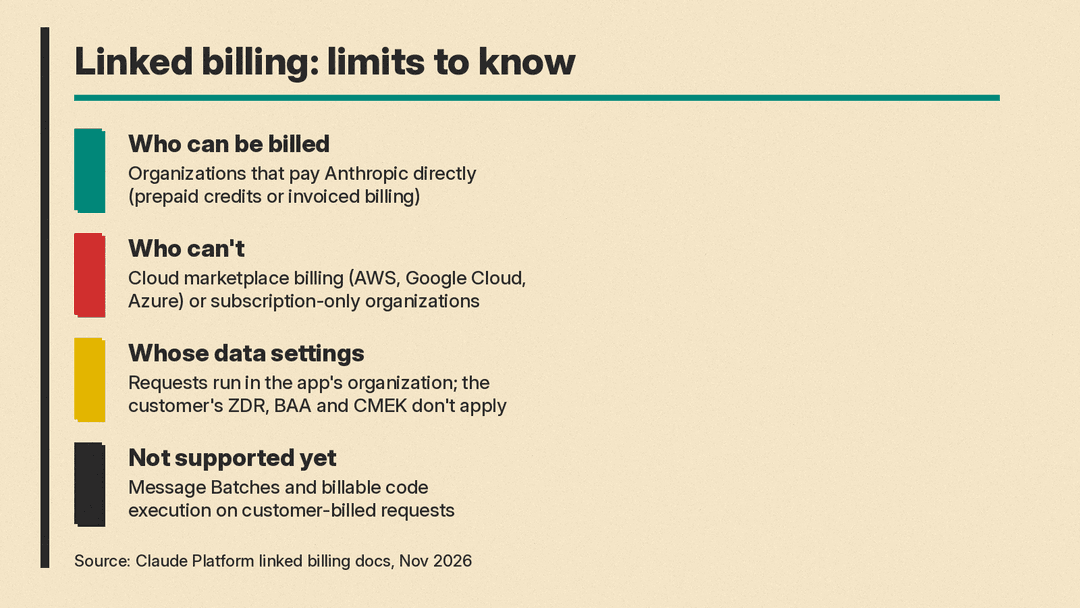
Who can be billed. According to the guide, the customer's organization must pay Anthropic directly for API usage; prepaid credits and invoiced billing both count. Organizations billed through AWS, Google Cloud or Azure marketplaces can't be billed this way, and neither can organizations that have only a Claude subscription plan. Those requests come back as a 403 user_profile_not_billable.
Which credits pay. The guide says some promotional credits can't pay for these requests, including the monthly API credits that come with Claude Max, Ultra and Team plans. Credits from Anthropic's partner, VC and startup programs aren't eligible either.
Whose data settings apply. Requests run in the platform's organization, not the customer's. The announcement says customer settings such as IP allowlists, encryption keys and data retention don't apply. The guide goes further: zero data retention, a business associate agreement and customer-managed encryption keys don't carry over, and it tells developers not to link customers that need HIPAA, FERPA or CMEK coverage for this usage.
What isn't supported yet. Message Batches can't bill the customer, and a customer-billed request can't use billable code execution features; the API returns a 400. When a customer hits a spend limit, the API returns a 402 linked_organization_spend_limit_reached, and the guide suggests the platform can still serve the request at its own cost by resending it with bill_to: "self".
Why it matters
Anthropic pitches linked billing as a more secure alternative to sharing API keys, and several launch partners made the same point in its announcement. "Manually copying API keys is inherently insecure," said Tom Moor of Linear. Runlayer CEO Andy Berman said, "No API key to share means one less attack vector."
There is a money side too. Asana's Arnab Bose said linked billing lets customers "use their existing Claude commitment" in Asana, and Moor said admins can now use "committed Claude spend directly" with Linear's cloud coding agent "in a click." Customers set the cap for each tool themselves. For other recent Anthropic developer news, see our posts on Code Mode in Claude Code and the Claude Fable 5.2 and Mythos 5.2 launch. If you are choosing a model for an app that will bill customers this way, our guide to which Claude model to use covers the current lineup.
Anthropic says platforms can add support by creating an app in the Console, and customers can find supported platforms on Claude Marketplace. The release notes add one more condition: linked billing works for customers whose organization pays Anthropic directly for API usage.
