

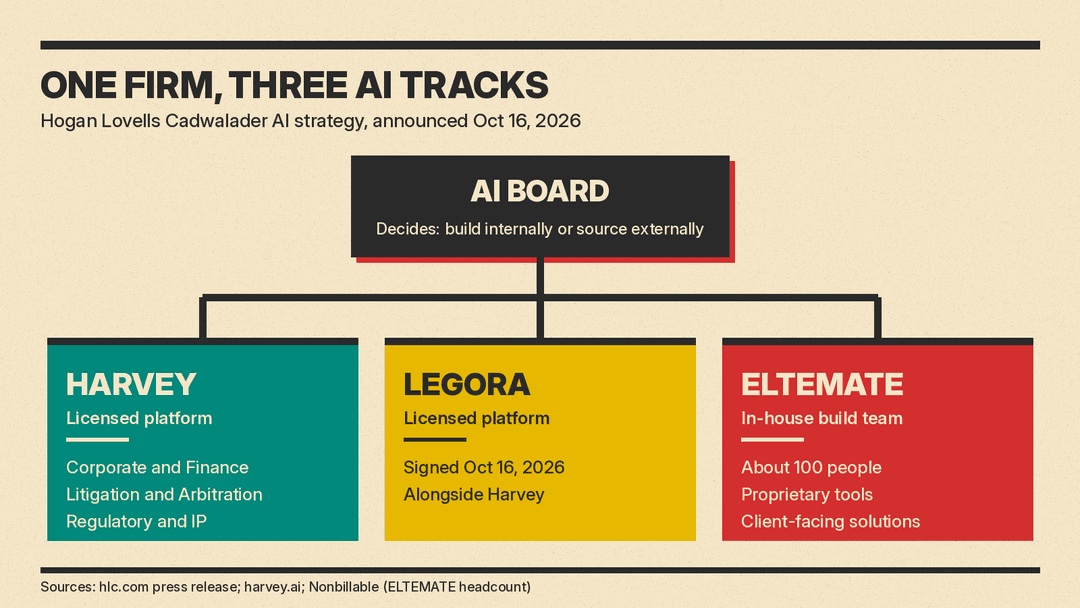
Most large law firms that buy legal AI pick one platform. Hogan Lovells Cadwalader picked two. On October 16 the firm announced a firmwide AI strategy with signed agreements with both Harvey and Legora, the two vendors that have been competing head to head for firmwide Big Law contracts. It also set up a new AI Board, named a managing partner for legal technology and AI, and created a commercial unit to rethink pricing.
The announcement is a useful snapshot of how the biggest law firms now buy AI: not as one tool, but as a portfolio that a central group manages.
What the firm announced
The press release lists five changes:
- Two vendor contracts. The firm signed agreements with Harvey and Legora. CEO Miguel Zaldivar said both "have been providing our lawyers with access to market-leading capabilities," so the deals formalize tools lawyers already use.
- An in-house build team. ELTEMATE, the firm's own legal technology business, "will continue to develop proprietary tools, workflows, and client-facing solutions." Nonbillable reports that ELTEMATE has roughly 100 people and is led by co-CEOs Sebastian Lach in Frankfurt and Manon Cordewener in Amsterdam.
- An AI Board. The board will review ideas from practice groups, decide whether each solution is built internally or sourced externally, allocate resources, and oversee development and deployment.
- New leaders. Paul Otto, a Washington, D.C. partner in the Global Regulatory practice, becomes Managing Partner, Legal Technology and AI. Oliver Campbell, a former capital markets lawyer, becomes Chief Transformation Officer.
- A Commercial Unit. Led by partner Bill Ferreira, it covers pricing, legal project management, pitching and client delivery, and will use AI "to create greater long-term value for clients."
Zaldivar's summary of the logic: "There is no single AI solution that will meet every need of a modern global law firm."
How lawyers at the firm use Harvey
Harvey's own announcement gives more detail on the deployment. The firm has adopted Harvey across Corporate and Finance, Litigation and Arbitration, and Regulatory and IP. Rollout ran through practice-group office hours, tailored workshops and one-on-one sessions with senior lawyers.
Lawyers at the firm have also built custom Harvey agents for three areas: knowledge management, capital markets, and international arbitration. They have worked on shared playbooks as well, which are written house positions on how to treat common clauses. Neither the firm nor Harvey published usage numbers, time savings or contract values.
Why buy two platforms
The firm did not explain how work will be split between Harvey and Legora. But the structure points to a few practical reasons a large firm might want both:
- Coverage. The two products overlap, but practice groups often prefer different tools for drafting, research or document review. Two contracts let each group use what works.
- Negotiating position. A firm locked into one vendor has less leverage at renewal. A firm that already runs both can shift usage.
- A hedge. Legal AI products change every few months. Running two platforms reduces the risk of betting the whole firm on one roadmap.
The cost is complexity: two security reviews, two sets of training, two sets of data controls. The new AI Board is the firm's answer to that, a single group that decides what gets built, what gets bought, and who pays for it.
Build versus buy across Big Law
Hogan Lovells Cadwalader is mixing both approaches. Other firms lean harder one way. A month earlier, Sullivan & Cromwell showed Agreement Analyzer, a custom contract review tool built with OpenAI on ChatGPT Enterprise. According to OpenAI's case study, S&C partner John Savva first built it as a single-user prototype with Codex. The tool runs several review passes over a draft agreement using firm precedents and negotiating playbooks, then returns a memo and proposed tracked changes for a lawyer to accept, modify or reject.
That is a build path anchored on one model provider. Hogan Lovells Cadwalader's path is to license two specialist platforms and keep an in-house team for the work that sets the firm apart. Both firms keep a lawyer in charge of the final output.
The pricing question
The Commercial Unit may be the most important part of the announcement. Big Law still bills mostly by the hour, and AI cuts the hours needed for drafting, review and research. A firm that wants to keep revenue while work gets faster has to change how it prices matters. Putting pricing, project management and AI under one structure suggests the firm expects that shift. The release does not say whether it will move clients toward fixed fees or other models.
There is also a staffing angle. In August, NALP reported that firms with more than 500 lawyers hired about 540 fewer Class of 2025 graduates than the year before, a 7.5% drop and the first decline at that size since the Class of 2014. Reuters noted that the report cited possible hiring shifts from generative AI among several causes, alongside federal job cuts and lower public interest funding. NALP did not attribute the decline to AI alone.
Why it matters
For legal AI vendors, the deal shows that winning a firm no longer means locking it in. For other large firms, it offers a template: a central board, a build team, and more than one vendor. The firm says it now has the scale to fund this. The changes come about three months after Hogan Lovells completed its merger with Cadwalader, according to Nonbillable.
What to watch next: whether other top firms follow with multi-vendor deals, and whether the Commercial Unit leads to published changes in how the firm bills clients.
Sources
- Hogan Lovells Cadwalader: Hogan Lovells Cadwalader unveils the next phase of its AI strategy (Oct 16, 2026)
- Harvey: Hogan Lovells Cadwalader Adopts Harvey (Oct 16, 2026)
- Nonbillable: Harvey or Legora? Hogan Lovells Cadwalader picked both
- Sullivan & Cromwell: Custom tool built in collaboration with OpenAI (Sept 18, 2026)
- OpenAI: Sullivan & Cromwell brings legal expertise into agreement review
- NALP: Employment for the Class of 2025, Selected Findings (PDF)
- Reuters: Entry-level hiring at large US law firms declined for the first time in a decade
