
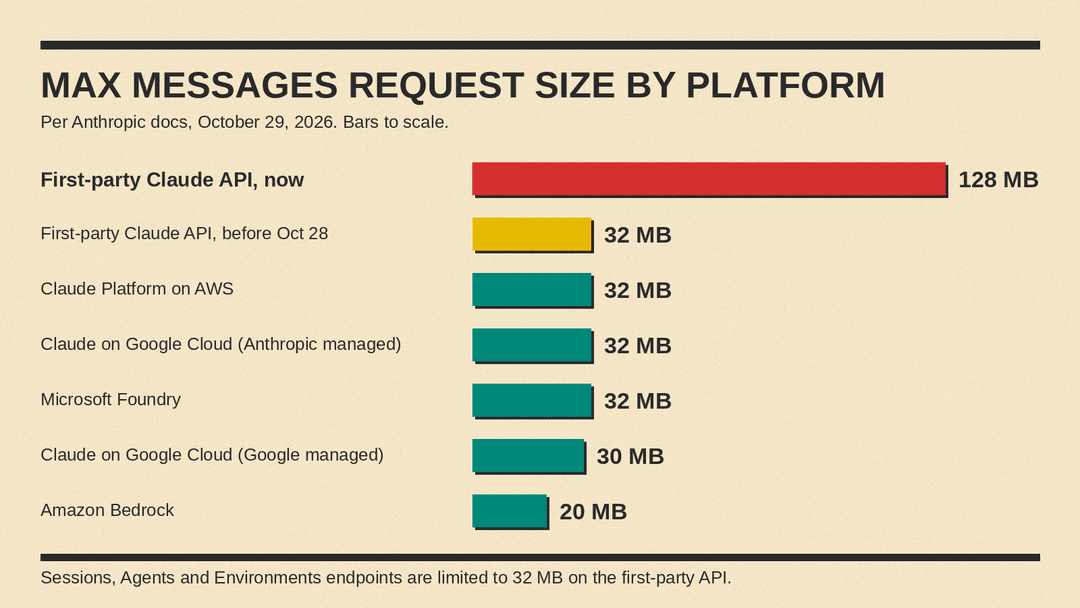
Anthropic has quadrupled how much data a single Messages API request to Anthropic's own Claude API can carry. According to the Claude Platform release notes, on October 28, 2026 the company raised the maximum request size for the Messages API and the Token Counting API from 32 MB to 128 MB "on the first-party Claude API." A day later, on October 29, it put a new Usage and Cost Analytics API into beta and moved its older usage and cost endpoints to legacy status.
Neither change is a new model. Both matter to teams that send Claude large files or pay a large Claude bill.
What changed on request size
The API overview now lists these limits for the first-party Claude API, meaning requests sent straight to Anthropic rather than through a cloud partner:
- Messages and Token Counting: 128 MB
- Message Batches API: 256 MB
- Files API: 500 MB
- Sessions, Agents and Environments: 32 MB
A request over the limit gets a 413 request_too_large error. The errors page adds that on the first-party API, Cloudflare returns this error "before the request reaches the API servers."
Request size is the raw size of what you send, not the number of tokens. It matters most when you put images or PDFs directly into a request as base64 text instead of uploading them first. Base64 makes files larger, so a handful of high-resolution screenshots or a long scanned PDF could hit 32 MB well before the model's context window was full.
The vision guide spells out the gap. It says the API supports up to 600 images per request (100 for models with a 200k-token context window), but that "request size limits can be reached first." It now gives the first-party limit as 128 MB.
The Token Counting endpoint got the same raise, so both endpoints now share the 128 MB limit on the first-party API.
The limit is not 128 MB everywhere
The change covers only Anthropic's own API. The same API overview note lists lower ceilings for partner platforms:
- Amazon Bedrock: 20 MB
- Claude Models on Google Cloud (Google managed): 30 MB
- Claude Platform on AWS, Claude Models on Google Cloud (Anthropic managed) and Microsoft Foundry: up to 32 MB for Messages and Token Counting
Anthropic tells readers to "consult your platform's documentation for current values." Teams that run the same code against Anthropic's API and a cloud partner should size requests for the smaller limit, or they will see errors on one platform and not the other.
Some per-image rules did not move. Each image can be at most 8,000 by 8,000 pixels. When one request holds more than 20 images, a stricter per-image limit applies to every image in it. The vision guide says that to stay under it on all platforms, keep each image at 3,000 pixels or less on each side, or send 20 or fewer image and document blocks. For many images, it still suggests uploading through the Files API and pointing to each file by file_id.
A new API for usage and cost
The second change is for whoever watches the bill. The Usage and Cost Analytics API has two endpoints, /v1/organizations/analytics/usage for token and request counts and /v1/organizations/analytics/cost for cost in US dollars. It is in beta and needs the analytics-usage-cost-2026-08-24 beta header.
According to the docs, it works for both Claude Console and Claude Enterprise organizations with the same endpoints and fields. Results can be grouped by up to five dimensions, such as model, workspace, API key, service tier or "actor." The actor is who a request is attributed to: a user, a service account, a federated AWS or Google Cloud identity, or the API key itself when no identity is behind it. The docs say usage from Claude Code after a member signs in is attributed to that member.
The cost endpoint reports both amount, which is cost after discounts and before credits, and list_amount at list prices. Results can be split into one-minute, one-hour or one-day buckets. One request can cover at most 31 days, and the start date must be on or after January 1, 2026.
There is a trade-off on speed. The migration table says the older Usage and Cost API typically showed data within 5 minutes. The new API "typically refreshes within 4 hours" and can take up to 24 hours. Values can also change until about 7 days after the end of a calendar month. For real-time alerts on runaway spend, that delay matters. For monthly chargebacks by team or key, the actor and workspace breakdowns are the main gain.
The older Usage and Cost API and four report endpoints of the Claude Enterprise Analytics API are now legacy. The release notes say "all of them remain supported," and the docs include guides for moving to the new API.
Why it matters
In late October, developers argued over how much Claude Code's background agent status line was costing, using their own telemetry to find out. The new API's docs say admins can get per-user Claude Code cost by filtering the cost endpoint to Claude Code and grouping by actor. It also gives one official place to see spend by person, model and workspace, and by API key on Claude Console organizations.
The request size raise is simpler. Agents that pass around screenshots, scanned contracts or long logs now have four times the room on Anthropic's own API before they need the Files API. On Bedrock and Google Cloud, the limits are lower.
