
On November 9, 2026, Baidu's ERNIE team published a research blog post titled "ERNIE Evolve: Toward Automated Research for Real-World AI R&D". It describes ERNIE Evolve, an automated research system made of AI agents that modifies code and runs experiments on its own. Baidu says it used the system to find inference speedups for ERNIE-5.5-Flash, a model the company describes as "in-development".
The main claim, according to Baidu's blog post, is that AI agents, not only engineers, found inference speedups for its next model that passed production-grade validation. Everything below comes from Baidu's own materials or from press reports citing them. These are vendor claims, not independently verified results. If you are new to Baidu's model family, our ERNIE explainer covers the background.
What is ERNIE Evolve?
Baidu frames the project around recursive self-improvement, or RSI: applying automated research systems to improve the AI that powers them. The company calls ERNIE Evolve "our first step toward this goal".
According to Baidu, the system works like this:
- It is given a code repository, an optimization objective, and evaluation criteria.
- It then modifies the code and runs experiments autonomously in isolated environments.
- Two nested loops drive the work. The outer loop decides what to investigate. The inner loop develops and tests improvements in each direction.
- Multiple research lanes run in parallel, and each lane keeps its own tree of candidate code versions.
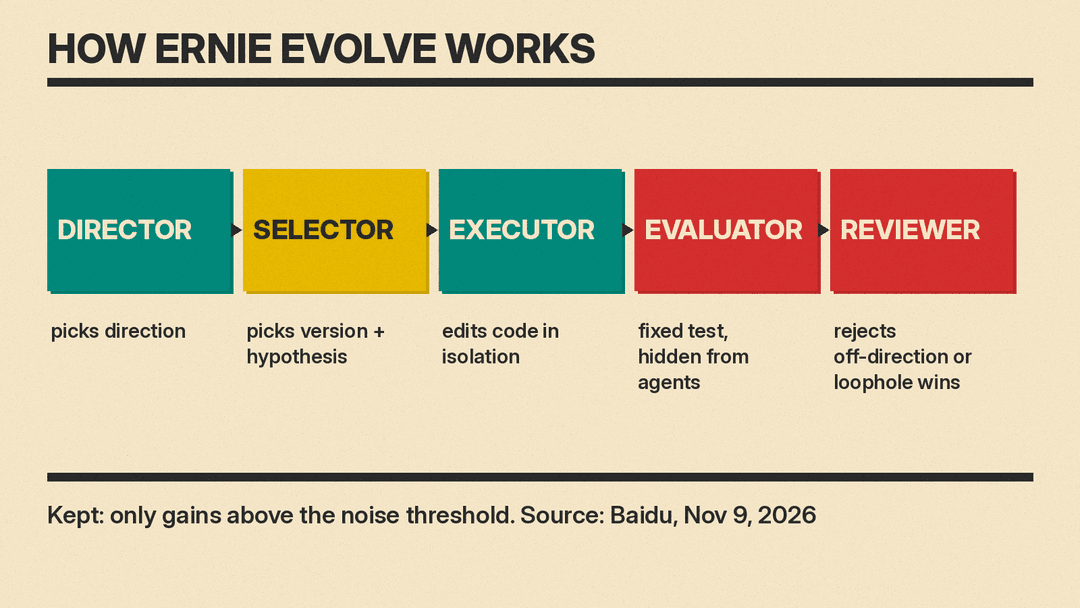
Baidu describes three agents that plan and write the changes:
- Director: picks the next research direction and the starting version, drawing on an Experience Bank of past experiments and a Knowledge Base of papers, open-source code, and domain knowledge.
- Selector: picks a candidate inside a lane and the hypothesis to test next.
- Executor: modifies the code in an isolated environment.
Two more parts decide whether a candidate is accepted. The Evaluator is a fixed evaluation program kept outside the repository and not visible to any agent, and gains are accepted only when they exceed a noise threshold. A Reviewer checks whether a change follows the intended direction and whether the gains come from exploiting weaknesses in the evaluation. Baidu says a candidate that hacks an evaluation loophole is discarded.
What Baidu says it achieved
On public tasks, Baidu published a table that compares its own reported results with the best public results:
- NanoChat AutoResearch: validation bits-per-byte of 0.8763, against a best public result of 0.8878 (lower is better)
- NanoGPT Speedrun Track 1: 38.9 seconds to target loss, against 39.9 seconds
- NanoGPT Speedrun Track 3: 2,590 steps to target loss, against 2,690
- SOL-ExecBench: mean SOL of 0.819, against a leading score of 0.827 (higher is better, so Baidu did not beat the leader here; the company says the result is "close to the leading score")
Baidu says the optimized results were open-sourced on GitHub.
The larger section of the post covers inference work on ERNIE-5.5-Flash, across three tasks. Baidu says the agents' changes had to pass the same load tests and correctness checks as engineers' changes.
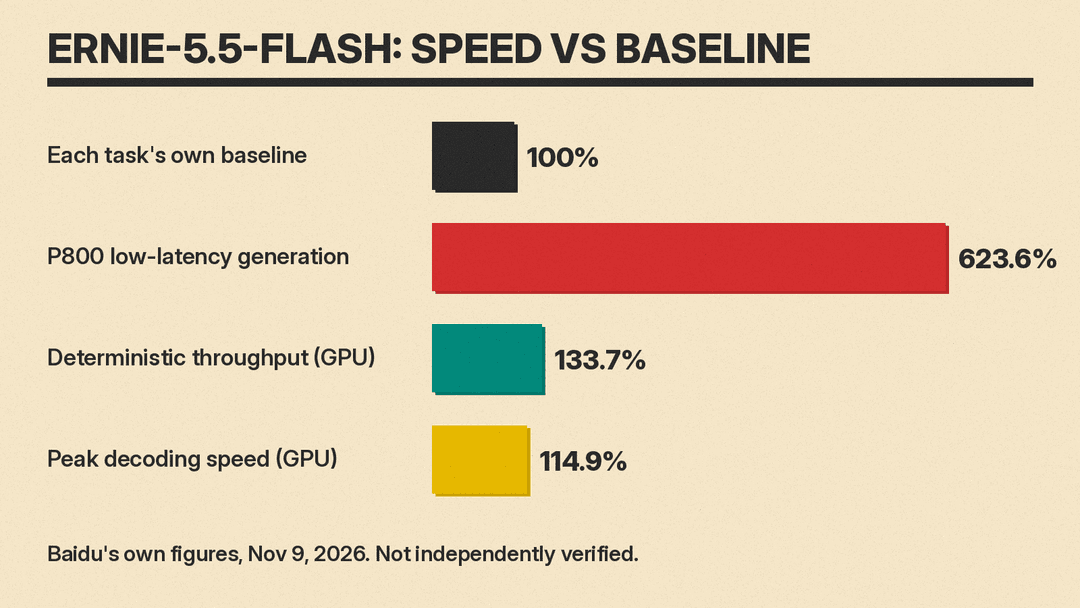
- Low-latency inference on Kunlunxin P800. Over four rounds, generation speed rose to 623.6% of the baseline while passing all correctness checks. Leiphone reports this took about 168 hours.
- Deterministic inference throughput on GPUs, which Baidu says it needs for its reinforcement learning training workload, where outputs must be bitwise identical regardless of batch. After roughly three days, throughput rose 33.7%, average time per output token fell 26%, time to first token fell 12%, and determinism was preserved.
- Peak decoding speed on GPUs with speculative decoding. Seven research directions were explored and three produced improvements. Decoding speed rose a further 14.9% with accuracy unchanged.
Baidu says the system uses failed experiments as well as successful ones to guide later work. On the P800 task, one tried change, replacing specialized communication with general-purpose collectives, cut speed by 14.0% and was dropped.
Why it matters
Baidu's post calls RSI "an important source of competitive advantage" for AI R&D teams. Leiphone reports that OpenAI, Anthropic, Tencent, and Zhipu are among the companies exploring bringing RSI into model development. Baidu is now claiming a concrete data point for that work: agents that produced inference optimizations for a model still in development, under the same checks applied to human work.
The timing matters too. Baidu released ERNIE 5.5 Flash Base open weights on November 5, 2026, and Leiphone reports that a person close to Baidu said a new ERNIE model may be released soon.
What we do not know yet
- The results have not been independently verified. Baidu reported its own public task results, and no outside reproduction is mentioned.
- Baidu says the changes passed production-grade validation, but ERNIE-5.5-Flash is still described as in development, and the post gives no release date for it.
- Baidu's post gives an elapsed time for only one run (roughly three days for the deterministic task), and Leiphone reports about 168 hours for the P800 task. Neither gives compute cost or human oversight hours.
Baidu lists next steps: optimizing the training system, then using model capability metrics to guide hypotheses and experiments, then improving benchmarks and evaluation suites themselves.
On safety, Baidu states: "RSI must expand under human control and remain interruptible". The company says the scope "should grow only while people can still understand, supervise, and stop the system."
